Omanghana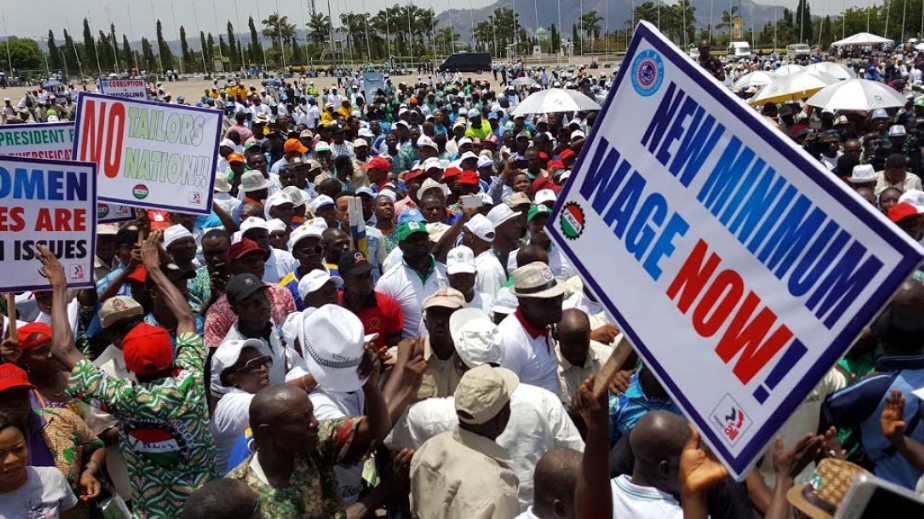
The Nigeria Labour Congress (NLC) has rejected a proposed ₦100,000 national minimum wage, arguing that the amount falls far short of what workers need to cope with the country’s worsening economic realities.
The union insists that discussions should focus on establishing a genuine living wage rather than what it describes as a “survival wage,” with some labor leaders suggesting that workers may require earnings approaching ₦1 million per month to maintain a reasonable standard of living under current economic conditions.
The renewed debate comes after the Chairman of the Nigeria Governors’ Forum (NGF), Governor AbdulRahman AbdulRazaq, indicated that state governors were considering raising the national minimum wage benchmark to ₦100,000.
However, labor representatives have dismissed the proposal as inadequate, citing the sharp rise in the cost of living across the country.
Workers Struggling Under Economic Pressures
According to the NLC, a combination of economic reforms and inflationary pressures has significantly weakened the purchasing power of Nigerian workers.
Union leaders point to several key factors driving household expenses higher, including:
- Persistent inflation
- Currency depreciation
- Rising electricity tariffs
- New tax measures
- Increased transportation costs
- The removal of fuel subsidies
They argue that these developments have outpaced wage growth, leaving many workers unable to meet basic living expenses.
How Inflation Has Eroded Wage Gains
Although President Bola Ahmed Tinubu signed a substantial increase in the national minimum wage in July 2024, raising it from ₦30,000 to ₦70,000, labor leaders say inflation has significantly reduced the value of those gains.
Economic data cited by analysts shows how rapidly wage increases can lose their effectiveness in an environment of sustained price increases.
Minimum Wage Timeline
2019
- National minimum wage set at ₦30,000
Mid-2024
- Inflation reduces the estimated real purchasing value of the wage to approximately ₦11,708
July 2024
- Federal government increases minimum wage to ₦70,000
2026
- Continued increases in food, transportation, and energy costs reduce the effective purchasing power of the wage
Labor groups argue that while statutory wages have increased, the real value of workers’ incomes has continued to decline.
NLC spokesperson Benson Upah said the union’s position is centered on ensuring that workers earn enough to meet basic living needs rather than merely survive.
Labor leaders argue that everyday expenses in major cities such as Lagos demonstrate why a ₦100,000 minimum wage would be insufficient for many households.
They point to rising prices of staple goods, housing, transportation, healthcare, and education as evidence that workers require significantly higher incomes to maintain a decent standard of living.
According to the union, wage policy should reflect actual living costs rather than nominal salary figures.
The NLC maintains that state governments are in a stronger financial position than in previous years and should be able to support higher wage payments.
Union officials argue that increased allocations from the Federation Account Allocation Committee (FAAC), along with improved government revenues in some sectors, have strengthened the fiscal capacity of many states.
Labor leaders contend that these resources should be used to improve worker welfare and protect citizens from the impact of inflation.
State governors, however, have taken a more cautious approach to the wage debate.
While several states, including Lagos, Rivers, and Imo, have implemented salary structures above the federal minimum wage, the Nigeria Governors’ Forum has emphasized the need for a balanced solution that reflects the varying financial capacities of states.
Officials warn that setting a wage floor too high could place severe financial pressure on less affluent states and local governments.
According to governors, some local government authorities continue to face challenges meeting existing salary obligations, raising concerns that a dramatic wage increase could lead to budgetary strain, delayed salary payments, or workforce reductions.
The disagreement between labor unions and state governments highlights the broader challenge of balancing worker welfare with fiscal sustainability in Africa’s largest economy.
As inflation continues to affect household budgets and living costs remain elevated, pressure is expected to grow for a comprehensive review of wage policies.
For now, negotiations remain ongoing, with labor unions demanding a wage structure that reflects current economic realities, while government officials seek a solution that can be sustained across all levels of the public sector.
Source: Omanghana