Omanghana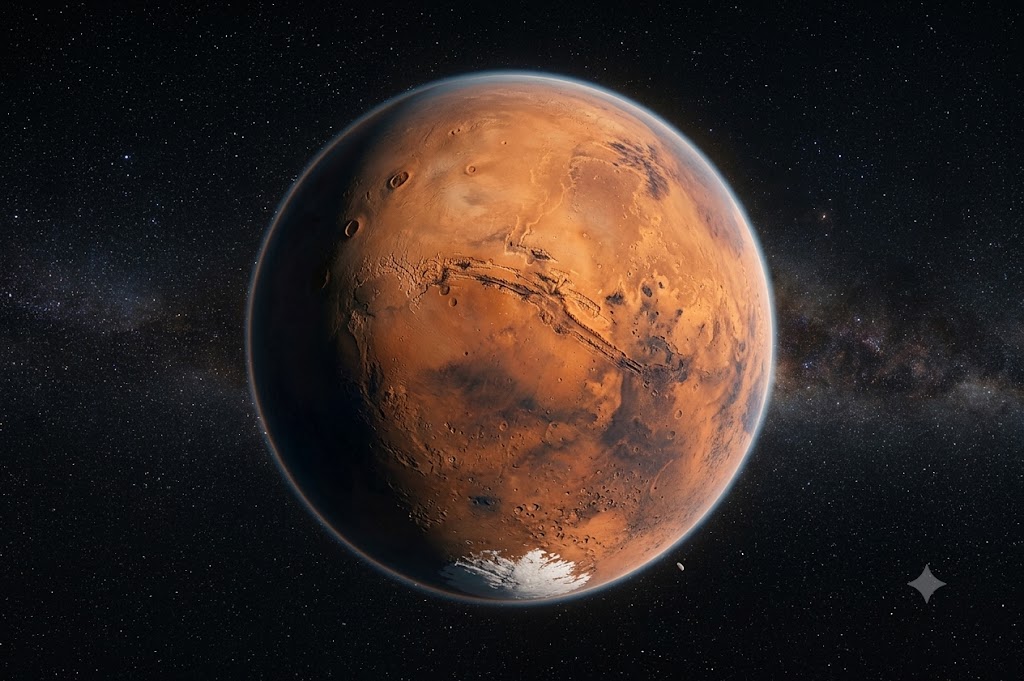
A groundbreaking study published in Nature Communications has revealed that Mars’ distinctive red appearance is caused by ferrihydrite—a water-rich iron oxide mineral—rather than hematite, the dry form of rust that scientists have long believed was responsible.
The research, led by Adomas Valantinas of Brown University and Janice Bishop of the SETI Institute, combines data collected from Martian orbiters, surface rovers, meteorite analyses, and laboratory simulations to provide the most comprehensive assessment yet of the Red Planet’s dust composition.
New Evidence Challenges Decades-Old Theory
For decades, researchers believed that Mars acquired its reddish color after iron-rich rocks reacted slowly with the planet’s atmosphere over billions of years, producing hematite, a dry iron oxide formed in arid conditions.
The new findings suggest otherwise.
According to the researchers, hematite alone cannot explain the widespread distribution and characteristics of the fine red dust that blankets the Martian surface. Instead, the evidence points to ferrihydrite as the dominant mineral responsible for the planet’s iconic appearance.
Unlike hematite, ferrihydrite forms in the presence of cool liquid water and oxygen, making it a strong indicator that Mars once experienced significantly wetter environmental conditions.
The mineral also develops at much lower temperatures than hematite, matching scientific models of Mars during its early geological history.
Stronger Evidence of an Ancient Wet Mars
The discovery has important implications for understanding the evolution of the Red Planet.
Scientists say the widespread presence of ferrihydrite suggests that Mars once supported long-lasting bodies of liquid water before gradually transforming into the cold, dry world seen today.
Rather than forming in isolated locations, the mineral appears to have developed on a planetary scale, indicating that water played a major role in shaping Mars’ surface billions of years ago.
The findings also strengthen the hypothesis that early Mars possessed environmental conditions capable of supporting microbial life. Because ferrihydrite forms in water-rich environments, its abundance points to a period when the planet may have been chemically and physically suitable for life to emerge.
Why Mars Appears Red From Earth
Although Mars is commonly known as the “Red Planet,” scientists note that much of its underlying bedrock is actually composed of brown, gray, and tan rocks.
Its striking reddish appearance is created by an extremely fine layer of ferrihydrite-rich dust that coats the surface and remains suspended in the atmosphere.
Without rainfall to wash away the dust, the particles accumulate over time and are continually redistributed by powerful winds and massive global dust storms. These storms spread the iron-rich material across the planet, maintaining the reddish haze that has made Mars instantly recognizable from Earth.
A New Chapter in Mars Exploration
The study offers one of the strongest pieces of evidence yet that water played a far greater role in Mars’ history than previously understood.
By identifying ferrihydrite as the mineral responsible for the planet’s red color, researchers have not only revised a decades-old scientific theory but also strengthened the case that ancient Mars may once have been a habitable world.
The findings are expected to guide future Mars missions as scientists continue searching for signs of past water activity and potential evidence of ancient microbial life beneath the planet’s dusty surface.
Source: Omanghana