Omanghana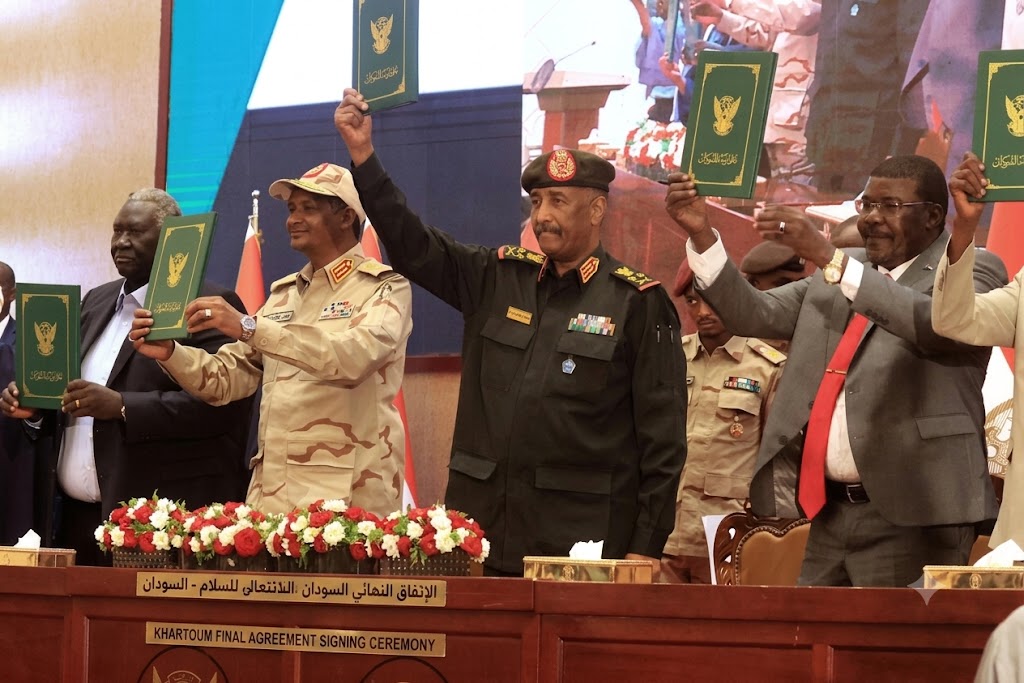
Sudanese civilians are expressing growing concern over the national army’s increasing dependence on powerful armed groups in its war against the paramilitary Rapid Support Forces.
Residents in army-controlled cities, including Khartoum and Wad Madani, say militia fighters now openly patrol markets, roads and residential areas with assault rifles and weapons mounted on vehicles, despite official restrictions on carrying arms in public.
Some witnesses claim that teenagers as young as 15 have been seen among the armed personnel, raising concerns about the possible recruitment and use of children in the conflict. Such accounts remain difficult to verify independently because of insecurity and limited access to affected areas.
For many Sudanese, the proliferation of armed factions has created a troubling sense of déjà vu. The war that began in April 2023 grew out of a power struggle between the Sudanese Armed Forces and the RSF, itself an armed force that had previously received state recognition and support but retained an independent command structure.
Civilians now fear the army may be repeating the same pattern by empowering groups whose present loyalty could weaken if their military, financial or political interests change.
Armed Groups Operate Despite Weapons Restrictions
The Sudanese authorities have announced measures intended to restrict the public display and movement of weapons in areas under army control.
Residents, however, say those regulations are frequently ignored by allied militias. Fighters are reportedly visible at checkpoints, commercial centers and major intersections, sometimes carrying heavy weapons or travelling in militazised vehicles.
The presence of multiple forces with separate commanders has created uncertainty over who controls security in government-held territory.
Civilians may struggle to determine whether an armed group reports to the national army, a militia commander, a political leader or a local authority. That confusion can weaken accountability when abuses occur.
It also complicates the army’s claim that the state is gradually restoring law and order in areas recaptured from the RSF.
Joint Forces Expand Battlefield Influence
One of the most powerful blocs supporting the army is the Joint Forces, a coalition largely composed of former Darfuri rebel movements.
The alliance includes groups associated with Darfur Governor Minni Minawi and Finance Minister Gibril Ibrahim. Both men lead movements that once fought the Sudanese government before joining the political process under peace arrangements.
The Joint Forces initially attempted to remain neutral in the war between the SAF and RSF but later aligned with the army as fighting intensified in Darfur.
Their combat experience, weapons and local networks have made them valuable to the army. However, their continued independence has also raised questions about their long-term role in Sudan’s political and military structure.
Analysts warn that a coalition based primarily on shared opposition to the RSF may struggle to survive once the immediate threat changes or competing interests emerge.
Sudan Shield Forces Control Territory in Al-Jazira
Another influential faction is the Sudan Shield Forces, led by Abu Aqla Kaykal.
Kaykal previously fought alongside the RSF before defecting and aligning his fighters with the Sudanese army. His change of allegiance helped alter the military balance in parts of Al-Jazira State.
Since joining the SAF camp, Kaykal has reportedly expanded his territorial and political influence across the region. Critics accuse him of operating an autonomous power base with limited oversight from civilian institutions or the regular military.
Local activists have alleged that members of the Sudan Shield Forces carried out retaliatory attacks and ethnically targeted killings in villages across Al-Jazira. The group would be entitled to respond to those allegations, which require independent investigation.
The accusations have deepened concerns that communities seen as sympathetic to one side could face collective punishment from whichever armed group controls their area.
Baraa ibn Malek Brigade Draws International Scrutiny
The Baraa ibn Malek Brigade has also become an important fighting force within the army-aligned coalition.
The Islamist group is associated with networks linked to the former government of Omar al-Bashir. Its fighters have participated in major battles alongside the SAF and have developed a reputation as one of the coalition’s most aggressive combat units.
The brigade has also faced allegations of links to Iran, although the nature and extent of any relationship remain disputed. Its growing influence has attracted scrutiny from the United States and regional governments concerned about the possible return of Bashir-era Islamist networks.
International pressure has reportedly been placed on army chief General Abdel Fattah al-Burhan to distance the SAF from the group.
For the army, however, cutting ties with an effective battlefield ally could weaken its position while the war against the RSF continues.
Sudan’s War Began With Failed Military Integration
The current crisis reflects Sudan’s repeated failure to establish a single, unified military under civilian authority.
The RSF developed from the Janjaweed militias mobilized during the conflict in Darfur. It was later formalized and expanded under Bashir before becoming a powerful national security force led by Mohamed Hamdan Daglo, widely known as Hemeti.
Following Bashir’s removal in 2019, tensions grew over how and when the RSF would be integrated into the regular army.
The RSF maintained its own commanders, financial networks, weapons and territorial influence. Disagreements over integration and command eventually contributed to the eruption of open warfare between the RSF and SAF in April 2023.
Sudanese civilians now worry that the army is creating a similar future problem by depending on armed groups that retain their own leadership and military capabilities.
Militias Show Little Sign of Disarming
SAF officials have repeatedly said that allied armed groups will eventually be integrated into the national military.
There is, however, little public evidence that the major militia leaders are preparing to surrender their weapons or dissolve their independent command structures.
Some factions possess artillery, anti-aircraft weapons, drones and large fleets of armed vehicles. Giving up those capabilities would significantly reduce their bargaining power in any post-war political settlement.
The longer the conflict continues, the more influence these groups may gain through territorial control, recruitment, commercial networks and access to state resources.
Militia commanders who suffer heavy losses on behalf of the army may later demand government positions, funding or authority over the territories they helped capture.
Risk of Coalition Fracture
The anti-RSF alliance remains united by a common enemy, but its members do not necessarily share the same vision for Sudan’s future.
Some factions are rooted in Darfur’s former rebel movements, others emerged from RSF defections, and Islamist groups seek influence connected to the political order that existed under Bashir.
Those differences could become more dangerous if the RSF is defeated or pushed out of strategically important regions.
Disputes over territory, government appointments, military rank, revenue and control of natural resources could divide the coalition. Rival groups may also attempt to preserve their authority in areas where they currently operate.
If the state cannot impose a unified chain of command, Sudan could move from a two-sided war into a fragmented struggle among multiple armed factions.
Civilians Demand Security Under One Authority
For civilians, the concern is not simply which side wins the war but whether any eventual victory restores a functioning state.
Residents want police, courts and accountable public institutions to replace armed checkpoints and militia patrols. They also want allegations of killings, looting and ethnic violence investigated regardless of whether the accused fighters support the SAF or RSF.
The army faces the difficult task of using allied groups for immediate battlefield needs while preventing them from becoming permanent centers of military and political power.
Without a credible disarmament and integration plan, Sudan risks preserving the conditions that produced the current conflict.
The central question is whether the SAF can bring its allies under a single accountable national structure—or whether today’s battlefield partners will become the armed rivals of Sudan’s next war.
Source: Omanghana