Omanghana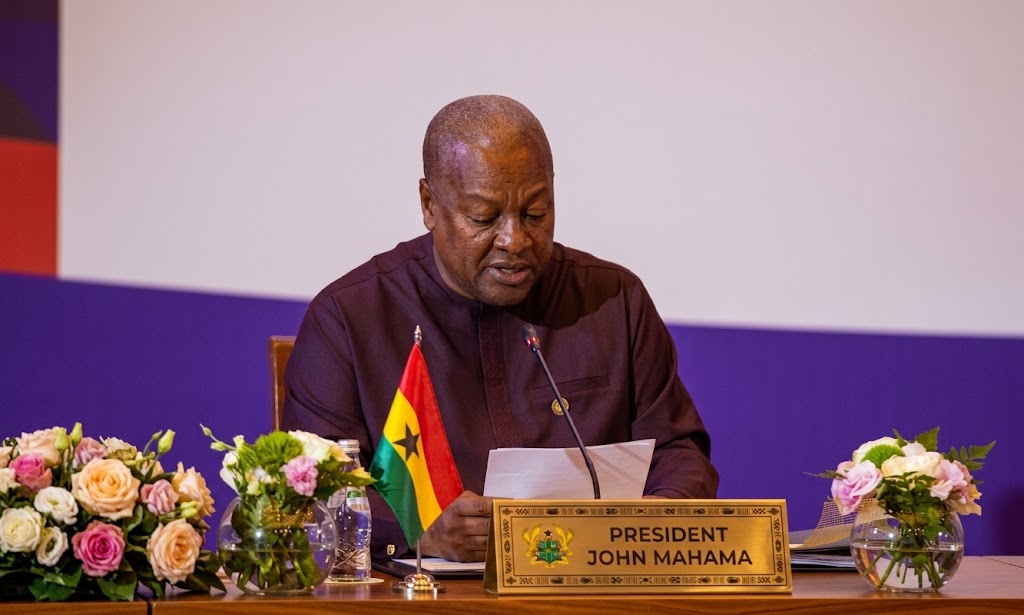
President John Dramani Mahama has called for the revitalization of the Non-Aligned Movement (NAM), urging member states to move beyond declarations and transform their collective diplomatic influence into concrete action on major global challenges.
Speaking in Belgrade, Serbia, during a high-level commemorative meeting marking the 65th anniversary of the first Non-Aligned Movement Summit, President Mahama argued that the relevance of the organization should be measured not simply by the number of countries it represents, but by the results it is able to achieve internationally.
The historic first NAM summit was held in Belgrade in 1961, bringing together countries seeking an independent path at the height of Cold War rivalry.
Mahama Urges NAM to Move From Declarations to Action
Addressing representatives of the movement’s approximately 120 member states, Mahama said NAM must strengthen mechanisms for implementing decisions reached at its summits and ministerial meetings.
He challenged member countries to ensure that resolutions and communiqués are followed by coordinated diplomatic action capable of producing measurable outcomes.
For Mahama, the movement’s numerical strength gives it significant influence within international institutions, but that influence can only be effective when members organize around shared priorities and follow through on their commitments.
He therefore called for stronger accountability and follow-up mechanisms to ensure that decisions taken under NAM ultimately improve the lives of the populations represented by its members.
Non-Alignment Does Not Mean Passive Neutrality
Mahama also sought to redefine the meaning of non-alignment in today’s increasingly polarized international environment.
Drawing on the philosophies of Ghana’s first President, Dr. Kwame Nkrumah, and former Yugoslav President Josip Broz Tito, Mahama argued that non-alignment should never be interpreted as passive neutrality, isolation or indifference in the face of injustice.
Instead, he said it should represent the ability of nations to maintain their strategic autonomy and make decisions according to their national and collective interests.
With competition intensifying among major global powers, Mahama warned that countries of the Global South must avoid becoming instruments of rival geopolitical blocs.
He maintained that NAM remains relevant precisely because it provides developing countries with a platform to protect their independence while cooperating on issues of shared international concern.
Economic Independence Must Accompany Political Freedom
Economic sovereignty featured prominently in Mahama’s address, with the Ghanaian leader arguing that political independence cannot be fully realized without greater economic self-determination.
He criticized a global economic structure in which many developing countries continue to export raw materials while importing higher-value finished products manufactured from those same resources.
Mahama called on NAM countries to coordinate their positions on reforms to the international financial architecture, particularly on debt sustainability, development financing and mechanisms for providing relief to heavily indebted countries.
He also emphasized the importance of mineral and natural resource sovereignty, arguing that resource-rich developing nations should capture a greater share of the economic value generated from their natural wealth.
The President further identified emerging technological inequalities as another major challenge requiring collective action.
He urged NAM members to work together to close gaps in digital infrastructure while ensuring developing countries have a meaningful voice in shaping international rules governing artificial intelligence and emerging technologies.
Mahama Cites UN Vote as Example of Collective Action
Mahama pointed to coordinated action at the United Nations General Assembly as an example of what developing countries can achieve when they organize around a common objective.
He cited the adoption of UN General Assembly Resolution A/RES/80/250 in March 2026, which Ghana sponsored with support from African Union and CARICOM countries.
The resolution addressed the historical consequences of the transatlantic slave trade and the chattel enslavement of Africans and secured 123 votes with significant support from NAM members.
Mahama presented the outcome as evidence that the movement’s numerical strength can translate into meaningful diplomatic influence when countries coordinate their positions and mobilize effectively within multilateral institutions.
President Demands Urgent Action on Sudan and Gaza
Turning to ongoing international conflicts, President Mahama called for greater humanitarian urgency in addressing civilian suffering in Sudan and Gaza.
He urged the international community to guarantee unhindered humanitarian assistance to affected populations and intensify diplomatic efforts aimed at ending violence, displacement and human suffering.
Mahama argued that NAM cannot remain silent when civilians are caught in devastating conflicts, stressing that defending human dignity and international justice should remain central to the movement’s mission.
Belgrade Meeting Revisits NAM’s Role in Changing World
The commemorative gathering was hosted by Serbian President Aleksandar Vučić and brought together leaders and representatives from Africa, Asia, Latin America and other parts of the world.
Belgrade carries particular historical significance for NAM because it hosted the movement’s inaugural summit in 1961.
Sixty-five years later, the anniversary meeting provided participating countries with an opportunity to reassess the organization’s role amid renewed geopolitical rivalry, economic fragmentation, conflicts and rapidly changing global power structures.
Mahama concluded by calling for a more organized, responsive and results-driven Non-Aligned Movement, backed by effective mechanisms for implementing decisions taken by its leaders and ministers.
His message was that NAM’s future relevance will depend not on the declarations it produces, but on whether its members can convert their collective strength into tangible diplomatic, economic and humanitarian outcomes for the billions of people they represent.
Source: Omanghana