Omanghana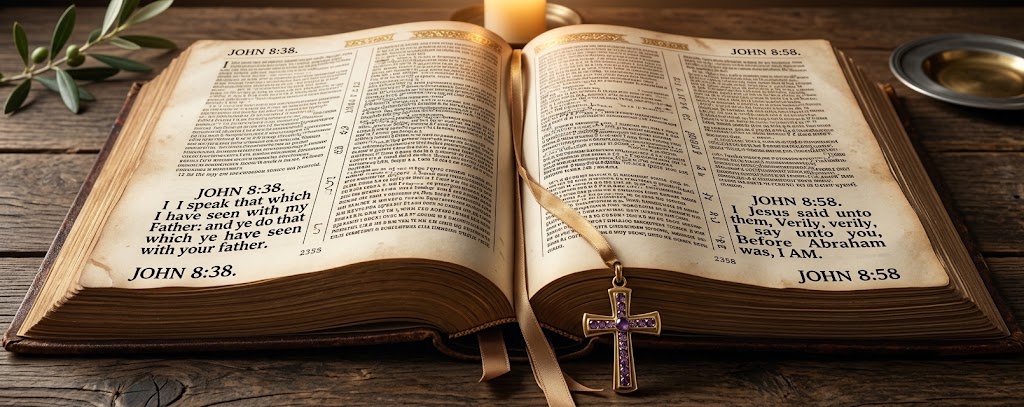
The question of whether Jesus claimed to be God remains central to Christian theology. Although He did not usually express His identity through modern theological formulas, the New Testament records statements and actions that His original audience understood as claims to divine identity, authority and equality with the Father.
Jesus presented Himself as eternal, used titles associated with God in the Old Testament, exercised powers belonging to God and accepted worship from His followers. These claims appear throughout the Gospels and the Book of Revelation.
Jesus Claimed Eternal Existence
One of Jesus’ clearest statements appears in John 8:58:
“Truly, truly, I say to you, before Abraham was, I am.”
Jesus did not merely say that He existed before Abraham. He used the present-tense expression “I am,” which Christians have traditionally understood as an echo of the divine name revealed to Moses in Exodus 3:14: “I AM WHO I AM.”
The reaction of those listening is significant. According to John 8:59, they immediately picked up stones to throw at Him. Their response shows that they did not interpret His words as an ordinary claim of pre-existence but as a declaration they considered blasphemous.
“I and the Father Are One”
In John 10:30, Jesus declared:
“I and the Father are one.”
Once again, His audience attempted to stone Him. When Jesus asked why, they replied that it was not because of His miracles but because He, “being a man,” was making Himself God.
The passage shows that His listeners understood the statement as more than an expression of agreement with God. Jesus was claiming a unique unity with the Father—one that His opponents believed crossed the boundary between humanity and deity.
At the same time, Christian doctrine does not interpret this statement to mean that Jesus and the Father are the same person. Rather, they are personally distinct while sharing the one divine nature.
Jesus Used God’s Eternal Titles
The Book of Revelation gives Jesus titles that the Old Testament applies to God.
In Revelation 1:17–18, the risen Christ says:
“Fear not, I am the first and the last, and the living one. I died, and behold I am alive forevermore.”
Revelation 22:13 similarly declares:
“I am the Alpha and the Omega, the first and the last, the beginning and the end.”
These words closely reflect Isaiah 44:6, where the Lord proclaims that He is “the first” and “the last” and that no God exists besides Him. By taking these titles, Jesus identifies Himself with God’s eternal existence and sovereign authority.
The statement that He died and now lives forever also points to the heart of the Christian message: the eternal Son genuinely entered human history, experienced death and rose again.
“Whoever Has Seen Me Has Seen the Father”
When Philip asked Jesus to show the disciples the Father, Jesus responded in John 14:9:
“Whoever has seen me has seen the Father.”
Jesus was not claiming to be the Father personally. His statement means that He perfectly reveals the Father’s character, presence and glory.
The surrounding passage reinforces both unity and distinction. Jesus speaks of being in the Father and the Father being in Him. Christianity therefore understands Him not merely as a prophet carrying information from God, but as the Son through whom God is uniquely and fully revealed.
The Son of Man With Everlasting Dominion
During His trial, the high priest asked Jesus whether He was the Messiah, the Son of the Blessed. Jesus answered in Mark 14:62:
“I am, and you will see the Son of Man seated at the right hand of Power, and coming with the clouds of heaven.”
This response combines two important Old Testament passages. The image of sitting at God’s right hand reflects Psalm 110:1, while the figure coming with the clouds comes from Daniel 7:13–14.
In Daniel’s vision, the Son of Man approaches the Ancient of Days and receives universal, everlasting dominion. Jesus applied that heavenly identity and authority to Himself. The high priest responded by tearing his garments and accusing Him of blasphemy, demonstrating the extraordinary nature of the claim.
Jesus Claimed Authority to Forgive Sins
Mark 2 records the account of a paralyzed man brought to Jesus. Before healing him, Jesus said:
“Son, your sins are forgiven.”
The scribes objected internally, asking, “Who can forgive sins but God alone?”
A person may forgive an offense committed directly against them, but Jesus pronounced forgiveness for the man’s sins before God. He then healed the man to demonstrate that “the Son of Man has authority on earth to forgive sins.”
The miracle served as visible evidence of an invisible divine authority. Jesus did not merely announce that God might forgive the man; He personally declared his sins forgiven.
Jesus Made Himself Equal With God
In John 5:17, Jesus defended His actions on the Sabbath by saying:
“My Father is working until now, and I am working.”
His opponents understood this as a claim of equality with God. John explains that they sought to kill Him because He was calling God His own Father and “making himself equal with God.”
The remainder of the passage develops the claim further. Jesus says that the Son gives life, raises the dead and exercises judgment. He also declares that everyone must honor the Son just as they honor the Father. These responsibilities go far beyond those of an ordinary prophet or religious teacher.
Jesus Accepted Worship
After encountering the risen Christ, Thomas declared in John 20:28:
“My Lord and my God!”
Jesus did not correct or rebuke him. Instead, He affirmed Thomas’ faith and pronounced a blessing upon those who would believe without physically seeing Him.
This is particularly important because Scripture records angels and apostles rejecting worship when people mistakenly offered it to them. Peter refused worship in Acts 10:25–26, while an angel rejected it in Revelation 19:10. Jesus, however, repeatedly received worship from His followers.
Thomas’ confession also serves as a climax to John’s Gospel, confirming the identity introduced at its beginning: “the Word was God” and later “became flesh.”
Jesus Placed Himself Alongside the Father and Holy Spirit
In Matthew 28:19, the risen Jesus commanded His disciples:
“Go therefore and make disciples of all nations, baptizing them in the name of the Father and of the Son and of the Holy Spirit.”
The word “name” is singular, yet the Father, Son and Holy Spirit are all included within it. Jesus therefore placed Himself within a threefold divine identity rather than presenting Himself as merely one servant among others.
This passage became foundational to the Christian doctrine of the Trinity: one God who eternally exists as three distinct persons—the Father, the Son and the Holy Spirit.
The Meaning of Jesus’ Claims
Taken together, these passages present a consistent portrait. Jesus claimed existence before Abraham, unity with the Father, authority to forgive sins, power to give life and judge humanity, and possession of eternal divine titles. He also accepted worship and identified Himself with the heavenly Son of Man who receives everlasting dominion.
The Christian belief in Christ’s deity is therefore not based on one isolated verse. It emerges from the combined testimony of His words, actions, titles, relationship with the Father, resurrection and the worship He received.
According to the New Testament, Jesus is fully human but not merely human. He is the eternal Son who entered history, revealed the Father, died for humanity’s sins, rose from the dead and reigns with divine authority.
Source: Omanghana