Omanghana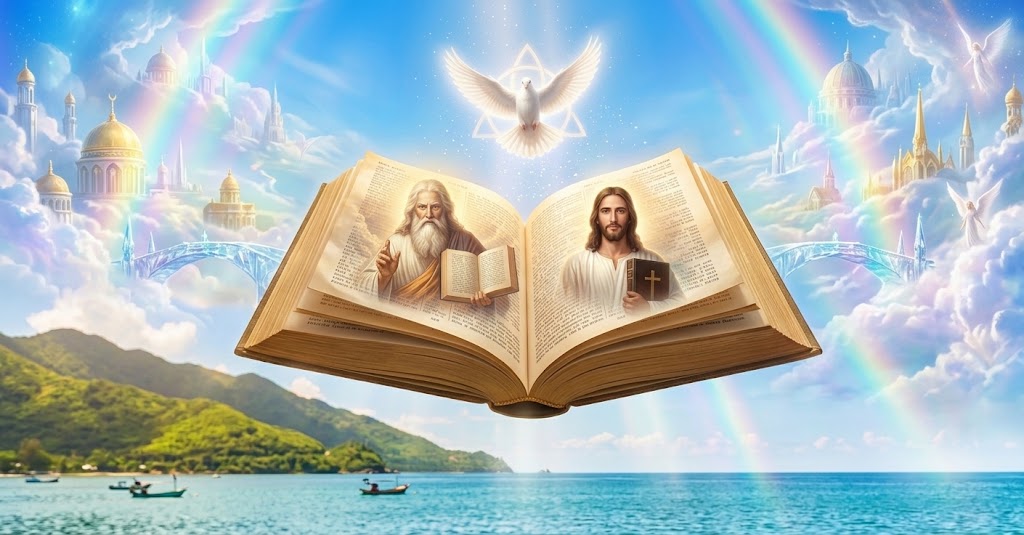
The Christian doctrine of the Trinity teaches that there is one God who exists eternally as three distinct persons: the Father, the Son and the Holy Spirit.
Each person is fully divine, co-equal and co-eternal. Christians do not worship three gods, nor do they believe that God merely appears in three different forms. Instead, the three persons share one undivided divine nature while remaining personally distinct.
Although Scripture associates particular roles with each person, the works of the Trinity cannot ultimately be separated. The Father, Son and Holy Spirit act together in perfect unity throughout creation, redemption and the spiritual transformation of believers.
God the Father: The Source and Architect
The Father is commonly described as the originator and initiator of God’s purposes. Scripture presents Him as the one who plans, sends and directs the work of salvation.
Ephesians 1:3–5 teaches that believers are chosen in Christ according to the Father’s gracious purpose. Salvation is therefore not an improvised response to human sin but part of God’s eternal plan.
The Father is also identified as the source of creation. First Corinthians 8:6 declares that all things come from the Father and that humanity exists for Him. This does not exclude the Son or the Holy Spirit from creation; rather, it highlights the Father’s role as its ultimate source.
Another defining role is that of sender. The Father sent the Son into the world to save humanity, as expressed in John 3:16. He also sent the Holy Spirit to teach, comfort and strengthen believers after Christ’s ascension.
The Father may therefore be described as the architect of salvation—the person who initiates the divine plan and sends the Son and Spirit to accomplish it.
God the Son: The Redeemer and Mediator
God the Son, revealed in human history as Jesus Christ, is the eternal Word who became flesh. Through Him, the invisible God was made known to humanity.
The Son was active in creation before His incarnation. John 1:1–3 teaches that all things were made through the Word, while Colossians 1:16–17 declares that everything was created through Christ and for Him. The same passage says that all things continue to hold together in Him.
The Son’s distinctive role in redemption is demonstrated through His incarnation, sinless life, sacrificial death and bodily resurrection.
Jesus described His mission as giving His life as a ransom for many in Mark 10:45. Through His death, He bore the consequences of sin and opened the way for reconciliation between God and humanity.
His resurrection confirmed His victory over sin and death. Following His ascension, Christ took His place at the Father’s right hand, where He continues to intercede for believers.
First Timothy 2:5 identifies Jesus as the one mediator between God and humanity, while Hebrews 7:25 teaches that He continually intercedes for those who approach God through Him.
The Son may therefore be called the accomplisher of salvation because He entered human history and completed the redemptive work necessary to save humanity.
God the Holy Spirit: The Sanctifier and Comforter
The Holy Spirit is not an impersonal force but a divine person who acts, teaches, guides and relates personally to believers.
One of the Spirit’s central works is regeneration, commonly described as the new birth. Titus 3:5 explains that spiritual renewal occurs through the Holy Spirit.
When people place their faith in Christ, the Spirit dwells within them and marks them as belonging to God. Ephesians 1:13–14 describes the Holy Spirit as a seal and guarantee of the believer’s future inheritance.
The Spirit also leads the process of sanctification, through which believers gradually become more like Christ. He empowers them to resist sin and develop godly character.
Galatians 5:22–23 describes the fruit produced by the Spirit as love, joy, peace, patience, kindness, goodness, faithfulness, gentleness and self-control.
Jesus referred to the Holy Spirit as the Paraclete, a Greek term translated as Helper, Advocate or Comforter. According to John 16:13, the Spirit guides believers into truth.
He also distributes spiritual gifts for the service and growth of the Christian community, as explained in 1 Corinthians 12:4–11. In addition, He strengthens believers in prayer, mission and Christian witness.
The Holy Spirit may therefore be described as the applier of salvation because He brings the benefits of Christ’s redemptive work into the lives of believers.
How the Trinity Works in Salvation
The distinct roles of the three persons can be summarized as follows:
| Person | Distinct role | Common description |
|---|---|---|
| The Father | Initiates, plans and sends | Architect of salvation |
| The Son | Accomplishes redemption and intercedes | Accomplisher of salvation |
| The Holy Spirit | Regenerates, sanctifies and empowers | Applier of salvation |
These descriptions are useful, but they should not be understood as dividing God into separate parts. The Father, Son and Holy Spirit always act with one will and one divine purpose.
The Father plans salvation through the Son, the Son accomplishes it in obedience to the Father and the Holy Spirit applies its benefits to believers. Together, the three persons reveal the unified work of the one true God.
Source: Omanghana