Omanghana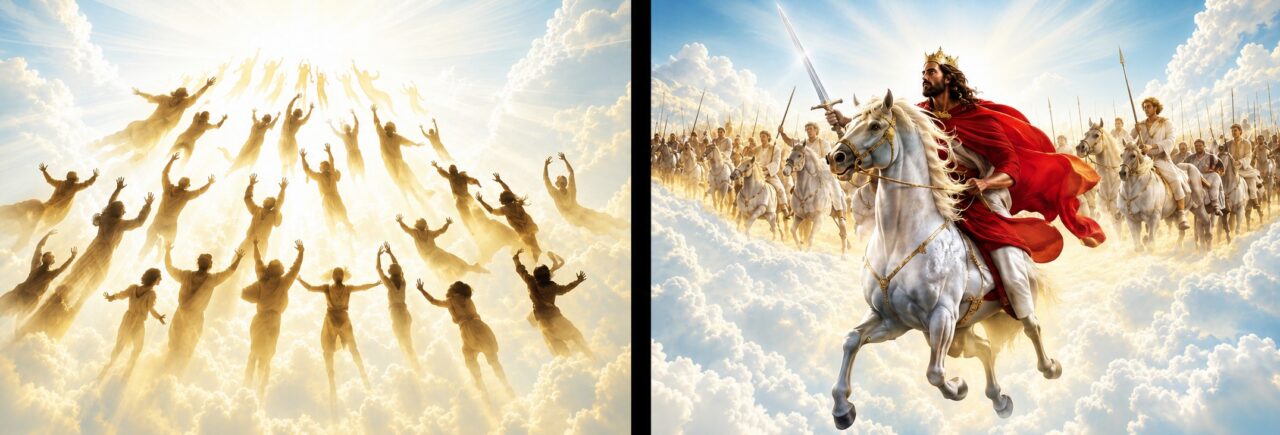
The Rapture and the Second Coming are closely related Christian beliefs, but some Protestant and evangelical traditions understand them as two separate events with different purposes.
This distinction is especially prominent in Dispensational Premillennialism, which teaches that the Rapture will occur before a seven-year period of global suffering known as the Tribulation. Jesus will then return visibly to Earth at the end of that period.
Other Christian traditions, including Amillennialism, do not separate the events. They interpret the biblical passages about believers being gathered to Christ and Jesus returning in glory as descriptions of one simultaneous event.
Under the dispensational view, the difference is often summarized in a simple way: at the Rapture, Jesus comes for his Church, while at the Second Coming, he returns with his people to establish his rule.
What Is the Rapture?
The Rapture refers to the moment when believers are “caught up” to meet Jesus in the air.
The word “Rapture” does not appear in most English Bible translations. It comes from the Latin rapiemur, meaning “we shall be caught up,” which was used to translate the Greek word harpazo in 1 Thessalonians 4:17.
In 1 Thessalonians 4:13–18, the Apostle Paul teaches that Jesus will descend from heaven and that believers who have died will rise first. Christians who remain alive will then be caught up with them in the clouds to meet the Lord in the air.
First Corinthians 15:51–53 adds that living believers will be transformed instantly and receive immortal, imperishable bodies.
Those who distinguish the Rapture from the Second Coming teach that Jesus meets believers in the air without physically descending to the Earth. The Church is then removed before the Tribulation begins.
Within this framework, the Rapture’s main purpose is deliverance. Paul presented the teaching as a source of comfort for Christians grieving believers who had died, assuring them that death would not separate God’s people permanently.
Some teachers describe the Rapture as secret because the removal of believers is expected to happen suddenly. However, the biblical passage itself mentions a commanding shout, the voice of an archangel and the trumpet of God, so Christians disagree over whether “secret” is an accurate description.
What Is the Second Coming?
The Second Coming refers to the visible and triumphant return of Jesus Christ to Earth.
In the dispensational interpretation, this event occurs after the Tribulation and the reign of the Antichrist. Jesus returns as the victorious King who defeats evil, judges the nations and establishes his kingdom.
Revelation 19:11–16 portrays Christ returning from heaven as a warrior-king accompanied by the armies of heaven. Revelation 1:7 declares that “every eye will see him,” presenting his return as a public event recognized across the world.
Zechariah 14:3–4 describes the Lord standing on the Mount of Olives near Jerusalem. Christians who interpret the prophecy literally connect it with Jesus physically returning to the Earth.
The central themes of the Second Coming are therefore judgment, victory and the public establishment of Christ’s authority.
Dispensational theologians generally teach that the believers gathered during the Rapture will accompany Jesus when he returns. The armies of heaven mentioned in Revelation are often understood to include both angels and glorified saints.
The Main Differences
In the pre-Tribulation dispensational view, Jesus remains in the air during the Rapture, while he physically returns to Earth at the Second Coming.
The Rapture centers on the resurrection and gathering of believers. The Second Coming centers on the defeat of the Antichrist, judgment of the world and establishment of Christ’s kingdom.
The Rapture is presented as an event that could occur without warning, while the Second Coming follows signs associated with the Tribulation.
Key passages used to support the Rapture include 1 Thessalonians 4:13–18 and 1 Corinthians 15:51–53. Major texts associated with the Second Coming include Revelation 19:11–16 and Zechariah 14:3–4.
Why Christians Disagree
The Bible clearly teaches that Jesus will return, the dead will be raised and believers will be gathered to him. The debate concerns how these events fit together and when they occur.
Pre-Tribulation Premillennialists place the Rapture before the Tribulation and the Second Coming after it. Other Premillennialists place the gathering of believers during or after the Tribulation.
Amillennial and many historic Christian traditions understand the resurrection, gathering of believers and visible return of Christ as parts of one final event rather than two appearances separated by seven years.
The distinction between the Rapture and Second Coming should therefore be presented as one influential Christian interpretation, not a belief held identically by every denomination.
Despite differences over timing, Christians broadly agree on the central hope behind both teachings: Jesus Christ will return, raise the dead, defeat evil and gather his people to himself.
Source: Omanghana