Omanghana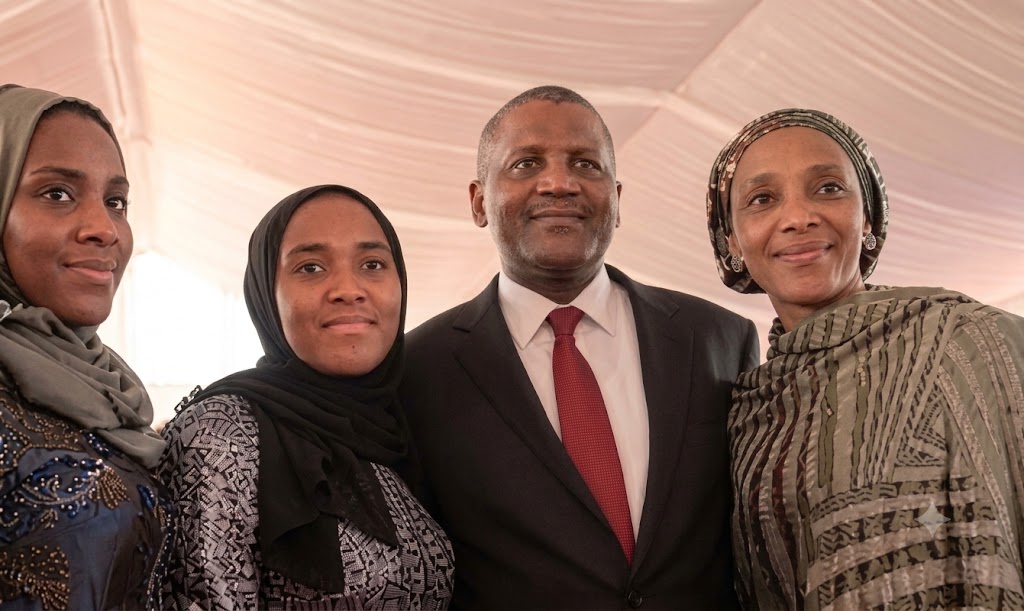
As Nigerian industrialist Aliko Dangote enters the legacy-building stage of his career, attention is increasingly turning to the roles his three daughters—Halima, Fatima and Mariya Dangote—could play in the future of the family’s vast business interests.
Rather than publicly naming one successor, Dangote appears to be pursuing a shared leadership structure in which each daughter manages a distinct part of the conglomerate.
That approach became more visible during an executive restructuring in February 2026, when the three women were reportedly given expanded responsibilities tied to the Dangote Group’s long-term “Vision 2030” strategy.
The transition moves them beyond their identities as members of the founder’s family and places them in operational, commercial and governance positions across the group.
Halima Aliko Dangote oversees aspects of the conglomerate’s international operations, including activities connected to its Dubai and London offices. Her responsibilities reportedly cover governance, investor relations and coordination across the group’s expanding global footprint.
She is also closely involved in the family’s philanthropic work as a principal trustee of the Aliko Dangote Foundation, which supports health, education and economic empowerment programmes across Africa.
Fatima Dangote has assumed responsibilities within the group’s energy and industrial operations. Her portfolio reportedly includes commercial activities connected to the 650,000-barrel-per-day Dangote Petroleum Refinery, fertilizer production and petrochemical operations.
She is also involved in corporate communications and administration, giving her a role in both the commercial and institutional management of some of the group’s most capital-intensive businesses.
Mariya Dangote focuses on commercial strategy and market development across the conglomerate’s cement and food businesses.
Serving as a Group Executive Director, she is responsible for supporting growth within the established operations that helped build the family’s industrial wealth. These include food processing and cement production across several African markets.
The division of responsibilities suggests that the next generation could manage the business collectively, with each daughter overseeing a separate but interconnected pillar.
Succession planning within the Dangote family also extends beyond commercial operations. In a Bloomberg interview, Halima said her father had made provisions for one-third of his wealth to be dedicated to charitable causes.
Based on estimates placing Aliko Dangote’s net worth between $35 billion and $36.5 billion, the commitment could amount to approximately $11.7 billion to $12 billion. The actual value would depend on the size and structure of his estate when the pledge is implemented.
The planned philanthropic allocation is expected to support long-term programmes in healthcare, education and social development across Africa through the family’s charitable institutions.
The growing prominence of Dangote’s daughters is significant in a corporate environment where succession has traditionally favoured male heirs.
However, Aliko Dangote has not publicly designated any one of the three as his sole successor. The emerging structure instead indicates a multigenerational leadership model built around shared authority and specialized responsibilities.
By distributing oversight of international operations, energy projects, cement, food production and philanthropy, the family appears to be laying the foundation for an institutionalized business structure capable of operating beyond its founder’s direct leadership.
Source: Omanghana