Omanghana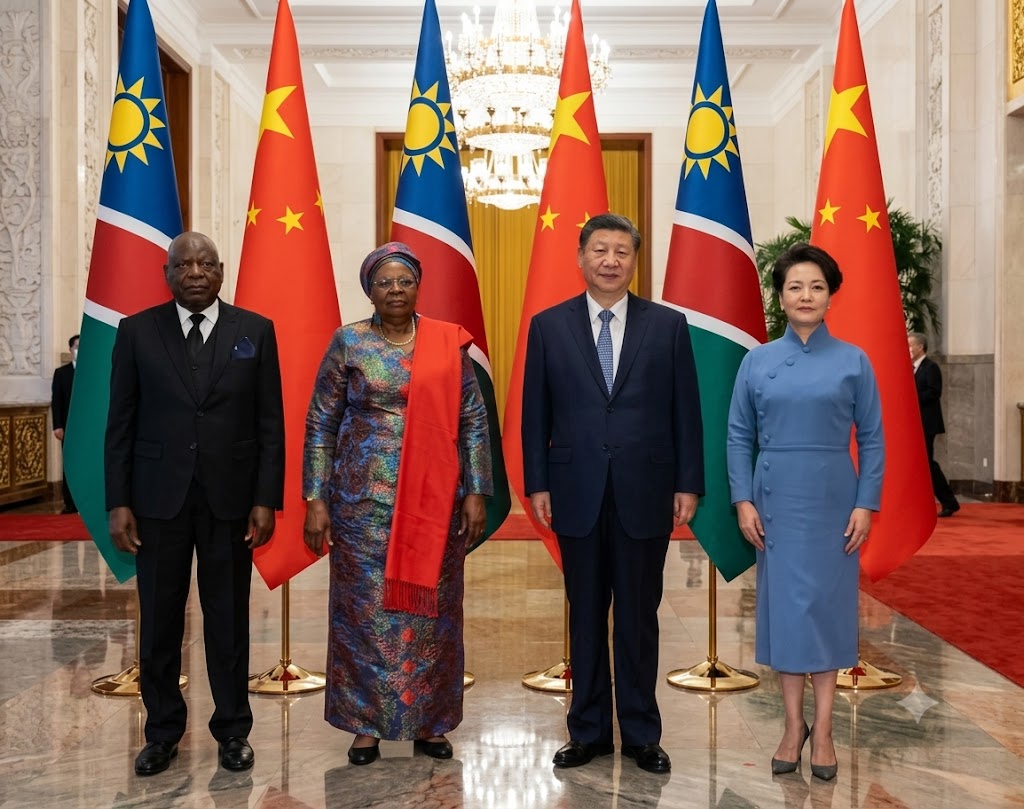
Namibia is seeking to use growing international competition for its critical minerals to accelerate domestic industrialization, create employment and reduce its dependence on exporting unprocessed resources.
The strategy gained momentum following President Netumbo Nandi-Ndaitwah’s state visit to Beijing, where Namibia and China signed eight cooperation documents covering green minerals, infrastructure, energy and broader economic relations.
Uranium, lithium and rare earth elements featured prominently in the discussions, with both countries supporting greater local processing, technology transfer and technical training. The agreements reflect Namibia’s determination to retain more of the economic value generated by its natural resources.
China is already one of Namibia’s most important economic partners, serving as a leading export market, investor and lender. Chinese companies have invested heavily in the country’s mining industry, while uranium reportedly accounted for approximately 85% of Namibia’s exports to China by value in 2025.
The new cooperation framework could expand Chinese involvement beyond mineral extraction into processing facilities, energy infrastructure and workforce development. For Namibia, however, the challenge will be ensuring that the commitments produce factories, skilled jobs and lasting industrial capacity rather than simply increasing raw-material exports.
China’s expansion comes as the European Union works to reduce its dependence on Chinese-controlled supply chains. In 2022, the EU established its first strategic partnership with an African country on sustainable raw materials and renewable hydrogen value chains by signing an agreement with Namibia.
Under its Global Gateway program, the EU has mobilized approximately €1.3 billion in loans and grants to support Namibia’s green industrial transformation. The package is expected to help attract considerably larger private investments.
Despite the commitment, analysts have warned that slow European private-sector participation could allow better-established Chinese companies to maintain their advantage. Namibia is therefore in a position to negotiate with competing partners while insisting that proposed projects support its national development priorities.
Japan has also entered the competition through the Lofdal Heavy Rare Earth Project in the Kunene Region. The project contains dysprosium and terbium, two minerals used in high-performance magnets for electric vehicles, wind turbines and advanced technologies.
The Japan Organization for Metals and Energy Security has committed up to C$47.7 million, or approximately $34 million, to a Toyota Tsusho subsidiary participating in the Lofdal project. The investment forms part of Japan’s effort to secure rare earth supplies outside China.
Namibia Critical Metals and its partners have separately approved approximately C$11 million for the next phase of Lofdal’s definitive feasibility study. The program will examine the possibility of processing mineral concentrate inside Namibia to produce separate light and heavy rare earth carbonate products.
Producing rare earth carbonates locally would allow Namibia to export a higher-value product instead of shipping untreated mineral concentrate abroad. It would also support the government’s broader policy of beneficiation, technology transfer and local employment.
Namibia’s mineral potential has attracted rising interest from companies seeking uranium, lithium, copper and rare earth elements. However, converting that interest into sustainable development will require clearer regulations, faster licensing decisions, dependable electricity and water supplies, and stronger domestic technical capacity.
The contest among China, the European Union and Japan gives Namibia greater negotiating power, but the country’s success will ultimately depend on the terms it secures. The central issue is no longer only who obtains access to Namibia’s minerals, but how much processing, expertise and long-term economic value remain inside the country.
Source: Omanghana