Omanghana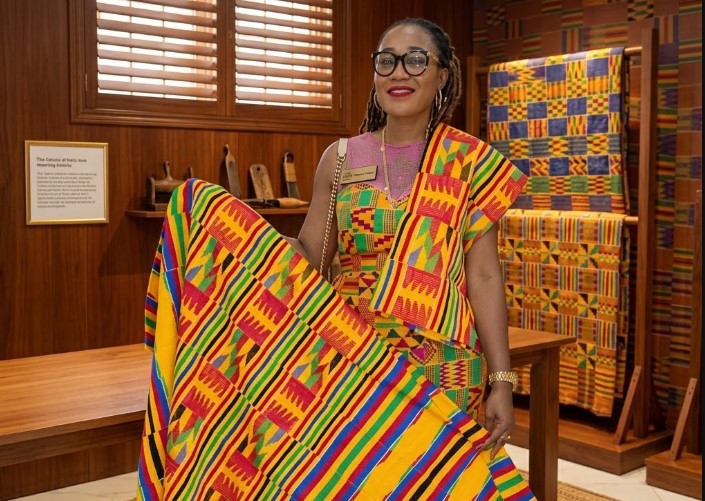
Ghanaian filmmaker, journalist and designated Kente Ambassador Amma Prempeh has urged the government and private investors to move beyond celebrating Kente’s international popularity and invest in the infrastructure required to develop it into a stronger global industry.
Her appeal follows growing international interest in authentic handwoven Kente, fueled by major cultural events, increased use of the fabric within the African diaspora and international recognition of its cultural and commercial significance.
Prempeh argued that Ghana must take deliberate steps to ensure that local weavers and traditional communities receive the economic benefits generated by Kente’s expanding global appeal.
One of the main challenges confronting the industry is its dependence on imported yarn. Weavers in established production centers such as Bonwire in the Ashanti Region reportedly face high production costs because essential raw materials are sourced from outside the country.
Prempeh therefore called for the establishment of a local yarn manufacturing factory and the revival of Ghana’s cotton industry. She said strengthening domestic production would reduce the cost of raw materials, improve supply reliability and make locally woven Kente more competitive in international markets.
She also advocated improved working conditions for artisans, including modern workshops, better equipment and structured training centers.
Although the industry must preserve its traditional hand-weaving techniques, Prempeh said appropriate technology and upgraded facilities could help artisans increase production and fulfil large international orders without compromising the quality and authenticity of the fabric.
Another priority is the creation of a digital certification and traceability system to protect authentic Ghanaian Kente from foreign imitations and mass-produced counterfeits.
Under the proposed system, every genuine piece of Kente would be accompanied by a digital certificate that buyers could scan to verify its origin. The platform could also provide information about the fabric’s design, cultural meaning and the individual artisan or weaving community responsible for producing it.
Prempeh said such a system would support the enforcement of Kente’s Geographical Indication status while giving international customers greater confidence that they are purchasing an authentic Ghanaian product.
She further called for development across the entire Kente value chain, noting that the industry’s economic potential extends beyond traditional weaving.
Increased investment could generate employment in fashion design, accessories, packaging, branding, digital marketing, cultural tourism and export logistics. Young people could also be encouraged to enter the industry through training, entrepreneurship support and access to modern production facilities.
The Ghana Export Promotion Authority has reported rising international demand for Kente and other locally produced arts and crafts. Industry stakeholders believe Ghana can earn substantially more from the sector if it improves production capacity, protects authenticity and develops effective routes to global markets.
Prempeh maintained that international recognition alone would not guarantee prosperity for weaving communities. She said strategic capital investment was necessary to transform Kente’s cultural value into sustainable jobs, higher incomes and increased export revenue.
Her appeal adds to growing calls for Ghana to protect its ownership of Kente while ensuring that communities which have preserved the craft for generations remain at the center of its commercial expansion.
Source: Omanghana