Omanghana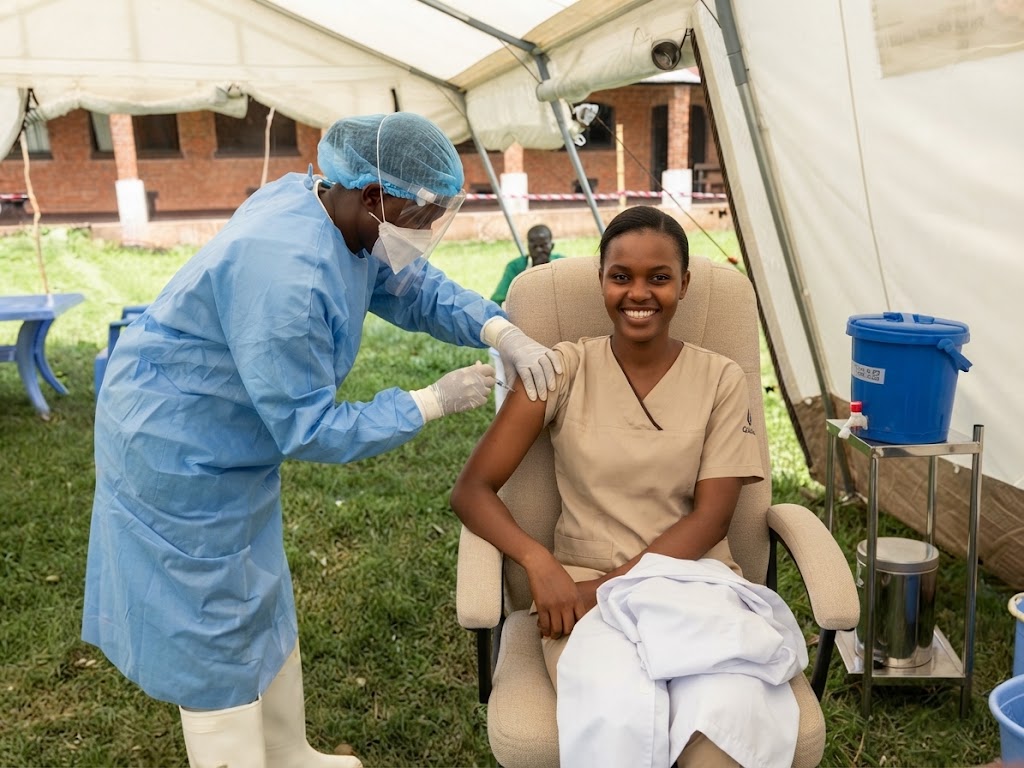
The Democratic Republic of the Congo has begun vaccinating healthcare and other frontline workers in Bunia as the country battles its deadliest Ebola outbreak on record.
The vaccination exercise was launched on September 19, 2026, in Bunia, the capital of Ituri province and one of the areas hardest hit by the epidemic. The programme will also cover other affected areas, including Mongbwalu and parts of North Kivu where infections have been rising rapidly.
Health authorities are prioritising doctors, nurses, laboratory personnel, burial teams and other workers directly involved in the Ebola response because of their heightened exposure to infected patients and materials.
As of the campaign’s launch, the DRC had recorded 7,541 confirmed cases and 3,639 deaths. Although transmission has recently declined in parts of Ituri, cases have continued to rise in North Kivu, leaving health officials cautious about declaring that the outbreak has peaked.
The epidemic is caused by the Bundibugyo virus, a less common Ebola virus species for which there is currently no specifically approved vaccine or treatment. That has made the response more difficult than previous Congolese outbreaks caused by the Zaire Ebola virus.
Frontline workers are being offered Ervebo, a vaccine manufactured by Merck and licensed for use against the Zaire Ebola virus. Preliminary scientific evidence suggests it may provide some protection against Bundibugyo virus, but its effectiveness against the strain has not yet been established.
The vaccine is consequently being administered under an emergency compassionate-use programme while researchers collect evidence on its safety and effectiveness.
Doctors Without Borders, also known as Médecins Sans Frontières, and its epidemiological research centre, Epicentre, have launched the BRAVO study to follow approximately 20,000 frontline workers over time.
The research will run for nine to 12 months, including about three months of vaccination and at least six months of participant monitoring. Scientists will assess whether Ervebo reduces infection or disease among workers exposed to the Bundibugyo virus.
The World Health Organization and the Africa Centres for Disease Control and Prevention approved an initial allocation of 70,000 Ervebo doses from the global Ebola vaccine stockpile.
Of that number, 50,000 doses are intended for healthcare and frontline personnel under current emergency recommendations. The remaining 20,000 doses have been assigned to a Phase III clinical trial examining the vaccine’s potential effect against Bundibugyo virus.
The DRC had already started administering the vaccine to frontline personnel in other affected provinces before the Bunia rollout. By mid-September, more than 3,000 healthcare and response workers had reportedly received it.
Containing the outbreak remains difficult because of armed conflict, displacement, weak infrastructure and extensive population movement across eastern Congo. Strikes by healthcare workers over unpaid allowances have also disrupted treatment and surveillance operations.
Insecurity in North Kivu and other affected provinces has limited access to some communities, while cases occurring outside known transmission chains have complicated efforts to identify contacts and stop further spread.
The current epidemic is the DRC’s 17th Ebola outbreak and the third linked to Bundibugyo virus. It is now the country’s deadliest outbreak and the second most lethal Ebola epidemic recorded globally, behind the 2014–2016 West African crisis that killed more than 11,000 people.
Health authorities hope the vaccination campaign will provide immediate protection to those most exposed while generating evidence that could guide future responses to outbreaks caused by the Bundibugyo virus.
Source: Omanghana