Omanghana
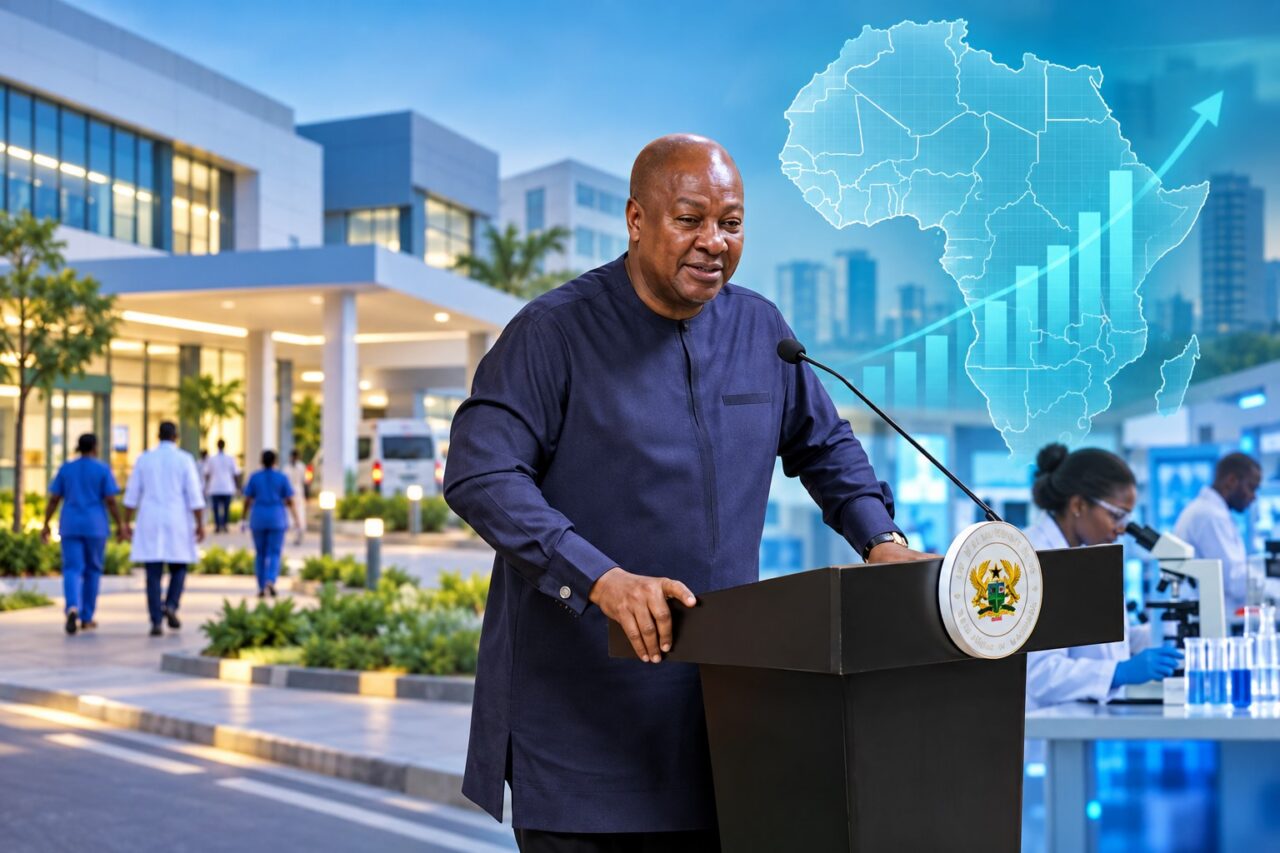
President John Dramani Mahama has called on African governments and global investors to place healthcare at the center of economic planning, arguing that sustained investment in the sector can create jobs, strengthen industries and protect national economies.
Delivering a keynote address at the Health Plenary of the inaugural Alamein Africa Forum in El Alamein, Egypt, on Saturday, October 3, 2026, he criticized the longstanding approach of financing healthcare only after other budget priorities have been addressed.
“Health is not a charitable cause; it is an investable, high-growth economic sector,” President Mahama said.
He argued that spending on healthcare should be recognised for its contribution to productivity, human capital development and long-term economic stability.
To illustrate the potential benefits, the President cited Copenhagen Consensus findings which, he said, showed that a targeted package of basic emergency maternal and newborn care could deliver $87 in economic and social returns for every dollar invested.
He also warned that declining external assistance made it increasingly urgent for African countries to develop sustainable financing arrangements. Citing OECD projections, he said health aid could fall by between 29 and 46 per cent compared with 2024 levels.
President Mahama identified dependence on imported medical products as another major vulnerability. He said Africa imports more than 70 per cent of its pharmaceuticals and nearly 99 per cent of its vaccines, exposing countries to supply disruptions while drawing substantial foreign exchange out of their economies.
He urged governments to support pharmaceutical production, research, technology and the infrastructure needed to manufacture essential health products locally. Stronger cooperation on regulation and procurement, he added, would help African manufacturers expand and improve access to medicines.
The President stressed that governments could not finance the transition alone. He called for commercial banks, sovereign funds, private investors and industrial developers to help build the continent’s healthcare manufacturing capacity.
He pointed to the African Continental Free Trade Area as an opportunity for manufacturers to serve a market of approximately 1.4 billion people, making investment more commercially attractive than production limited to individual national markets.
Turning to Ghana, President Mahama highlighted measures under the Accra Reset, including expansion of the National Health Insurance Scheme, the Free Primary Healthcare Program and the Ghana Medical Trust Fund.
He also cited efforts to strengthen the Food and Drugs Authority and the National Vaccine Institute as part of Ghana’s ambition to become a producer of health products.
He urged African leaders and investors to translate their commitments into factories, connected supply chains and support for innovators, with the aim of improving access to care and strengthening the continent’s ability to meet its own health needs.
Source: Omanghana