Omanghana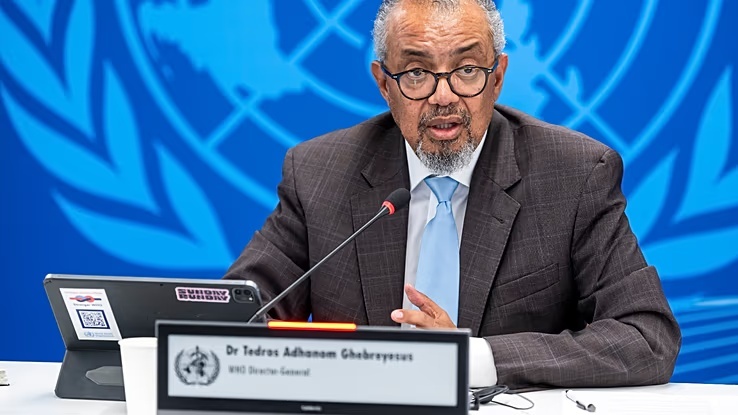
The World Health Organization (WHO) has urged the public not to panic following the confirmation of France’s first domestically detected Ebola case, emphasizing that the overall global public health risk remains low and that existing safety measures have effectively minimized the potential for wider transmission.
WHO Director-General Tedros Adhanom Ghebreyesus said there is “no need for panic,” noting that international health protocols and rapid response systems worked as intended to contain the situation.
French Doctor Diagnosed After Returning From Humanitarian Mission
According to health authorities, the confirmed case involves a French physician who had been volunteering in the Democratic Republic of the Congo with the humanitarian organization ALIMA (The Alliance for International Medical Action).
The doctor traveled on a commercial Air France flight from Kinshasa to Paris on June 23 while reportedly experiencing only mild symptoms, including a headache. During the journey, the individual’s condition slightly worsened.
Upon arrival at Charles de Gaulle Airport, French authorities immediately isolated the patient and transferred them to a specialized medical facility, where Ebola was subsequently confirmed.
Officials from France’s Health Ministry said the patient is in stable condition and currently has a very low viral load.
As a precautionary measure, five passengers who were seated near the doctor during the flight have been identified as close contacts and placed under mandatory 21-day home isolation while being monitored for symptoms.
Outbreak Continues to Intensify in Central Africa
While the WHO considers the threat outside the affected region to be low, the Ebola outbreak in Central Africa continues to expand.
The current outbreak was first declared on May 15, 2026, in the eastern Ituri Province of the Democratic Republic of the Congo and has since grown rapidly.
Health authorities report that more than 1,000 cases and 267 deaths have been recorded in the DRC, representing a fatality rate of approximately 25 percent. The virus has also spread beyond the country’s borders, with neighboring Uganda reporting 20 confirmed cases and two deaths.
The outbreak is being driven by the Bundibugyo strain of the Ebola virus, a variant for which there is currently no approved vaccine or standard treatment, making containment efforts more challenging than in previous outbreaks involving other Ebola species.
Healthcare workers have been among the hardest hit, with nearly 80 infections reported among frontline personnel. WHO officials say the case in France highlights the occupational risks faced by medical teams responding to outbreaks in affected regions.
WHO Maintains Low Risk Beyond the Epicenter
The WHO continues to assess the public health threat differently depending on geographic location and exposure risk.
The organization classifies the risk within the Democratic Republic of the Congo as very high, citing ongoing conflict, strained healthcare infrastructure, and difficulties in contact tracing. Neighboring countries face a high level of risk because of cross-border movement and displaced populations.
For Europe and the wider international community, however, the WHO maintains that the overall risk remains low, noting that Ebola is not transmitted through the air and spreads primarily through direct contact with the bodily fluids of an infected person.
Health officials say continued surveillance, rapid isolation of suspected cases, and effective contact tracing remain the key tools for preventing further international spread while efforts continue to contain the outbreak at its source.
Source: Omanghana