Omanghana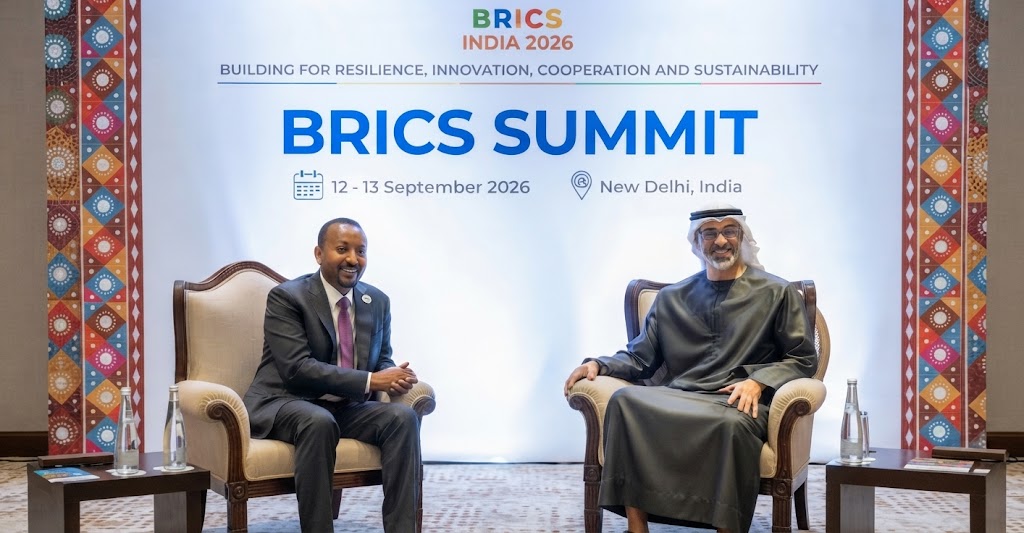
Ethiopian Prime Minister Abiy Ahmed is strengthening his country’s relationships with major global powers, even as disputes over maritime access and unresolved security concerns continue to complicate relations within the Horn of Africa.
The contrast was evident at the 2026 BRICS summit in New Delhi, where Abiy held bilateral meetings with several world leaders and promoted Ethiopia as an important representative of Africa and the wider Global South.
During talks with Indian Prime Minister Narendra Modi, the two leaders reviewed cooperation in trade, investment, agriculture, manufacturing, defence, technology and capacity building. The meeting followed Modi’s visit to Addis Ababa in December 2025 and reflected growing strategic ties between the two countries.
Ethiopia formally joined BRICS in January 2024, giving Addis Ababa a stronger platform for engagement with China, India, Brazil, Russia, South Africa and the bloc’s other members. Abiy has used the group to advocate reforms to global financial institutions and increased representation for developing countries.
Ethiopia has also offered to host a regional office of the BRICS New Development Bank in Addis Ababa. If accepted, the proposal could position the Ethiopian capital as a channel for development finance and investment across Africa.
Beyond BRICS, Abiy’s government has pursued a diversified foreign policy involving Western governments, Asian economies and Middle Eastern investors. This approach reduces Ethiopia’s reliance on traditional aid partners while expanding access to infrastructure financing, technology and security cooperation.
Ethiopia’s large population, economic potential, military capacity and location near the Red Sea make it strategically important to international partners. Addis Ababa also hosts the headquarters of the African Union, reinforcing the country’s diplomatic relevance.
The picture is more complicated closer to home. Ethiopia’s determination to secure reliable access to the sea has alarmed some neighbouring governments and become one of the most sensitive issues in regional politics.
Landlocked since Eritrea gained independence in 1993, Ethiopia depends heavily on Djibouti for international trade. Abiy argues that direct and diversified maritime access is essential to the country’s long-term economic development.
A 2024 memorandum between Ethiopia and Somaliland triggered a major diplomatic crisis with Somalia. Mogadishu viewed the agreement, which offered Ethiopia access to the Gulf of Aden, as a violation of Somali sovereignty because it involved the self-declared but internationally unrecognised Somaliland administration.
Relations improved after Turkish mediation produced the Ankara Declaration, followed by an agreement between Ethiopia and Somalia to restore diplomatic ties in January 2025. Despite that progress, the dispute demonstrated how Ethiopia’s maritime ambitions can quickly create wider security concerns.
Relations with Eritrea have also deteriorated since the reconciliation that earned Abiy the 2019 Nobel Peace Prize. Eritrea was excluded from the negotiations that produced the 2022 Pretoria Agreement ending the war between Ethiopia’s federal government and the Tigray People’s Liberation Front.
Unresolved territorial and security questions in northern Ethiopia, together with renewed attention on Eritrea’s Assab port, have fuelled fears of another confrontation. Abiy has repeatedly said Ethiopia will not go to war over maritime access and insists that any agreement will be pursued through negotiation.
At the 2026 BRICS summit, he again described sea access as an economic priority that Ethiopia would seek exclusively through diplomatic channels.
Northern Ethiopia nevertheless remains unstable. Rivalries involving federal authorities, factions within the Tigray leadership, Amhara militias and Eritrea have created shifting alliances and continuing suspicion.
Internal conflicts in Amhara and Oromia also affect Ethiopia’s regional relationships. Refugee movements, ethnic communities extending across national borders and the presence of armed groups make domestic security developments a concern for neighbouring countries.
Abiy’s foreign policy therefore presents a complex picture. Global powers often view Ethiopia as a major African market, a diplomatic centre and a valuable security partner. Its neighbours, however, must weigh Addis Ababa’s ambitions against concerns about sovereignty, borders, ports and the regional balance of power.
Ethiopia’s international influence may continue to grow through BRICS and other partnerships, but its long-term regional position will depend on whether Abiy can convert calls for economic integration into agreements that neighbouring countries consider mutually beneficial and respectful of their sovereignty.
Source: Omanghana