Omanghana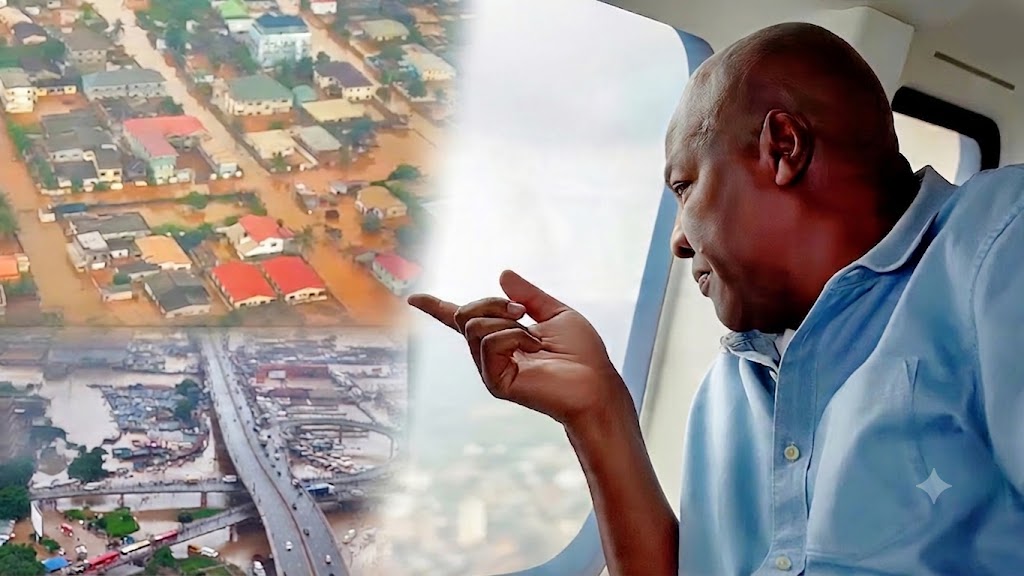
Former Greater Accra Regional Minister Nii Laryea Afotey-Agbo has defended President John Dramani Mahama’s decision to conduct an aerial assessment of flood-affected communities in the Greater Accra Region, describing the move as the most practical and efficient way to evaluate the scale of the disaster.
His comments come amid public criticism from some Ghanaians who argued that the President should have visited affected communities by road to engage directly with victims and witness the devastation at ground level.
Speaking on The Big Issue on Saturday, July 4, 2026, Afotey-Agbo rejected the criticism, insisting that the extraordinary conditions created by the flooding made an aerial inspection both necessary and appropriate.
Roads Rendered Impassable
According to the former regional minister, many of the roads leading to flood-hit communities had become inaccessible due to rising water levels, making road travel slow, difficult, and, in some cases, impossible.
He explained that the widespread flooding significantly disrupted transportation across parts of the capital, limiting the ability of emergency responders and government officials to move quickly between affected areas.
Afotey-Agbo argued that under such circumstances, using a helicopter enabled the President and accompanying officials to assess multiple locations within a short period and gain a comprehensive understanding of the disaster.
He noted that relying solely on road travel would have delayed the assessment and reduced the government’s ability to coordinate an immediate response.
A Faster Assessment of the Disaster
The former Greater Accra Regional Minister said an aerial survey provides a broader perspective that cannot easily be obtained from the ground.
He explained that viewing flooded communities from the air allows decision-makers to identify submerged roads, damaged infrastructure, blocked drainage systems, and communities cut off by floodwaters, enabling emergency agencies to prioritize relief efforts more effectively.
According to him, the helicopter tour offered government officials a clearer picture of the extent of the destruction across the Greater Accra Region, helping to inform subsequent relief and recovery operations.
Responding to Public Criticism
President Mahama’s aerial inspection sparked mixed reactions on social media and other public platforms, with some critics suggesting that the approach distanced the President from residents directly affected by the floods.
Others argued that a ground visit would have demonstrated greater empathy and allowed the President to interact personally with victims whose homes and livelihoods were destroyed.
However, Afotey-Agbo maintained that the criticism overlooked the logistical realities of the emergency.
He stressed that disaster response should not be judged solely by the mode of transportation used by national leaders but rather by the effectiveness of the actions taken to support affected communities.
Avoid Politicising a National Disaster
The former minister called on political leaders and the public to refrain from turning the flooding crisis into a partisan debate.
He said natural disasters require unity and collaboration rather than political point-scoring, emphasizing that the immediate priority should be protecting lives, assisting displaced families, and restoring damaged infrastructure.
Afotey-Agbo urged all stakeholders to support efforts aimed at helping affected communities recover while working together to prevent similar disasters in the future.
Calls for Permanent Flood Mitigation Measures
Beyond the immediate emergency response, Afotey-Agbo stressed the need for comprehensive engineering solutions to address Ghana’s recurring flooding problem.
He advocated sustained investment in modern drainage systems, regular desilting of storm drains, improved waste management, and stricter enforcement of building regulations to prevent construction on waterways and flood-prone lands.
He also called for better urban planning and coordinated infrastructure development to improve the resilience of cities against increasingly intense rainfall linked to climate change.
According to him, Ghana must shift from responding to floods after they occur to implementing preventive measures that reduce their frequency and impact.
Focus on Recovery and Resilience
As recovery efforts continue, government agencies have begun providing relief to affected communities while assessing the full extent of damage caused by the floods.
Afotey-Agbo believes the disaster should serve as a turning point for policymakers to accelerate long-term investments in flood-control infrastructure and urban resilience, ensuring that future heavy rains do not result in the same level of destruction experienced by residents across the Greater Accra Region.
Source: Omanghana