Omanghana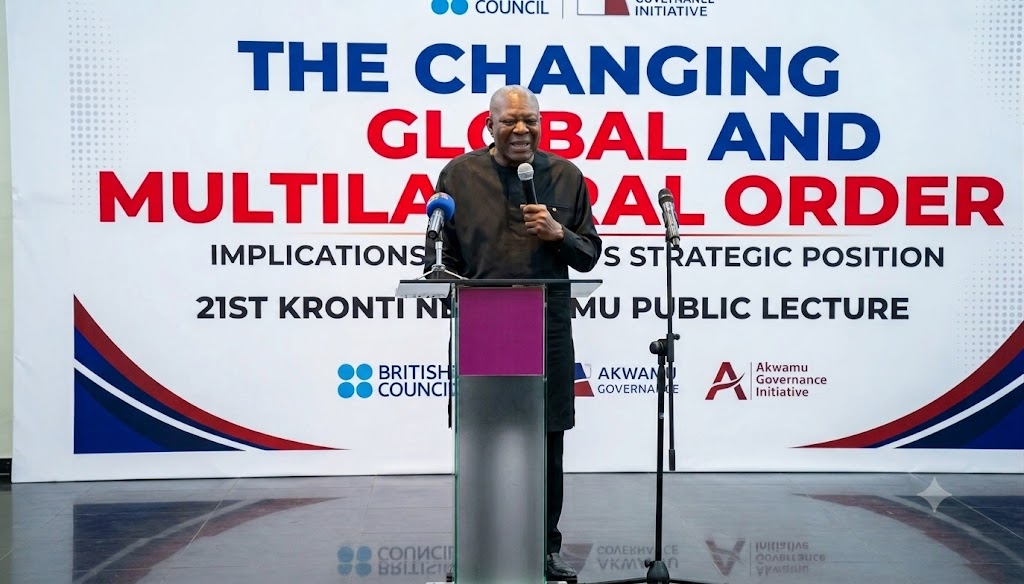
Ambassador D.K. Osei has called on African countries to abandon passive and fragmented diplomacy in favor of bold leadership, stronger regional unity and clearly defined long-term foreign policies.
The President of the Council on Foreign Relations Ghana warned that the continent risks losing influence as the rules-based international system weakens and major powers increasingly pursue their interests through unilateral action.
He made the remarks ahead of the Ghana Center for Democratic Development’s 21st Kronti ne Akwamu Public Lecture, held in Accra on Wednesday, July 29, 2026.
The event examined the theme, “The Changing Global and Multilateral Rules-Based Order: Implications for Ghana and Africa’s Strategic Positioning.”
Ambassador Osei chaired the lecture, while distinguished Ghanaian diplomat and former Foreign Affairs Minister Hanna S. Tetteh delivered the keynote address.
Africa Risks “Following Every Wind”
Ambassador Osei argued that many African governments lack comprehensive and institutionalized foreign-policy frameworks capable of protecting national and regional interests over the long term.
Instead, countries frequently react to geopolitical developments through short-term diplomatic calculations, shifting their positions according to the interests of more powerful international actors.
He described this approach as an attempt to “play safe,” warning that it could leave African countries following “every wind that blows” without a clear strategy of their own.
According to him, African governments must determine their priorities before deciding how to engage with competing global powers.
Foreign policy, he maintained, should not change dramatically whenever a new government assumes office or an external partner applies economic and diplomatic pressure.
It should be supported by strong institutions, expert analysis and a national consensus on the country’s security, trade and development interests.
Ghana began developing its first comprehensive foreign-policy framework in 2025 to consolidate the country’s diplomatic principles, national interests and strategic priorities. Ambassador Osei’s intervention underscored the importance of completing and institutionalizing that process.
Leadership Remains the Central Challenge
The veteran diplomat identified the quality of political leadership as one of the main obstacles to Africa’s global influence.
He argued that leaders who place personal or narrow domestic political interests above long-term national and continental priorities weaken their countries’ sovereignty and negotiating strength.
Africa’s challenge, he suggested, is not merely a shortage of natural resources, population or economic potential. It is the failure to convert those advantages into coordinated strategic power.
The continent possesses vast reserves of critical minerals required for electric vehicles, renewable-energy technologies, defense systems and digital infrastructure. It also has the world’s youngest and one of its fastest-growing populations.
Despite these advantages, African countries often negotiate separately with larger economies, allowing external actors to dictate terms involving taxation, debt, environmental standards, mineral extraction and data governance.
Unity Can Amplify Africa’s Influence
Ambassador Osei said a country’s international influence is not determined only by its population, geographical size or economic strength.
Its ability to build alliances and act collectively can also provide significant diplomatic leverage.
He cited the European Union as an example of how countries with different economic and political interests can use regional integration to amplify their influence in global negotiations.
Through coordinated institutions, the EU is able to exercise considerable influence over trade, competition, environmental regulation and digital policy.
Africa, by comparison, continues to struggle to translate the African Union and other regional organizations into an equally powerful diplomatic bloc.
Ambassador Osei urged African governments to make greater use of the AU, the African Continental Free Trade Area and subregional bodies to coordinate policy and negotiate as a collective.
Global Rules-Based System Under Pressure
The 21st Kronti ne Akwamu Lecture took place amid growing concern about the future of the multilateral institutions established after the Second World War.
Organizations such as the United Nations, World Trade Organization and international financial institutions were intended to provide predictable rules for relations among states.
However, powerful countries increasingly bypass those institutions when established rules conflict with their strategic interests.
Trade restrictions, unilateral sanctions, military interventions and competing technology standards have contributed to a more fragmented international environment.
Developing countries are also being required to respond to rules created elsewhere on corporate taxation, green investment classifications, carbon standards, artificial intelligence and control of digital data.
Individually, many African countries have limited power to shape those decisions. Acting collectively would give the continent a stronger opportunity to influence the rules before they are imposed.
Reform of International Institutions
The discussion renewed calls for reforms to international institutions that no longer reflect present global political and economic realities.
Africa remains without a permanent seat on the United Nations Security Council despite accounting for 54 UN member states and a substantial proportion of the council’s peace and security agenda.
African governments have also criticized the governance of the International Monetary Fund, World Bank and other financial institutions, arguing that decision-making power remains concentrated in advanced economies.
Ambassador Osei’s remarks emphasized the need for African countries to pursue those reforms through a consistent and united diplomatic strategy.
A fragmented approach, he warned, allows external powers to negotiate with individual states and weaken common continental positions.
A Strategic Agenda for Ghana and Africa
The lecture identified several areas requiring urgent action from African governments.
Countries must develop comprehensive foreign policies that survive changes in political administration and provide clear guidance for diplomats, security agencies and economic institutions.
The African Union and regional blocs must also be strengthened to prevent and resolve conflicts without excessive dependence on external powers.
On trade, African states must coordinate their positions and accelerate implementation of the African Continental Free Trade Area. A larger integrated market would improve the continent’s bargaining power while supporting industrialization and intra-African commerce.
Governments must also move beyond exporting unprocessed minerals and agricultural commodities. Greater local processing and manufacturing would allow African countries to retain more economic value and negotiate stronger partnerships.
Ambassador Osei argued that the continent’s future influence will depend on whether its leaders can turn Africa’s resources, population and regional institutions into a coherent strategic force.
The 21st Kronti ne Akwamu Public Lecture formed part of CDD-Ghana’s continuing effort to encourage public discussion on governance, democracy and national development. The annual platform has hosted policymakers, academics, diplomats and civil-society leaders since its establishment in 2005. CDD-Ghana
Source: Omanghana