Omanghana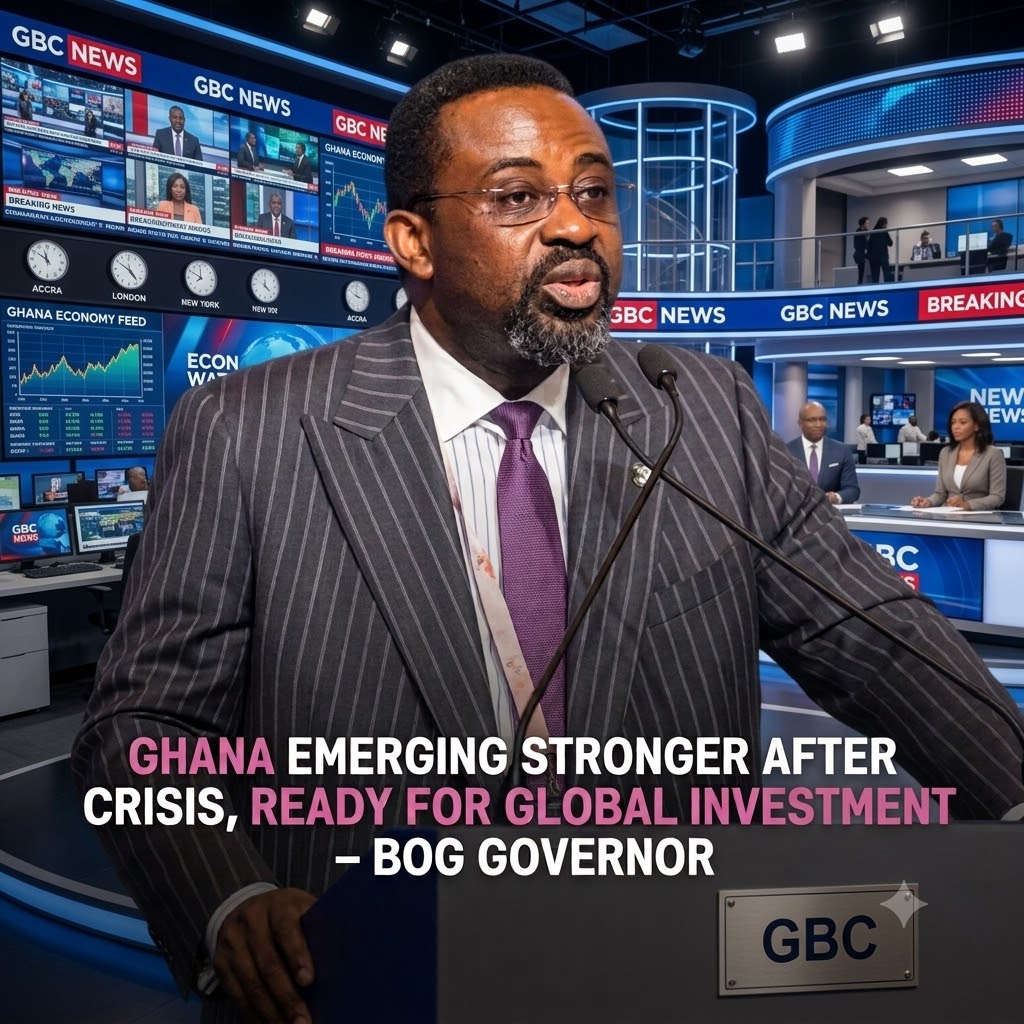
Governor of the Bank of Ghana, Dr. Johnson Pandit Asiama, has presented Ghana’s recent economic recovery as a blueprint for strengthening financial resilience across Africa, urging central banks to deepen domestic capital markets to better withstand future economic shocks.
Speaking at the Bank for International Settlements (BIS) Roundtable of Governors from African Central Banks in Basel, Switzerland, on Saturday, June 27, 2026, Dr. Asiama said Ghana’s experience demonstrates the critical importance of building strong local financial systems capable of supporting sustainable economic growth.
Addressing fellow central bank governors and financial policymakers, he stressed that while many African economies remain vulnerable to global financial volatility, strengthening domestic debt markets can significantly improve macroeconomic stability and reduce dependence on external financing.
Deep Domestic Capital Markets Key to Economic Stability
According to Dr. Asiama, one of the most important lessons from Ghana’s recent economic stabilization is the need to develop broader and more diversified domestic capital markets.
He explained that as governments increasingly rely on domestic borrowing to finance infrastructure projects, development programs, and budget deficits, well-functioning local debt markets become essential for maintaining economic resilience.
Strong domestic financial markets, he noted, provide governments with reliable long-term financing while helping central banks preserve monetary policy effectiveness and maintain adequate liquidity within the banking sector.
Dr. Asiama emphasized that deeper capital markets also reduce vulnerability to sudden shifts in global investor sentiment and external financing conditions.
Ghana’s Economic Recovery Gains Momentum
Highlighting Ghana’s recent macroeconomic progress, the Bank of Ghana Governor pointed to significant improvements in inflation, foreign exchange reserves, and fiscal sustainability.
He noted that inflation, which peaked at a historic 54.1 percent in 2023, has declined substantially to 21.2 percent, reflecting the impact of coordinated monetary and fiscal policy measures.
The easing inflationary pressures have enabled the Bank of Ghana to reduce its benchmark policy rate by 350 basis points, bringing it down to 21.5 percent, its lowest level in three years.
According to Dr. Asiama, the improvement signals growing confidence in Ghana’s economic recovery while creating a more supportive environment for investment and business expansion.
Stronger Foreign Reserves Support Cedi Stability
The Governor also highlighted the significant improvement in Ghana’s external position.
Gross international reserves have risen to US$10.67 billion, equivalent to approximately 4.7 months of import cover, providing an important buffer against external economic shocks and strengthening confidence in the stability of the Ghana cedi.
He explained that stronger reserve levels have enhanced the country’s ability to manage exchange rate pressures while reinforcing overall macroeconomic stability.
Debt Restructuring Creates Fiscal Space
Dr. Asiama identified Ghana’s external debt restructuring program as another major contributor to the country’s economic turnaround.
According to him, the successful restructuring of approximately US$13.1 billion in external debt with bilateral and commercial creditors has created valuable fiscal space for the government.
The restructuring is expected to generate savings of nearly US$6 billion over the next five years, easing debt servicing pressures and allowing greater investment in priority sectors of the economy.
He noted that restoring debt sustainability has been a crucial pillar of Ghana’s broader economic recovery strategy.
Beyond Stabilization: Building Sustainable Financial Markets
While acknowledging the progress made, Dr. Asiama cautioned that macroeconomic stabilization alone is insufficient to secure long-term prosperity.
He urged African policymakers to focus on developing more sophisticated financial instruments capable of mobilizing long-term domestic investment and reducing dependence on sovereign borrowing.
Among the innovations he highlighted was the development of commercial paper programs that can provide alternative financing for strategic state institutions such as the Ghana Cocoa Board (COCOBOD).
Such financing mechanisms, he explained, would diversify funding sources, attract greater private sector participation, and reduce pressure on government borrowing.
Call for Greater Regional Financial Resilience
Dr. Asiama concluded by encouraging African central banks to collaborate more closely in strengthening domestic financial systems capable of supporting sustainable economic transformation.
He argued that deeper capital markets, stronger financial institutions, sound macroeconomic policies, and innovative financing tools will be essential if African economies are to withstand future global economic shocks while accelerating investment, industrialization, and inclusive growth.
According to the Bank of Ghana Governor, Ghana’s recent experience demonstrates that with disciplined reforms, effective monetary policy, and resilient domestic financial markets, African economies can successfully overcome periods of severe economic distress and build stronger foundations for long-term development.
Source: Omanghana