Omanghana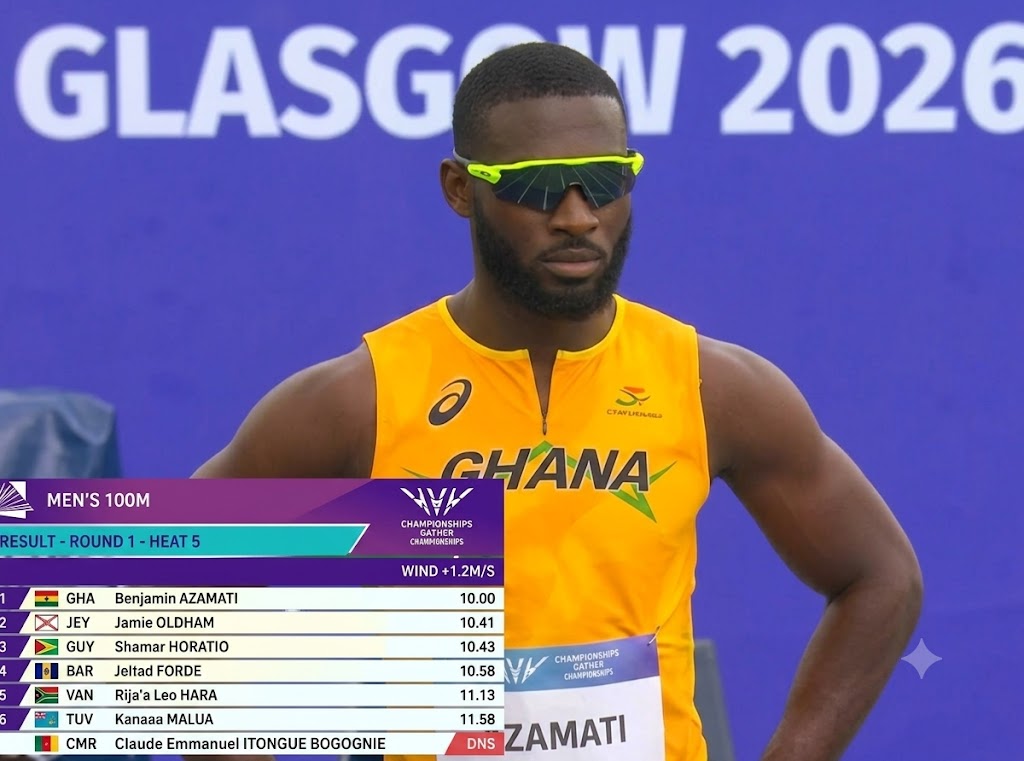
Ghanaian sprinter Benjamin Azamati finished seventh in the men’s 100-metre final at the 2026 Commonwealth Games in Glasgow, narrowly missing the podium and the government’s medal-based financial rewards.
The 28-year-old entered the final as one of Ghana’s leading medal prospects after producing an impressive season-best time of 10.00 seconds in the opening round. That performance was the fastest across the qualifying heats and reportedly the quickest opening-round time recorded in Commonwealth Games history.
Azamati, however, could not reproduce that form in the final. He crossed the finish line in seventh place, finishing ahead of only one competitor in the eight-man medal race.
Cameroon’s Emmanuel Eseme won the gold medal with a Commonwealth Games record of 9.83 seconds, delivering one of the standout performances of the athletics program.
Strong Opening Raised Medal Expectations
Azamati generated excitement within Team Ghana after comfortably winning his heat in 10.00 seconds. His compatriot Abdul-Rasheed Saminu also impressed during qualifying, recording 10.01 seconds as the two Ghanaians produced the fastest times across the opening round.
Azamati’s performance suggested he was in the form required to challenge for a medal. It also raised hopes that Ghana could end its long wait for Commonwealth Games gold.
Conditions and pressure often change significantly between the preliminary rounds and a major championship final, however. Athletes must recover quickly while preparing to face the competition’s fastest qualifiers in a single decisive race.
Although Azamati successfully progressed through the rounds and secured a place among the eight finalists, he was unable to match the acceleration and finishing strength of the leading competitors when the medals were decided.
Seventh Place Falls Outside Government Bonus Scheme
Ahead of the Games, Sports and Recreation Minister Kofi Adams announced a medal-based incentive package for Ghanaian athletes competing in Glasgow.
Under the announced structure, an individual gold medalist would receive US$10,000 from the government. Silver and bronze medal winners were allocated US$3,000 and US$2,000 respectively.
| Final position | Government reward |
|---|---|
| Gold medal | US$10,000 |
| Silver medal | US$3,000 |
| Bronze medal | US$2,000 |
| Seventh place | No medal bonus |
The package does not provide a performance bonus for athletes who finish outside the first three positions. Azamati’s seventh-place result therefore made him ineligible for a payment under the medal reward structure.
The minister had doubled the gold-medal reward from the US$5,000 offered at the previous Commonwealth Games. Silver and bronze rewards remained at the previously announced levels. Adams also promised a personal contribution of US$1,000 in addition to the state package for medal-winning athletes.
The incentive program was introduced to motivate Team Ghana and encourage the country’s athletes to improve on the five medals secured at the 2022 Commonwealth Games in Birmingham. Graphic Online reported the government’s revised medal rewards before the Glasgow competition began.
Final Appearance Remains a Significant Achievement
Despite missing out on a medal, reaching the Commonwealth Games 100m final remains a notable achievement for Azamati. The event brought together some of the fastest sprinters from Africa, the Caribbean, Europe and Oceania.
His 10.00-second qualifying performance also demonstrated his ability to compete at an elite international level. Azamati and Saminu topped the opening-round standings ahead of several highly rated competitors, underlining Ghana’s strength in men’s sprinting.
Azamati’s campaign will nevertheless be viewed as a missed medal opportunity because of the standard he set in the heats. His challenge will be to translate that early-round speed into a complete performance during future major finals.
The result also renews discussion about athlete support and whether incentives should be limited to medal winners. While podium rewards recognize exceptional results, finalists also carry significant training, travel, medical and preparation costs throughout the season.
For Azamati, the Glasgow campaign ends without an individual medal or government performance bonus. His qualification time and appearance in the final, however, provide evidence that he remains one of Ghana’s most competitive sprinters on the international stage.
Source: Omanghana