Omanghana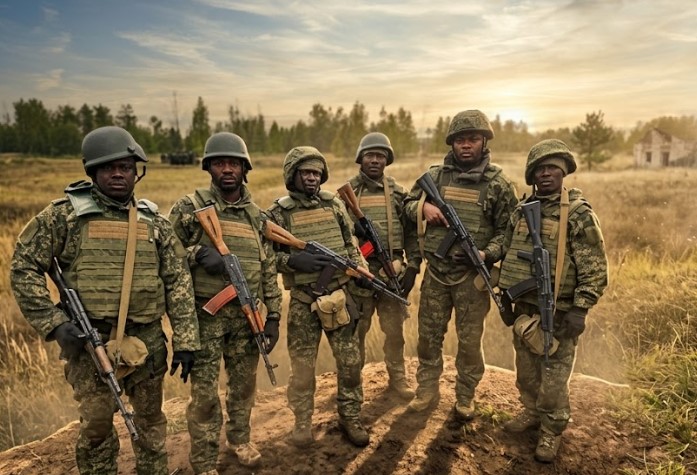
Daniel Angel Masie Nchama, a 22-year-old former information technology student from Equatorial Guinea, has warned young Africans against deceptive overseas employment offers after escaping forced service with Russian troops fighting in Ukraine.
Now safely back with his family in Malabo, Nchama has described how promises of military training and future employment as a bodyguard allegedly led to coercion, battlefield deployment, hunger and the deaths of hundreds of recruits.
His account adds to growing concerns that foreign nationals are being recruited into the Russian military through informal networks offering misleading employment opportunities.
Nchama left Equatorial Guinea in December 2025 after being contacted by a Cameroonian intermediary identified only as Fabrice. Hoping to establish a life abroad, he travelled believing he would receive several months of military training before beginning work as a bodyguard.
After reaching Russia, Nchama and other foreign recruits were presented with contracts written entirely in Russian, a language they did not understand.
When they objected, the recruiters allegedly told them it was too late to translate the documents. Nchama said that when he attempted to use his mobile phone to translate the contract, a Russian soldier placed a firearm on the table.
He interpreted the gesture as a direct threat and signed the document. The recruits’ passports were subsequently confiscated and never returned.
Instead of receiving the lengthy training they had been promised, the group underwent about two weeks of basic instruction followed by approximately 45 days of intensive military preparation in Murmansk, northern Russia.
They were then transported towards the Ukrainian battlefield in armored vehicles.
Nchama said he did not initially know they had reached the front. The reality became clear when a missile struck his vehicle and killed two of the fighters travelling with him.
He was assigned to a 424-member battalion in the Donetsk region. According to his account, every other member of that unit was killed within two weeks, leaving him as the only survivor.
He was subsequently placed in another battalion operating around Volnovakha and ordered to lead part of the unit during a mission to capture six Ukrainian villages.
Nchama claimed that only three of the 566 recruits assigned to that operation survived. The battlefield figures are based on his testimony and have not been independently verified.
Conditions on the front were severe. He described freezing temperatures, continuous drone attacks and prolonged food shortages, including one nine-day period during which his group received nothing to eat.
The starving fighters eventually killed a deer and consumed it raw, he said.
Nchama also alleged that orders were enforced through threats of execution. Refusing an instruction, he said, could result in a fighter being killed by someone within the unit.
He encountered numerous other foreign nationals serving alongside Russian troops, including Africans from Cameroon, Nigeria and Libya, as well as fighters from Colombia.
Ukraine estimates that more than 1,780 citizens from 36 African countries have joined or been recruited into Russian forces. The investigative group All Eyes on Wagner has separately identified 1,417 Africans recruited between January 2023 and September 2025, more than 300 of whom reportedly died.
In March 2026, Nchama secretly contacted his parents and sent an urgent plea for assistance. The recording spread widely on social media in Equatorial Guinea, prompting his family to approach the authorities.
The Equatorial Guinean government subsequently opened diplomatic negotiations to secure his release and pledged to investigate the recruitment networks targeting its citizens.
Nchama said that even after the diplomatic intervention, Russian military officials tried to persuade him to remain. He was presented with three medals and offered a house, a vehicle, formal military employment and Russian citizenship.
Determined to leave, he told his superiors that he wanted to spend the weekend with a friend, inventing a name to support the story.
He then travelled to an airport, where Equatorial Guinea’s ambassador met him and placed him under diplomatic protection. Nchama eventually returned to Malabo in June, where he was reunited with his parents.
The Equatorial Guinean government has promised to dismantle trafficking and recruitment networks that lure young people into foreign military service.
Following his son’s return, Nchama’s father urged young Africans and their families to carefully investigate international job offers, particularly those involving vague military training or unusually attractive benefits. “These promises are death guaranteed,” he warned.
Source: Omanghana