Omanghana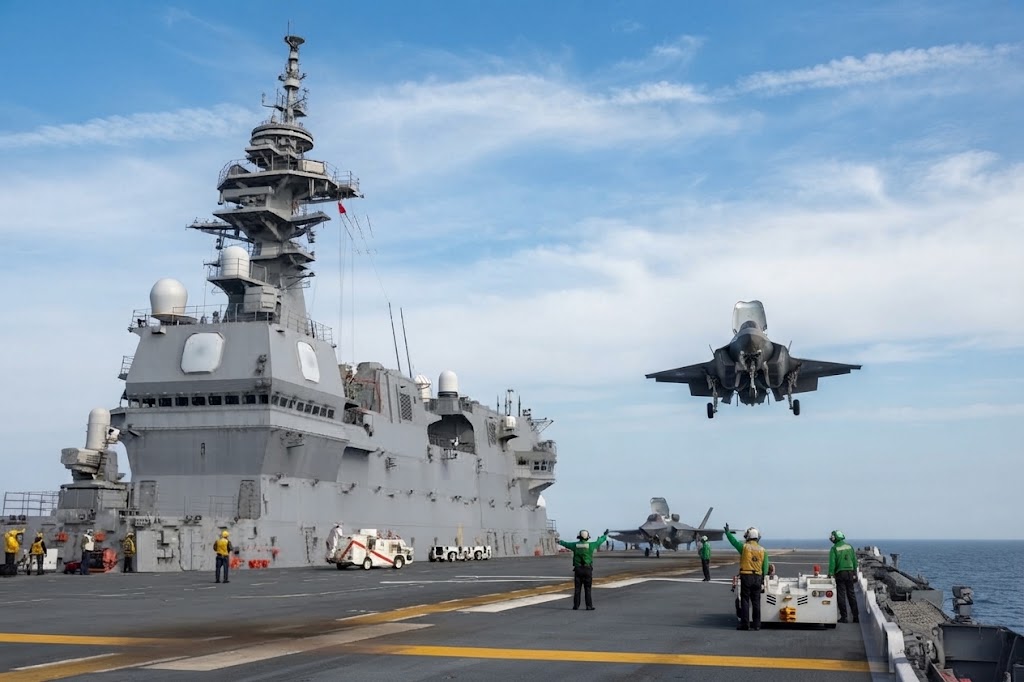
Two developments involving Lockheed Martin’s F-35 stealth fighter are drawing attention to changing security calculations in the Western Pacific and North Africa.
The United States Marine Corps has deployed Marine Fighter Attack Squadron 533, also known as the “Hawks,” from Marine Corps Air Station Beaufort in South Carolina to Marine Corps Air Station Iwakuni in Japan.
The F-35B squadron arrived under the Marine Corps’ Unit Deployment Program on September 5, 2026. It joined Marine Aircraft Group 12 of the 1st Marine Aircraft Wing and replaced Marine Fighter Attack Squadron 232 as the rotational unit operating in the Indo-Pacific.
The deployment strengthens the American tactical air presence in a region shaped by increasing military competition with China. Japan hosts permanent and rotational United States forces and remains a central part of Washington’s defense strategy in the Western Pacific.
The F-35B’s short-takeoff and vertical-landing capability allows it to operate from amphibious assault ships, established airfields and smaller expeditionary locations. This flexibility is particularly important because large, fixed military bases could become vulnerable to long-range missile attacks during a major conflict.
By dispersing the aircraft across multiple locations, Marine commanders aim to make their forces more difficult to locate and target while maintaining the ability to conduct combat operations.
However, the aircraft’s estimated combat radius of about 700 kilometers presents operational challenges across the Pacific’s vast distances. The limitation increases the importance of aerial refueling, forward-positioned fuel supplies, amphibious vessels and access to allied bases.
China’s J-20 stealth fighter is generally credited with a longer operating range, although direct comparisons are difficult because publicly reported figures may measure different flight profiles, fuel loads and mission requirements.
Meanwhile, Morocco is reportedly pursuing the acquisition of as many as 32 F-35A fighters as part of an arrangement potentially valued at up to $18 billion when aircraft, weapons, training, infrastructure and long-term support are included.
If completed, the acquisition would make Morocco the first African country and first Arab state to operate the fifth-generation stealth fighter. It would also represent a major shift in the balance of air power across North Africa.
The reported interest is closely connected to Morocco’s strategic rivalry with Algeria, which operates a large fleet of Russian-built combat aircraft. Rabat has steadily strengthened its military cooperation with Washington and modernized its air force with American weapons and upgraded F-16 fighters.
The F-35A would provide Morocco with low-observable technology, advanced sensors, networked operations and precision-strike capabilities. These features could give the country an advantage that extends beyond conventional comparisons involving aircraft numbers, speed and weapons capacity.
However, the proposed Moroccan acquisition has not yet been publicly confirmed as an approved sale by the United States government. Available official records list other recent weapons packages for Morocco but do not include a formal congressional notification for F-35 fighters. The discussions should therefore be treated as reported negotiations rather than a completed agreement.
Together, the developments demonstrate the growing importance of the F-35 in American alliance strategy and regional military competition. In the Pacific, the aircraft is being positioned for dispersed operations amid concerns about China’s missile and air capabilities. In North Africa, its possible introduction could transform the regional balance and intensify the arms competition between Morocco and Algeria.
Source: Omanghana