Omanghana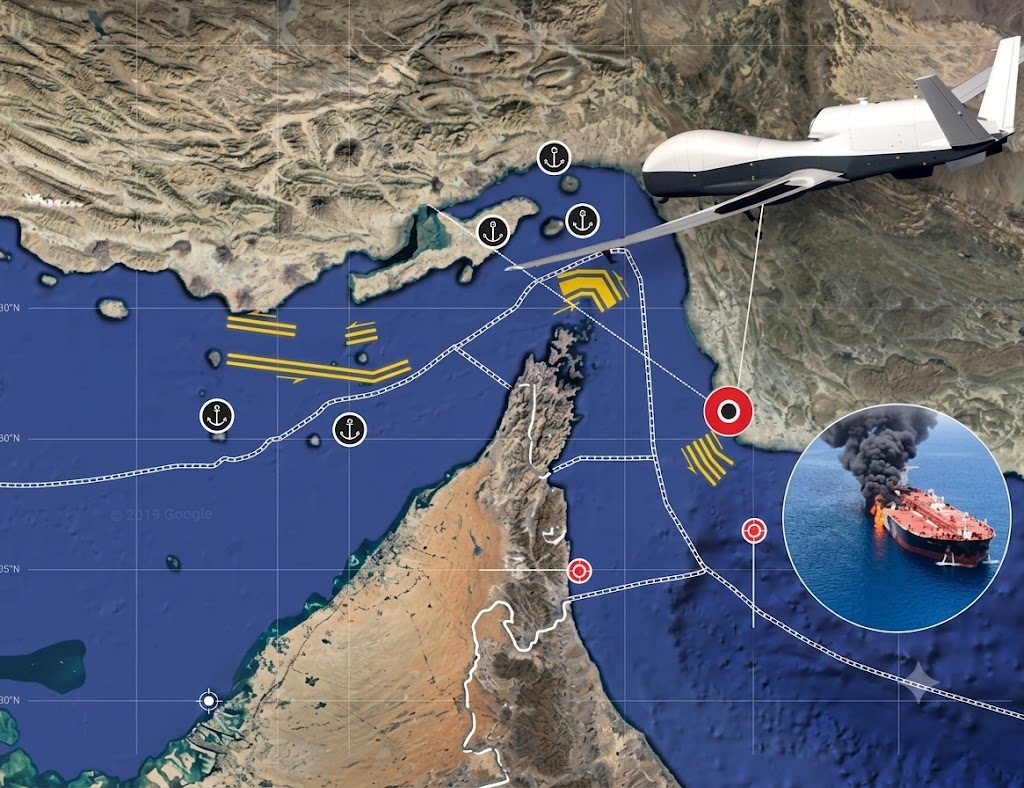
A dramatic military confrontation has erupted between the United States and Iran over control of the Strait of Hormuz, with both nations exchanging missile strikes and asserting competing claims over one of the world’s most strategically important maritime corridors.
According to the fictional scenario, the U.S. Central Command (CENTCOM) carried out a third consecutive night of precision strikes targeting Iranian military facilities, while U.S. President Donald Trump declared a previous interim ceasefire void. The administration announced plans to assume responsibility for securing the Strait of Hormuz and proposed a 20% safety fee on commercial vessels transiting the waterway.
Iran, meanwhile, rejected the U.S. declaration and announced the closure of the Strait of Hormuz. The Islamic Revolutionary Guard Corps (IRGC) asserted that the strategic passage falls under Iranian authority and launched retaliatory missile and drone attacks against U.S. military installations and allied facilities across several Gulf states.
Competing Claims Over a Strategic Waterway
In this fictional scenario, the conflict centers on competing interpretations of who has the authority to regulate traffic through the Strait of Hormuz, a narrow passage through which roughly one-fifth of the world’s seaborne oil trade normally passes.
The United States argues that the strait is an international waterway that must remain open to global commerce. Under the scenario, Washington deploys naval forces to escort commercial shipping through a southern navigation corridor near Oman while introducing a transit security fee to finance maritime operations.
Iran disputes that position, maintaining that it has sovereign authority over the strait and announcing that all commercial traffic must receive approval through Iranian authorities before entering the waterway.
Commercial Shipping Comes Under Attack
The fictional crisis intensifies after Iranian forces allegedly disable an unauthorized commercial container vessel operating in the area.
The situation worsens when two United Arab Emirates oil tankers are reportedly struck by missiles while sailing through nearby waters, resulting in casualties among the crews and raising fears of a broader disruption to global energy supplies.
New Naval Technology Enters the Conflict
The scenario also depicts the United States introducing autonomous surface vessels into offensive naval operations for the first time.
The unmanned systems reportedly target military infrastructure at Iran’s Bandar Abbas naval base as part of a wider campaign to weaken Iran’s maritime capabilities.
At the same time, Washington announces a renewed maritime blockade on vessels traveling to or departing from Iranian ports.
Regional Conflict Widens
The fictional conflict expands beyond the Strait of Hormuz as Iran launches retaliatory missile and drone strikes against military installations in several Gulf nations.
Air defense systems are activated across the region, while reports of damage to energy infrastructure heighten concerns that the confrontation could evolve into a broader regional war with significant implications for international shipping, energy markets, and global security.
Source: Omanghana