Omanghana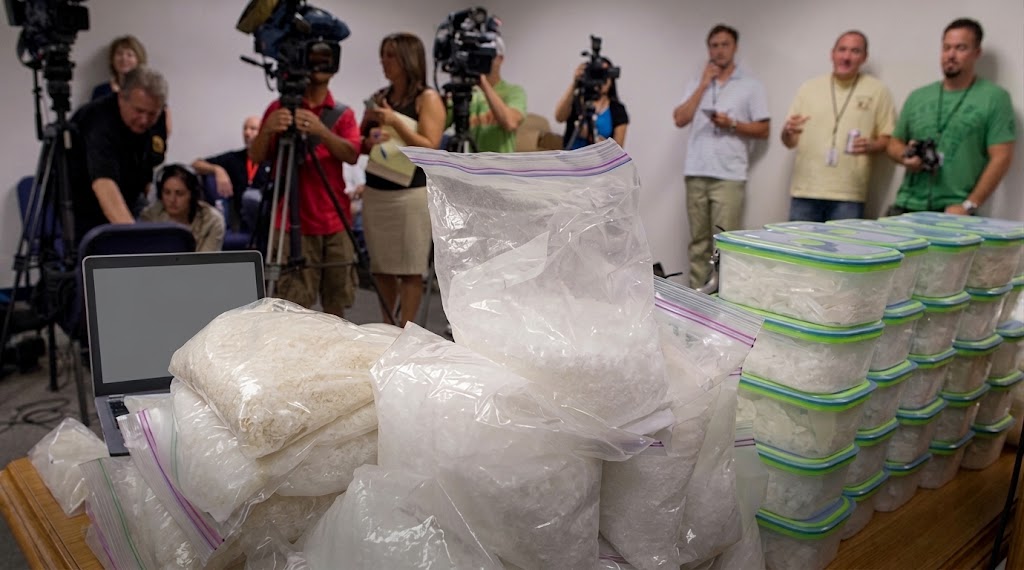
Suspects linked to two large clandestine crystal methamphetamine laboratories uncovered on remote South African farms have appeared in court as authorities intensify their campaign against transnational drug-manufacturing networks.
The cases involve an alleged R600 million operation near Musina in Limpopo and another laboratory valued by authorities at more than R1 billion in Swartruggens, North West.
Both facilities were uncovered during intelligence-led operations involving the Directorate for Priority Crime Investigation, commonly known as the Hawks, and specialized units of the South African Police Service.
International agencies also supported aspects of the investigations, reflecting growing concern that foreign criminal networks are working with regional partners to manufacture synthetic drugs inside South Africa.
Five Accused in Musina R600 Million Drug Case
Five foreign nationals appeared before the Musina Magistrate’s Court after police raided a farm in Limpopo’s Vhembe District on August 20, 2026.
The accused are Mexican nationals Verdogo Marioano Barrera, 48, and Leon Castilo Juan, 39, as well as Zimbabwean nationals Nyamukanga Tichaona Roy, 23, Mabayi Lee, 35, and Nyamukanga Tanaka Royce, 20.
They face charges relating to the illegal manufacture of a scheduled substance, drug dealing, drug possession, money laundering and contraventions of the Immigration Act.
All five were remanded in custody while arrangements were made for accredited language interpreters and further court proceedings.
The charges remain allegations, and the accused are presumed innocent unless found guilty by a court.
Industrial-Scale Laboratory Found on Remote Farm
The Musina raid followed an intensive two-month investigation into suspected drug-manufacturing activities at Plot 19, Kamkusi Campbell.
Investigators said they discovered a sophisticated laboratory allegedly being used to manufacture crystal methamphetamine for distribution.
Drugs and laboratory equipment with an estimated street value of R600 million were seized, together with an undisclosed amount of cash. Police described the operation as industrial in scale.
The valuation was supplied by law-enforcement authorities and represents an estimated street value. It should not necessarily be understood as the price that the drugs, chemicals or equipment would have realized in a single wholesale transaction.
The operation involved the Hawks, SAPS Crime Intelligence, the South African Narcotics Enforcement Bureau, the Hawks’ Limpopo division and the Special Task Force.
The United States Drug Enforcement Administration and Homeland Security Investigations were also identified among the agencies supporting the operation.
South African Broadcasting Corporation footage from the operation showed the remote location and some of the equipment found at the suspected production site.
Nationality Details Initially Conflicted
Initial police statements described the five suspects as two Mexican nationals, two Zimbabweans and one Malawian.
The National Prosecuting Authority’s subsequent court account identified the group as two Mexicans and three Zimbabweans. The names and nationalities listed in the court proceedings are used in this report.
The NPA said the investigation was continuing and that additional charges had not been ruled out as authorities worked to identify other people and assets allegedly linked to the operation.
The Hawks described the seizure as a significant disruption of an organized criminal enterprise and said investigators would pursue its financial and operational networks.
Swartruggens Laboratory Valued Above R1 Billion
The Musina case followed another major discovery on a farm near Swartruggens in North West province in May 2026.
Eleven suspects were initially arrested on May 13 after investigators uncovered what they believed was a large-scale methamphetamine production facility.
The group comprised five Mexican nationals, two Mozambicans, one Zimbabwean and three South Africans.
They appeared in the Swartruggens Magistrate’s Court on charges related to drug manufacturing, illegal possession of hazardous materials, illegal possession of precious metals and violations of immigration law.
The matter was postponed to allow authorities to arrange interpreters, verify immigration records and prepare for possible bail applications.
Nearly Half a Tonne of Methamphetamine Seized
Police initially recovered approximately 481 kilograms of suspected methamphetamine from the Swartruggens property.
Tons of chemical substances and drug-manufacturing equipment were also seized, together with three firearms.
Forensic specialists continued processing the scene after the arrests, with authorities warning that the total quantity of confiscated material could increase.
The Hawks estimated that the value of the entire illegal laboratory exceeded R1 billion. South Africa’s government news service reported that the facility was believed to have been involved in large-scale methamphetamine production.
The Mexican nationals named in that case were Fabián Astorga, Jesús Alonso Medina Astorga, Luis Alberto Ramírez Ríos, José Andrés Medina and Jacquelin López Madrid.
The Mozambican nationals were identified as Ismael Afiado Massingue and Lourenço Constantino Cumbane, while Tobias Soyani was identified as Zimbabwean.
The South African accused were named as Tyron John Schutte, Kyle Schutte and Vusi Amos Mkambi.
Investigators Examine Possible Mexican Links
The presence of Mexican nationals at both sites has strengthened suspicions that South Africa’s synthetic-drug trade is becoming increasingly international.
Police said preliminary investigations identified the Swartruggens facility as the fourth clandestine laboratory discovered in South Africa with alleged Mexican links.
The Musina operation has generated similar concern, although authorities have not publicly identified a particular cartel or confirmed that either laboratory was controlled by a named Mexican criminal organization.
The nationality of a suspect alone does not establish membership of a cartel. Investigators will need financial records, communications, travel information and evidence from the production and distribution networks to prove any direct organizational connection.
Organized-crime researchers nevertheless warn that foreign specialists may be collaborating with South African and regional groups to establish local manufacturing facilities instead of relying exclusively on imported finished drugs.
This model could reduce transportation risks, provide easier access to Southern African markets and allow criminal networks to move products through the region’s major ports and overland trade corridors.
Remote Farms Offer Concealment
Both suspected laboratories were located on farms away from densely populated urban communities.
Remote properties can provide criminal groups with the space required to store chemical precursors, install specialized equipment and carry out large-scale production with a reduced risk of immediate detection.
Distance from residential areas may also make it easier to conceal unusual vehicle movements, chemical smells, heavy equipment and high electricity consumption.
Investigators are examining whether farms are being leased, purchased or used through local intermediaries to hide industrial drug operations.
South African authorities have uncovered suspected drug laboratories in Limpopo, North West and other provinces in recent years, suggesting that isolated agricultural properties are becoming attractive locations for synthetic-drug manufacturing.
Earlier Limpopo Raid Also Involved Mexican Suspects
The latest cases form part of a wider pattern.
In July 2024, police uncovered a large methamphetamine laboratory on a farm near Groblersdal in Limpopo. Chemicals and drugs valued at approximately R2 billion were seized, and four suspects—including two Mexican nationals were arrested.
At the time, Hawks officials described the presence of Mexican citizens as a significant development in their investigation of South Africa’s synthetic-drug market.
The repeated discovery of large laboratories with foreign suspects suggests that South Africa is being used not only as a transit point for narcotics but also as a manufacturing base.
However, investigators have not yet publicly established whether the production was intended mainly for South African consumers, regional markets or export to other continents.
Multi-Agency Operations Target Entire Networks
The Hawks and SAPS are increasingly relying on coordinated intelligence operations to target laboratories before drugs enter distribution networks.
The investigations combine narcotics enforcement, organized-crime intelligence, tactical support, forensic analysis, immigration checks and financial investigation.
International cooperation is particularly important when suspects, precursor chemicals, equipment or financial transfers cross national borders.
The participation of the DEA and Homeland Security Investigations in the Musina operation indicates that authorities are examining possible connections extending beyond Southern Africa.
Law-enforcement agencies are also expected to investigate the origin of the chemicals, how the laboratory equipment entered the country, where the finished drugs were intended to go and whether proceeds were moved through legitimate businesses or financial institutions.
South Africa Faces Growing Synthetic-Drug Challenge
South Africa’s geography, major ports, developed road network and connections to international trade routes make it attractive to transnational criminal organizations.
The country is both a consumer market and an important transit point for illegal drugs moving between Asia, Latin America, Europe and other parts of Africa.
The discovery of industrial-scale methamphetamine laboratories indicates an additional challenge: criminal networks may now be investing more heavily in local production.
Authorities say dismantling the physical laboratories is only one stage of the response. Successful prosecution will also require investigators to identify financiers, property owners, chemical suppliers, distributors and officials who may have assisted the operations.
The Musina and Swartruggens cases are continuing before the courts as police work to establish the full scale of the networks behind the suspected laboratories.
Source: Omanghana