Omanghana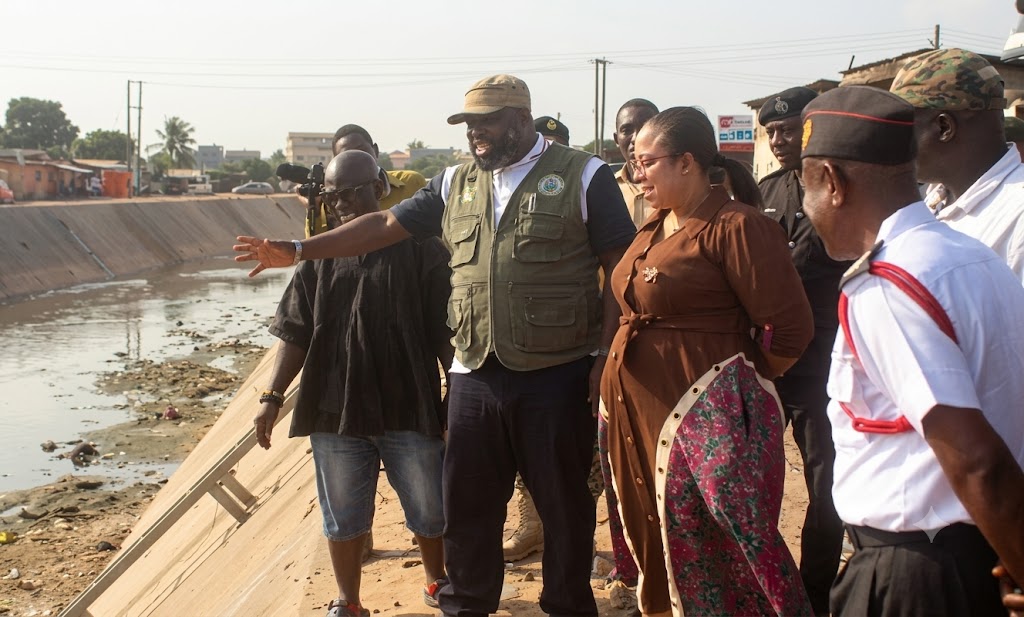
The Greater Accra Regional Coordinating Council has announced plans to strictly enforce a mandatory 50-metre buffer zone along major water bodies across the capital.
Under the directive, unauthorized structures constructed within designated drainage and waterway buffers will be demolished as part of renewed efforts to address Accra’s persistent flooding problem.
The intervention follows recent floods that submerged homes, damaged property and displaced thousands of residents in parts of the Greater Accra Region.
The demolition exercise will initially focus on the Ayawaso Central Municipality, La Dade-Kotopon Municipality and areas under the Accra Metropolitan Assembly.
Operations are expected to begin immediately under the supervision of the regional coordinating council, with officials monitoring the exercise to ensure compliance with planning and environmental regulations.
Greater Accra Regional Minister Linda Ocloo announced the action during an inspection of heavily congested drainage channels, including the Korle Lagoon, Gallaway and Agbogbloshie.
She explained that engineering projects and periodic desilting alone would not resolve the city’s flooding challenges if structures continued to obstruct waterways and residents persisted in dumping waste into drains.
The AMA Head of Waste Management, Solomon Noi, said specialized amphibious excavators were required to remove silt and waste from major storm drains.
However, he noted that unauthorized buildings erected close to the channels were preventing the machinery from reaching several critical locations and operating safely.
Information from the Greater Accra Resilient and Integrated Development project reportedly indicates that more than 10,497 illegal structures have encroached on drainage buffers across the capital.
These developments have reduced the capacity of waterways to carry stormwater and eliminated natural overflow areas, increasing the risk of flooding during heavy rainfall.
The coordinating council has advised affected property owners to remove their structures voluntarily before enforcement teams arrive.
Owners who refuse to comply will have their properties forcibly removed and could be surcharged for the equipment, fuel and labor used in carrying out the demolition.
The regional minister also called on developers to comply with spatial planning laws and avoid building within protected waterways, drainage reservations and wetlands.
Residents were urged to stop disposing of solid waste, scrap metals and other materials in open drains. Officials warned that the practice obstructs water flow and undermines government investments in drainage construction and desilting.
GARCC said sustainable flood prevention would require firm enforcement, responsible development and active cooperation from residents, traditional authorities and local assemblies.
Source: Omanghana