Omanghana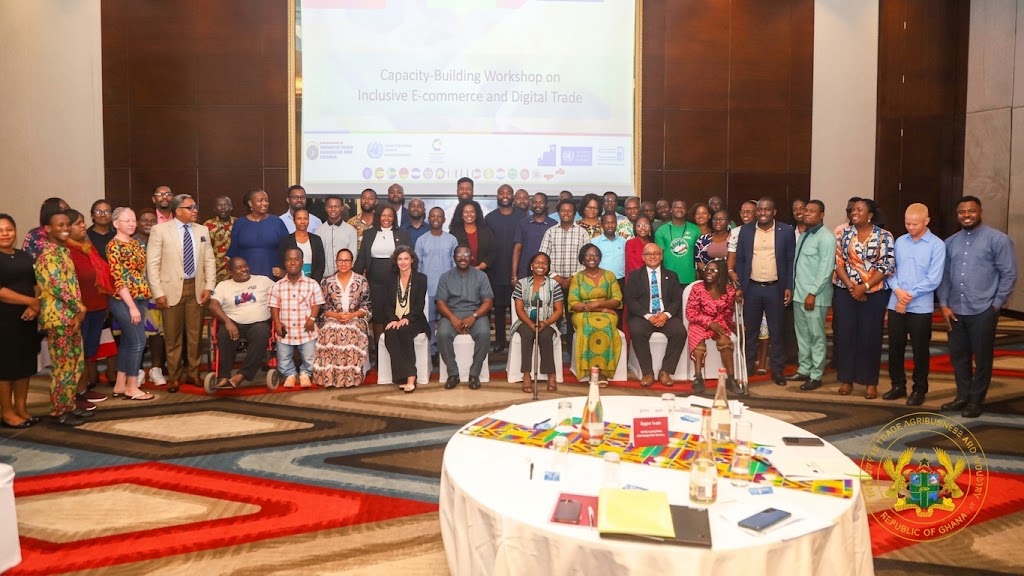
Ghana has reiterated its commitment to developing an inclusive digital economy that allows every citizen to participate in and benefit from the growth of e-commerce.
The government says particular attention will be given to persons with disabilities, women entrepreneurs, rural businesses, young traders and other groups that face barriers to accessing digital markets.
The Minister for Trade, Agribusiness and Industry, Elizabeth Ofosu-Adjare, outlined the commitment in a speech delivered on her behalf during a capacity-building workshop on Inclusive E-Commerce and Digital Trade in Accra.
Ofosu-Adjare said Ghana’s digital transformation must not benefit only people living in urban areas or those with advanced digital skills, reliable internet connections and access to expensive devices.
She stressed the need for deliberate policies and support systems that enable marginalized groups, informal businesses and small-scale operators to participate meaningfully in the digital economy.
According to the Minister, digital inclusion requires more than introducing new technologies. It also involves addressing inequalities in connectivity, affordability, skills, infrastructure and access to financial services.
She indicated that removing these barriers would allow more Ghanaians to use digital tools to reach customers, receive payments and expand their businesses beyond their immediate communities.
Ofosu-Adjare also provided an update on Ghana’s National E-Commerce Strategy, which the government has been developing over the past two years.
The strategy is being prepared in partnership with the United Nations Conference on Trade and Development, the Office of the United Nations Resident Coordinator, the United Nations Development Program and the United Nations Capital Development Fund.
The initiative is supported under the Joint Sustainable Development Goals Fund and is intended to provide a coordinated framework for Ghana’s digital commerce sector.
The strategy is expected to address major issues affecting the growth of e-commerce, including digital infrastructure, online payments, consumer protection, logistics, cybersecurity, taxation and digital skills.
The Minister noted that e-commerce has moved beyond being an alternative method of doing business and has become a central part of modern commercial activity.
She said micro, small and medium-sized enterprises increasingly rely on digital platforms to advertise products, engage customers, process transactions and expand their operations.
Local artisans, farmers and traders are also using online marketplaces and social media platforms to reach consumers outside their traditional locations.
For rural enterprises and smaller businesses, digital commerce can provide a route to new markets without the high costs associated with establishing physical outlets in multiple locations.
The Minister said these opportunities make it necessary for the government and its development partners to ensure that Ghana’s digital trade ecosystem remains accessible, secure and affordable.
Speaking at the workshop, Martine Julsaint Kidane of UN Trade and Development supported the Minister’s call for a more inclusive approach to digitalization.
She noted that the adoption of digital technologies across Africa is improving market access, encouraging innovation and creating employment opportunities.
Digital platforms are also helping small-scale producers connect directly with regional and international buyers, allowing them to participate more effectively in regional and global value chains.
The Accra workshop provided a platform for stakeholders to examine the challenges preventing vulnerable groups and smaller enterprises from benefiting fully from e-commerce.
Discussions also focused on practical measures to improve digital skills, access to technology, online safety and the participation of underserved communities in Ghana’s expanding digital economy.
Source: Omanghana