Omanghana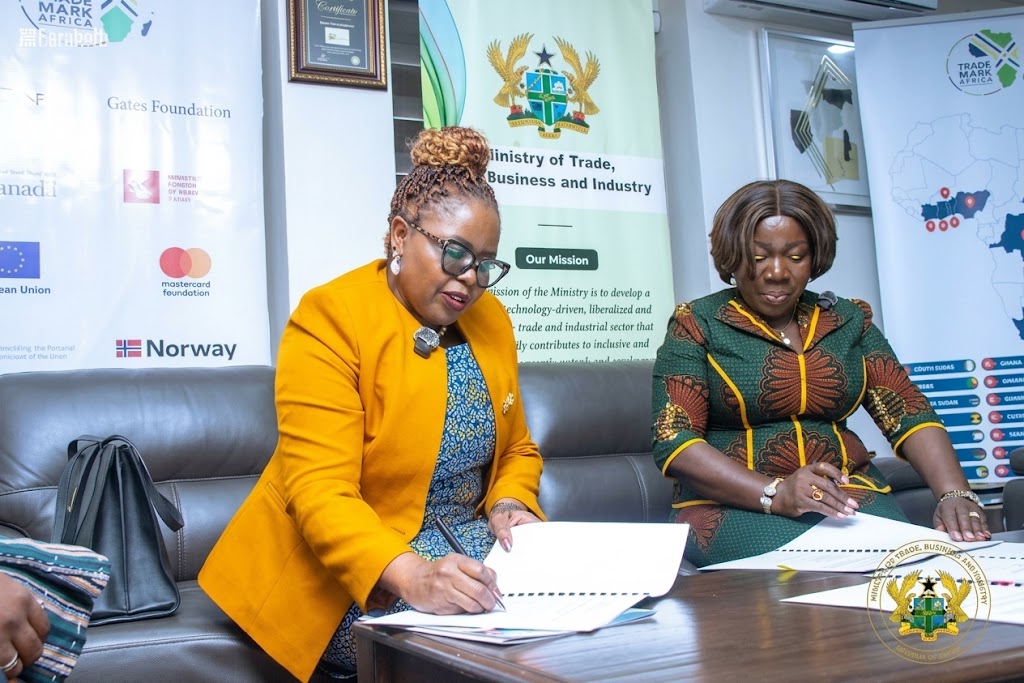
Ghana’s Ministry of Trade, Agribusiness and Industry has renewed its partnership with Trademark Africa through a Memorandum of Understanding aimed at improving trade facilitation, expanding exports and supporting sustainable economic development.
The agreement was signed by the Minister for Trade, Agribusiness and Industry, Elizabeth Ofosu-Adjare, and Trademark Africa’s Deputy Chief Executive Officer, Allen Sophia Asiimwe.
The renewed cooperation builds on a partnership established in January 2023 under Ghana’s National African Continental Free Trade Area Policy Framework and Action Plan.
Under the new agreement, the two institutions will collaborate on initiatives designed to reduce barriers to trade, improve cross-border transportation and strengthen the competitiveness of Ghanaian products in regional and international markets.
A major focus of the partnership will be supporting Ghana’s implementation of obligations under the World Trade Organization’s Trade Facilitation Agreement, the African Continental Free Trade Area and trade protocols adopted by the Economic Community of West African States.
The framework is expected to help Ghana harmonies its trade procedures with regional and international requirements while creating a more predictable environment for businesses, exporters and investors.
The partnership will also support the modernization of cross-border trade corridors through improvements in digital infrastructure, customs administration, border management and logistics systems.
Particular attention will be given to the Abidjan–Lagos Corridor, one of West Africa’s most important commercial routes. The planned interventions are intended to reduce cargo transit times, lower transportation costs and ease congestion at major border points along the corridor.
Improving the quality and international competitiveness of Ghanaian goods is another priority under the agreement.
The Ministry and Trademark Africa will work to strengthen product standards, certification processes and quality assurance systems, especially within the agribusiness and light manufacturing sectors.
These measures are expected to help Ghanaian producers meet the regulatory and quality requirements of regional and global markets, allowing more locally manufactured goods to enter competitive export value chains.
The agreement also places strong emphasis on improving opportunities for small and medium-sized enterprises, women and young entrepreneurs.
Targeted programs will be introduced to expand access to markets, trade finance and information for groups that often face difficulties participating in formal cross-border trade.
The initiative is expected to help more Ghanaian businesses take advantage of opportunities available under the AfCFTA by connecting them to regional and continental supply chains.
Support will also be provided to exporters as international markets introduce stricter sustainability and environmental requirements.
Through the green trade component of the partnership, Ghanaian businesses will receive assistance to adopt environmentally responsible production methods and comply with emerging global sustainability standards.
Speaking about the impact of the collaboration, Elizabeth Ofosu-Adjare highlighted progress recorded at the Akanu–Noepe Joint Border Post between Ghana and Togo.
The facility has benefited from integrated digital customs systems, improved physical infrastructure and solar-powered solutions. These interventions have supported round-the-clock clearance services while helping to reduce delays and congestion at the border.
The partnership has also delivered training to more than 1,250 women and small-scale cross-border traders.
Participants received guidance on simplified AfCFTA trade procedures, regulatory compliance and safer methods of conducting business across borders.
The renewed agreement is expected to deepen these interventions while helping Ghana strengthen its position as a regional trade hub and maximize the economic opportunities presented by continental integration.
Source: Omanghana