Omanghana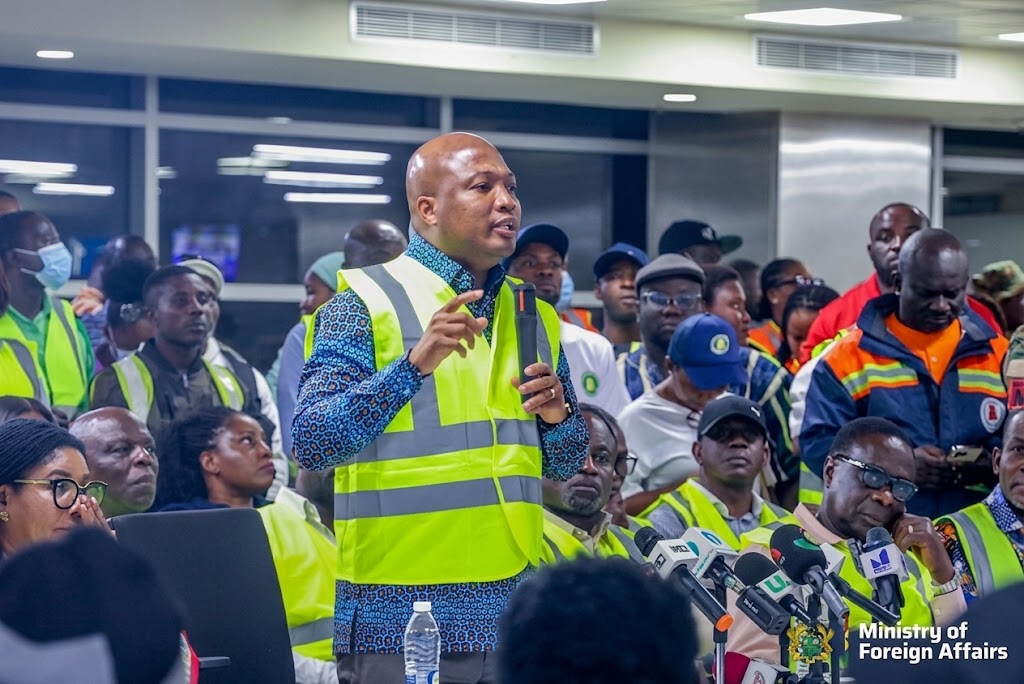
The Government of Ghana has secured approximately 200 employment opportunities for citizens returning from South Africa under a structured national evacuation and reintegration programme.
Minister for Foreign Affairs Samuel Okudzeto Ablakwa announced the initiative during a press briefing on Monday, July 27, 2026. He said the employment arrangements were created through partnerships with Ghanaian businesses and other private-sector organisations.
The programme is intended to help returnees rebuild their lives immediately after arriving in Ghana following renewed anti-migrant protests and reported xenophobic attacks in South Africa.
According to the minister, the intervention goes beyond transporting stranded citizens home. It also provides financial assistance, employment opportunities and short-term resettlement support to help returnees reintegrate into their communities.
Engineers & Planners Employs 100 Returnees
Engineers & Planners, owned by Ghanaian businessman Ibrahim Mahama, is leading the private-sector employment initiative after agreeing to absorb 100 returnees into its workforce.
The commitment represents half of the approximately 200 job opportunities secured under the programme.
Telecommunications companies AT Ghana and Telecel have also pledged to provide designated employment slots for qualified returnees. The exact number of positions offered by each company was not immediately disclosed.
Government officials are expected to match applicants with available jobs based on their qualifications, professional experience and practical skills.
The partnerships could provide opportunities in engineering, construction, telecommunications, administration and other operational areas, depending on the requirements of the participating companies.
Each Returnee to Receive GH¢5,500
In addition to employment support, the government has announced a GH¢5,500 financial package for every evacuee.
The money is intended to cover transportation from the airport, temporary resettlement expenses and the purchase of basic household items.
Many of those returning may have left South Africa at short notice, making it difficult for them to sell their property, recover wages or transport personal belongings. The cash assistance is therefore expected to provide immediate relief while they reconnect with relatives and search for stable accommodation.
The government has not yet provided full details about the payment process or whether the packages will be distributed immediately upon arrival.
Ablakwa Defends State Support
Responding to criticism over the rapid mobilisation of public resources for the returnees, Ablakwa said the affected citizens should not be treated as destitute people or refugees in their own country.
He described them as “royals of this nation” who deserve to return home with dignity and receive the basic support needed to begin again.
The minister argued that the state has a responsibility to protect Ghanaian citizens abroad and assist them when violence or other emergencies force them to return.
He maintained that evacuation without a reintegration plan could leave returnees unemployed, homeless and vulnerable, creating additional social and economic difficulties.
Renewed Xenophobic Tensions Trigger Evacuation
The repatriation programme was introduced in response to renewed anti-migrant demonstrations and reported xenophobic attacks targeting African foreign nationals in South Africa.
The unrest created fear among migrant communities, including Ghanaians working and living in different parts of the country. Some reportedly lost jobs or businesses, while others requested assistance to return home because of concerns for their safety.
Ghanaian authorities subsequently began tracking citizens seeking voluntary evacuation and coordinating their movement to designated departure points.
The operation remains voluntary, with citizens who wish to stay in South Africa permitted to do so.
First Phase Returned 926 Ghanaians
Between May and June 2026, emergency flights brought 926 Ghanaian nationals home during the first phase of the exercise.
The returnees were received and processed by government agencies before being assisted to travel to their respective communities.
Officials collected information about their identities, places of residence, skills and immediate needs. That profiling process is expected to support the allocation of jobs and other reintegration assistance.
The latest operation represents the final phase of the voluntary evacuation programme. An additional 1,000 Ghanaians are expected to return in controlled batches through the Accra International Airport.
Staggering the arrivals is intended to help authorities manage immigration processing, transportation, accommodation and the distribution of support packages.
Reintegration Remains the Major Challenge
While the evacuation addresses the immediate safety concerns facing citizens in South Africa, their long-term reintegration will depend on access to sustainable employment, housing and social support.
The approximately 200 jobs secured so far will cover only a portion of the total number of returnees. This means additional opportunities may be required to support those who do not receive immediate placement.
Some returnees may also possess specialised skills or business experience that could be redirected into entrepreneurship. Government agencies could therefore consider vocational programmes, business-development assistance and access to credit as complementary measures.
Transparent criteria will be essential to ensure that employment opportunities and financial packages are distributed fairly.
Government Appeals for More Private-Sector Support
The participation of Engineers & Planners, AT Ghana and Telecel demonstrates the potential role of private businesses in supporting the reintegration effort.
Other employers may be encouraged to provide jobs, apprenticeships or training opportunities for returning citizens.
The government’s approach reflects an attempt to move beyond emergency evacuation toward a broader recovery programme that allows returnees to rebuild their livelihoods.
With nearly 2,000 citizens expected to have returned by the end of the final phase, attention will now focus on how quickly the promised jobs and financial packages are delivered.
The success of the initiative will ultimately depend on whether the returnees receive sustained assistance after leaving the airport and are able to establish stable lives in Ghana.
Source: Omanghana