Omanghana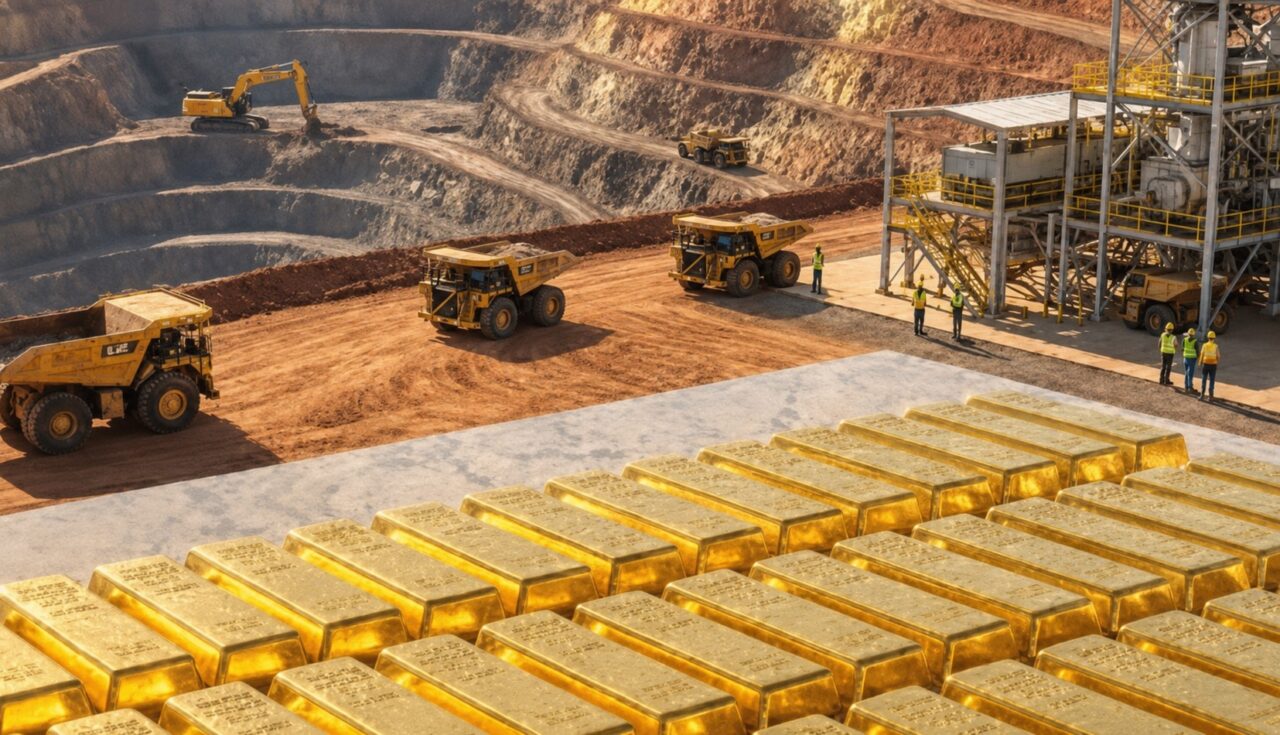
Gold Fields has intensified efforts to secure a new mining lease for its Tarkwa gold operation as the company’s existing rights approach their April 2027 expiration date.
The South African mining group is relying heavily on Tarkwa’s economic contribution to Ghana, particularly its claim that approximately 74% of the value generated by the mine remains within the country through local procurement, employee compensation, taxes and community investments.
Gold Fields Chief Executive Officer Mike Fraser and other senior executives have stepped up engagement with the Minerals Commission, traditional authorities and key stakeholders as the government considers the future ownership and management structure of one of Ghana’s largest gold mines.
The negotiations are unfolding amid a broader government campaign to increase Ghanaian participation in the mining industry, strengthen technology transfer and ensure that mineral wealth delivers greater benefits to local communities.
Gold Fields Seeks 20-Year Extension
Gold Fields submitted its application for the renewal of the Tarkwa mining leases in November 2025, well ahead of the April 2027 expiration date.
The company is seeking a 20-year extension that would allow it to continue operating the mine while making further long-term investments in production, technology and infrastructure.
As part of its application, Gold Fields has presented the Minerals Commission with a comprehensive operational and capital investment plan covering the proposed renewal period.
The plan is expected to outline future production targets, mine development, equipment upgrades, environmental management, employment, local procurement and community-development commitments.
The company believes the proposal demonstrates its willingness to remain a long-term partner in Ghana’s mining industry. Government authorities, however, have signaled that the application will be subjected to close scrutiny and will not receive automatic approval.
Tarkwa Accounts for Major Share of Gold Fields’ Output
The Tarkwa mine is a crucial part of Gold Fields’ global portfolio, accounting for approximately 20% of the company’s total gold production.
The operation produced about 475,000 ounces of gold in 2025, reinforcing its position as one of the group’s most valuable assets and a major contributor to Ghana’s mining economy.
Losing operational control of Tarkwa would therefore have significant consequences for Gold Fields’ production profile, revenue and long-term strategy.
For Ghana, the decision carries equally important implications because the mine supports employment, local businesses, state revenue and economic activity in surrounding communities.
Company Highlights 74% Local Value Retention
Gold Fields has made its local economic contribution a central part of the campaign for renewal.
According to the company, about 74% of the value generated at Tarkwa remains in Ghana. This includes payments to Ghanaian suppliers, salaries and benefits for employees, government revenue and spending on infrastructure and community programms.
The figure is being presented as evidence that the mine already maintains substantial connections to the domestic economy and provides benefits beyond the direct extraction and export of gold.
Gold Fields is also expected to emphasize its support for local businesses, skills development, workforce training and social investment as negotiations continue.
The government is likely to demand stronger and enforceable commitments, particularly in areas such as Ghanaian ownership, senior management participation, technology transfer and the procurement of locally manufactured goods.
Government Says Renewal Will Not Be Automatic
Ghanaian authorities have made it clear that the Tarkwa lease renewal process will not be treated as business as usual.
The government is seeking to renegotiate the country’s relationship with multinational mining companies to ensure that natural-resource extraction produces greater long-term benefits for Ghanaians.
Under this approach, foreign mining companies may be required to demonstrate more substantial contributions to local industrial development, technology transfer and ownership participation before receiving new or extended leases.
Gold Fields must therefore prove that its proposed 20-year plan aligns with Ghana’s changing mining policy and broader economic priorities.
The decision is expected to consider not only Tarkwa’s current performance but also the company’s future commitments on employment, environmental rehabilitation, community development and domestic value addition.
Damang Handover Raises Stakes
The negotiations are being closely watched because of the government’s earlier decision regarding Gold Fields’ Damang mine.
In April 2026, Gold Fields was required to hand the mature operation back to the state after its lease-renewal application was unsuccessful. The government subsequently began arrangements to transfer operational responsibility to Ghanaian interests, including local mining contractor Engineers & Planners.
The Damang decision demonstrated that the government is prepared to reject renewal requests when it believes a different ownership or operational structure would better serve the national interest.
It also raised concerns within Gold Fields that Tarkwa could face a similar outcome if negotiations fail.
Some local advocacy groups have called for Tarkwa to be brought under greater Ghanaian control. Supporters of this position argue that locally controlled companies should play a larger role in managing the country’s strategic mineral assets.
Gold Fields, on the other hand, is seeking to demonstrate that continued operation under its management would protect production, employment and investor confidence while generating substantial local economic value.
Proposed Mining Law Adds Uncertainty
The negotiations are also taking place as Ghana works to overhaul its mining legislation.
Under provisions reportedly contained in the proposed reforms, the maximum duration for renewed mining leases could be reduced to 10 years, compared with the longer periods previously available.
If adopted in its current form, the proposed limit could conflict with Gold Fields’ request for a 20-year extension and require the company to revise its long-term investment plans.
The draft framework could also eliminate stability agreements that have historically protected some foreign mining companies from unexpected changes in taxes, royalties and other fiscal obligations.
Supporters of the reforms argue that such agreements restrict the government’s ability to respond to changing economic conditions and ensure that Ghana receives a fair share of rising mineral revenues.
Mining companies, however, may view the removal of fiscal protections as an added investment risk, particularly for projects requiring large amounts of capital over several decades.
Employment and Local Businesses at Stake
The outcome of the Tarkwa negotiations will affect more than Gold Fields and the government.
Thousands of employees, contractors and local suppliers depend directly or indirectly on the mine. Businesses providing transportation, engineering, catering, construction, maintenance and other services could be affected by any major change in ownership or management.
Traditional leaders and communities near the operation will also be watching for guarantees concerning employment, compensation, environmental protection and development projects.
While a transition to Ghanaian operators could advance local-ownership objectives, it would require careful planning to avoid disruptions to production, jobs and supplier contracts.
Decision Could Reshape Ghana’s Mining Industry
The Tarkwa lease renewal is emerging as an important test of Ghana’s new approach to mineral-resource management.
Approval of the 20-year application would allow Gold Fields to maintain control of one of its most important operations, although the renewal could come with tougher conditions on localization and investment.
A shorter extension, revised partnership arrangement or transfer to Ghanaian operators would signal a major shift in the government’s relationship with multinational mining companies.
For Gold Fields, the campaign now depends on persuading regulators that its local value retention, investment proposal and operational experience make it the strongest long-term partner for Tarkwa.
For Ghana, the challenge will be to secure greater national benefits from the mine while protecting production, jobs, community interests and confidence in the country’s mining sector.
Source: Omanghana