Omanghana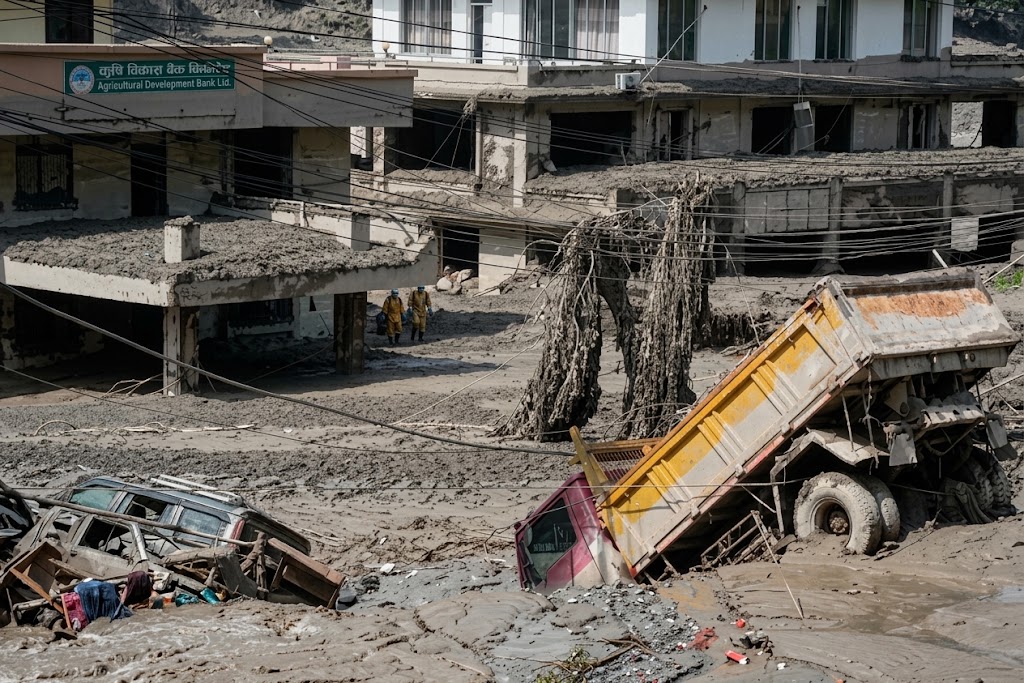
A massive glacier collapse in the Himalayas has unleashed devastating flash floods and mudslides across Nepal, killing hundreds of people, leaving nearly 2,000 missing and wiping out entire settlements.
The disaster struck on Wednesday, August 26, 2026, sending a powerful mixture of water, ice, rocks and mud through the Bhote Koshi River corridor in Rasuwa district before surging into downstream river systems.
Timure, Syabrubesi and several settlements around the Nepal-Tibet border were among the worst affected. Homes, roads, bridges and hydropower facilities were destroyed as the fast-moving flood swept through communities with little warning.
Glacier Collapse Unleashes Wall of Debris
Preliminary assessments indicate that a large mass of ice and rock detached high in the Himalayan border region. The force of the collapse was powerful enough to register on seismic monitoring equipment, initially leading some residents to believe an earthquake had occurred.
The falling material displaced enormous volumes of water and debris, creating a dark surge that travelled rapidly through the narrow mountain valleys.
Witnesses described hearing a thunderous noise before seeing black water, rocks and mud rushing towards their communities. Within minutes, buildings were swept away and entire neighborhoods disappeared beneath thick deposits of debris.
Authorities and scientists are continuing to assess the precise chain of events, including whether the collapse created or breached temporary lakes upstream.
Hundreds Dead and Nearly 2,000 Missing in Nepal
At least 579 deaths had been confirmed in Nepal by August 28, while 1,924 people remained unaccounted for, according to figures reported by authorities. Additional deaths and disappearances were recorded across the border in Tibet, bringing the wider toll to nearly 600 dead and approximately 2,500 missing.
The casualty figures could rise as rescue teams reach previously inaccessible areas and search through destroyed buildings, riverbanks and deep layers of mud.
Among the missing are residents, hydropower workers, traders, pilgrims and foreign tourists who were travelling through the mountainous border region when the disaster occurred.
Timure and Hydropower Facilities Devastated
Timure, a major trading settlement near the Nepal-Tibet border, suffered extensive destruction. Survivors said houses, shops, government offices and other buildings were swept away in rapid succession.
Several hydropower projects along the river corridor were also damaged or destroyed. Floodwater and mud entered tunnels where employees had sought safety or become trapped while working.
Nepalese soldiers rescued groups of people from some of the affected tunnels, but mud and damaged access routes continued to obstruct efforts to locate other workers.
Roads, bridges, electricity systems and communications infrastructure were also washed away, isolating communities throughout the disaster zone.
Survivors Describe Narrow Escapes
Many residents survived by running uphill only seconds before the flood reached their homes.
One survivor from Timure recalled feeling the ground shake before seeing police officers and residents flee towards higher ground. From a forest above the town, he watched buildings being carried away by the flood.
Others spent the night on hillsides without adequate food or shelter before helicopters could reach them. Some survived on emergency food packages dropped by the Nepal Army.
Displaced families returning to their communities have found little remaining beyond mud, sand and scattered debris. Multi-storey homes, businesses, farmland and personal belongings were lost within minutes.
Helicopters Lead Rescue Operations
The steep terrain and widespread destruction of roads have made many of the worst-affected communities accessible only by air.
Military helicopters are being used to evacuate injured residents, rescue stranded survivors and deliver food, drinking water and medical supplies. Thousands of people have been moved to safety, while Nepal has deployed military personnel, emergency workers and drones to support search operations.
Rescue teams face continuing risks from unstable slopes, blocked rivers and newly formed lakes. Operations were temporarily suspended in some areas after rising water levels raised fears of another sudden flood.
Authorities have urged people living near riverbanks to relocate to higher ground as monitoring continues.
More Than 90,000 People Need Urgent Assistance
The International Federation of Red Cross and Red Crescent Societies estimates that more than 90,000 people have been severely affected by the disaster.
Many survivors are sheltering in army camps, temporary relief centers and makeshift accommodation. They face urgent shortages of food, clean drinking water, clothing, medicine and secure shelter.
High-altitude temperatures and damaged sanitation systems have created additional health concerns, particularly for children, older residents and people with injuries or chronic medical conditions.
The Red Cross estimates that at least 93,000 people are in serious need, while UNICEF has identified about 17,000 children requiring urgent humanitarian support.
Threat of Further Flooding Remains
Authorities are closely monitoring lakes formed or enlarged by the glacier collapse. One larger lake reportedly has no clearly visible outlet, raising concerns that increasing water pressure could trigger another destructive surge.
Satellite imagery, cameras and downstream sensors are being used to assess changes in the lakes and issue warnings to communities.
The unfolding disaster highlights the growing vulnerability of Himalayan settlements to glacier instability, landslides and sudden flooding. As search operations continue, thousands of families remain uncertain about the fate of missing relatives while relief agencies race to reach isolated survivors.
Source: Omanghana