Omanghana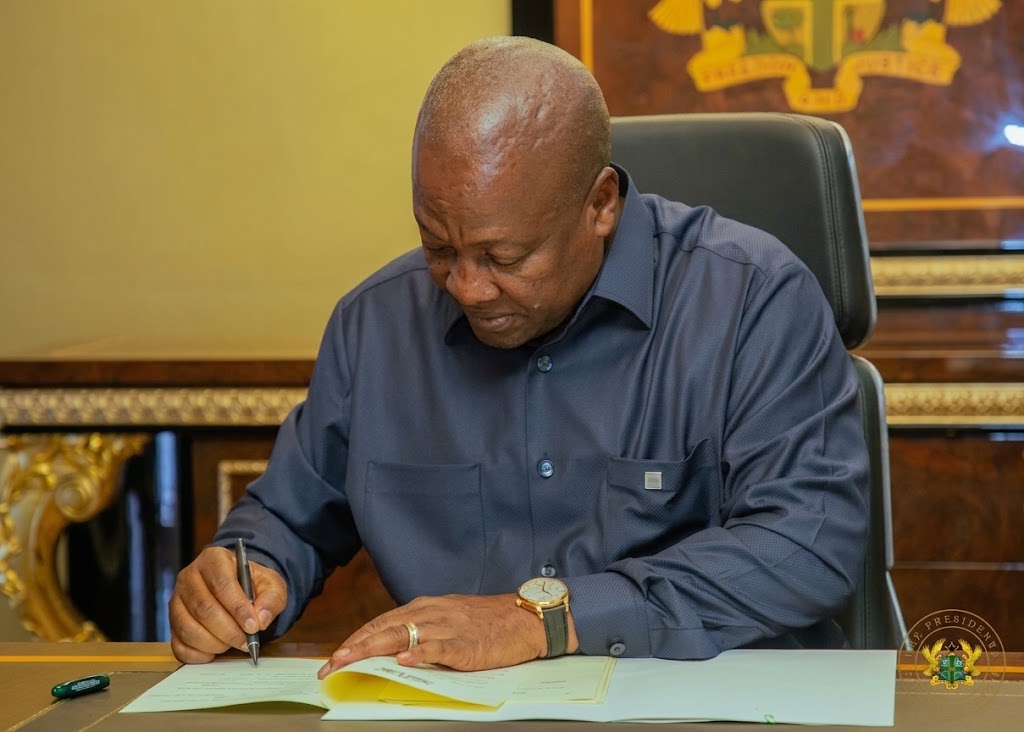
President John Dramani Mahama has assented to the Tribunals Bill, 2026, officially transforming it into the Tribunals Act, 2026, despite sustained opposition from the Minority in Parliament, organized labor and other political actors.
The legislation was signed alongside nine other Acts covering customs administration, taxation, community service, maritime offences, defense education, energy levies, cocoa regulation and revenue mobilization.
According to the Presidency, the Tribunals Act gives effect to constitutional provisions empowering the Chief Justice to establish Regional Tribunals to handle designated categories of offences more efficiently.
Regional and District Tribunals Reintroduced
The legislation creates a two-tier structure consisting of Regional and District Tribunals within Ghana’s judicial system.
The tribunals are expected to exercise jurisdiction over specified offences, including economic fraud, financial loss to the state, illegal mining, tax evasion, customs violations, smuggling and other matters assigned by law.
Government argues that the structure will reduce pressure on the traditional courts and accelerate cases that frequently remain unresolved for several years.
The law also provides for judicial oversight and establishes mechanisms intended to ensure that the tribunals comply with constitutional requirements and accepted legal procedures. Their implementation will involve the Chief Justice and a Tribunal Oversight Committee operating under the Judicial Council.
Panel System Sparks Concern
One of the most contested features is the proposed panel system under which a legally qualified chairperson will sit with non-lawyer panel members.
Opponents argue that allowing people without formal legal training to determine criminal cases could weaken judicial standards and increase the risk of inconsistent decisions.
Supporters maintain that lay participation is constitutionally recognized and could promote public involvement in justice delivery. They also insist that the tribunal chairperson’s legal qualifications and the available appeal processes will provide safeguards against abuse.
Minority Walks Out of Parliament
Parliamentary disagreement centered largely on Clause 4 of the Bill, which provided for establishing the Regional and District Tribunals.
Minority Leader Alexander Afenyo-Markin sought to have the clause removed, arguing that Ghana already had a functioning judicial structure comprising the District, Circuit and High courts, as well as the Court of Appeal and Supreme Court.
He maintained that delays within the existing system should be addressed through increased funding, improved infrastructure, digitization and additional judicial personnel rather than creating another adjudicatory structure.
“What kind of chaos are we introducing?” he asked during the parliamentary debate, insisting that the country’s judicial architecture was “not broken.”
After an initial voice vote, the Minority Leader demanded a headcount. His proposal to delete Clause 4 was subsequently defeated by 135 votes to 16.
The Minority then withdrew from the Bill’s further consideration and walked out of the chamber. Parliament later waived the customary interval between the consideration stage and the third reading before passing the legislation.
Bawumia Asked Mahama to Withhold Assent
Former Vice President Dr. Mahamudu Bawumia also appealed to President Mahama not to sign the Bill immediately.
He called for wider consultations involving the Council of State, Ghana Bar Association, organized labor, civil society organizations and political parties.
Dr. Bawumia argued that the proposed system would not resolve court congestion and noted that constitutional review bodies had previously recommended removing Regional Tribunals from the 1992 Constitution.
He urged the President to allow broader national dialogue before bringing the tribunals into operation. President Mahama’s decision to grant assent means that appeal was not accepted.
TUC Warns Against “Weaponizing Justice”
The Trades Union Congress strongly opposed the legislation during its consideration in Parliament.
TUC Secretary-General Joshua Ansah said Ghana’s past experiences with public tribunals provided sufficient reason to abandon attempts to revive the system.
“The Bill, when passed into law, can be a potent tool for weaponizing justice delivery and entrench the perception held by many that our justice system is up for grabs by politicians,” he warned.
The union also cited recommendations from the Constitution Review Committee chaired by Professor H. Kwasi Prempeh. According to the TUC, the committee proposed removing Regional Tribunals from the Constitution because the High Court had effectively assumed their workload.
The TUC called for the full committee report and the government’s official position on its recommendations to be published before any attempt to activate the tribunal system.
Government Defends Constitutional Basis
The Mahama administration has rejected suggestions that the new tribunals will operate as a parallel or politically controlled justice system.
Government officials maintain that Regional Tribunals are expressly recognized under Articles 126 and 142 of the 1992 Constitution and will function within the established judiciary rather than outside it.
They have also sought to distinguish the new framework from the public tribunals associated with the Provisional National Defense Council era, which were widely criticized over political interference and human rights concerns.
The administration says the Act is intended to strengthen accountability, accelerate corruption and financial-crime trials and ensure that serious cases do not remain in the courts indefinitely.
Although the law may support the prosecution of cases arising from anti-corruption investigations, including matters associated with Operation Recover All Loot, its jurisdiction extends beyond any single government initiative.
The Presidency said the Tribunals Act is part of a broader package intended to modernize justice delivery, improve public administration and strengthen economic governance.
With presidential assent secured, attention will now turn to how the tribunals are constituted, the categories of cases assigned to them and whether the promised safeguards will prevent political interference while protecting the rights of accused persons.
Source: Omanghana