Josiah
The development of traditional communities in Ghana is often discussed as though it were entirely the responsibility of central government or district assemblies. Yet, across the country, some of the most consequential local interventions have emerged where traditional leadership has chosen to play an active convening role, bringing together public institutions, private capital, professional networks and community interests around a clearly defined development agenda.
Kona, in the Sekyere South District of the Ashanti Region, is beginning to offer an instructive example.
Under the leadership of Nana Konadu Yiadom Kumanin IV, Obrɛmpɔn and Konahene under Otumfuo Osei Tutu II, the Kona Traditional Council has in recent months pursued a series of interventions aimed at strengthening security, local governance, mobility, education, investment attraction and broader economic opportunity.
The significance of this effort lies not merely in the individual projects themselves, but in the emerging philosophy behind them.
Traditional authority, in this case, is being used not only to preserve custom and adjudicate local matters, but also to help build an enabling environment for development.
That is a model worth examining.
One of the most visible outcomes is the newly constructed Kona Police Station. The facility has been completed and, according to the Traditional Council, steps have been taken with the Ghana Police Service to make it operational even before its formal and public commissioning.
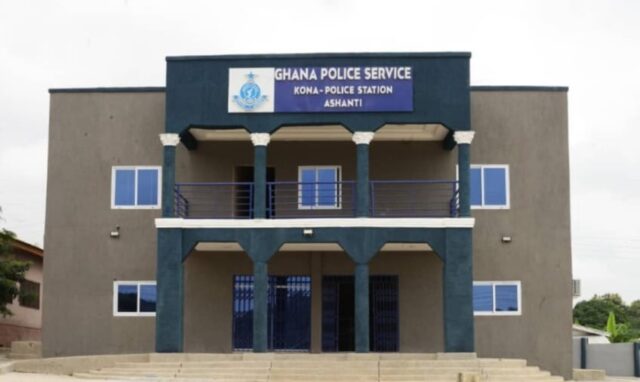
This is a practical intervention with implications beyond policing.
Security remains one of the basic conditions for local economic growth. Businesses are more likely to invest where assets, workers and customers are protected. Financial institutions, educational establishments and service providers similarly require a reasonable level of public safety before expanding their presence in any community.
The value of the police station should therefore be considered not only in terms of law enforcement, but also as part of the broader infrastructure that supports confidence and investment.
The Traditional Council has also sought to strengthen its own administrative capacity.
Before travelling to the United States as part of the Asanteman delegation accompanying Otumfuo Osei Tutu II for the Akwasidae Kesie celebrations in Maryland, the Konahene provided a branded vehicle and driver to support the work of the Kona Traditional Council.
At the most recent Awukudae before his departure, he also presented a new Hyundai Elantra to the Konahemaa, Nana Amponsah Agyemang III.

Such gestures may easily be reduced to ceremony, but that would miss their institutional significance.
Within Asante traditional governance, the Queenmother is not a symbolic appendage to the chief. The Ohemaa has important responsibilities relating to customary governance, succession, counsel, family welfare and the representation of women within the traditional structure.
Resourcing that office is therefore defensible as an investment in institutional functionality.
If traditional councils are expected to support mediation, social mobilisation, development advocacy and community welfare, then the offices through which those responsibilities are exercised must themselves have the means to function effectively.
Kona’s broader ambition became clearer in July with the enstoolment of Dr. Maxwell Ampong as the first Aboafuohene of the Kona Traditional Council, under the stool name Nana Kwadwo Marfo Ampong I. By assigning specific responsibility for building relationships with businesses, investors, financial institutions, professionals, development organisations and the diaspora, the Traditional Council has effectively institutionalised part of its development and investment-mobilisation agenda.
That is a useful departure from the often ad hoc approach to community development, where chiefs and local leaders depend primarily on personal relationships or occasional appeals for assistance.
For Kona, the challenge now is to ensure that the Kona Traditional Council develops beyond symbolism into a disciplined platform for project development, investor engagement and measurable outcomes.
The priorities already outlined include the establishment of a public Senior High School, technical and vocational training opportunities, stronger entrepreneurship education, improved financial access and partnerships capable of supporting local enterprise.
There are also plans and proposals around a community-focused financial institution, an events facility, agricultural value-chain partnerships, digital payment systems and stronger linkages between Kona residents and the wider Ghanaian economy.
Some of these remain aspirations rather than completed projects, and they should be treated as such.
Editorial rigour requires a distinction between what has been delivered, what is under active development and what remains on the drawing board. Yet, the existence of a project pipeline is itself important.
Communities that seek investment must move beyond general appeals for development and begin identifying specific, bankable and socially useful opportunities. Investors and development institutions respond more effectively where there is clarity around land, infrastructure, local demand, governance, implementation partners and expected impact.
This is also why the Kona Traditional Council’s interest in improved road connectivity deserves attention.
The Ghana Government’s wider Big Push infrastructure programme is intended to strengthen transport links, reduce travel times and improve access to markets. For communities located along strategic corridors, road investment can have a multiplier effect, including support for trade, agriculture, housing, financial services, education, and new commercial activity.
Kona already benefits from proximity to important road connections within the Mampong-Agona-Kumasi axis. Any further improvement in connectivity could strengthen its attractiveness to businesses and investors.
The task for the traditional leadership is therefore not simply to welcome infrastructure when it arrives, but to ensure that the community is positioned to capture the economic opportunities it creates.
This means planning for enterprise, skills development, land use, agriculture, financial inclusion and local participation.
That is where Kona’s current direction becomes particularly relevant.
Development finance institutions often speak of “crowding in” private investment by first creating the conditions that reduce risk. Those conditions include roads, security, reliable institutions, skilled labour, predictable local governance and clear channels for stakeholder engagement.
Traditional authorities cannot provide all of these on their own. Neither should they attempt to replace district assemblies or central government. But they can play a valuable convening role.
They can mobilise community support, facilitate responsible access to land, resolve local obstacles, maintain social cohesion, connect investors with local stakeholders and provide continuity across political cycles.
At a time when the financing needs of Ghanaian communities far exceed the resources available to government alone, this function should not be underestimated.
The Konahene’s participation in the Akwasidae Kesie celebrations in the United States also presents a wider opportunity. The Ghanaian and African diaspora represents not only remittance flows, but also professional expertise, business networks, technology and investable capital.
If Kona can translate its cultural and traditional relationships into structured economic partnerships, it may be able to mobilise resources far beyond what conventional local development channels can provide.
The real test, however, will remain implementation.
New vehicles, a police station, an investment-oriented traditional office and discussions around roads and education are encouraging indicators. They must now form part of a coherent development framework with timelines, partnerships, accountability and clear outcomes for residents.
For Kona, the opportunity lies in demonstrating that traditional leadership can be both a guardian of heritage and a catalyst for modern development. If the present momentum is sustained with discipline, transparency and an emphasis on measurable community benefit, Kona’s experience could offer useful lessons for traditional areas across the country.
Development is ultimately not measured by announcements, ceremonies or titles. It is measured by whether people become safer, better educated, more employable, more productive and better connected to opportunity.
On that test, Kona has begun to put some important pieces in place.