Omanghana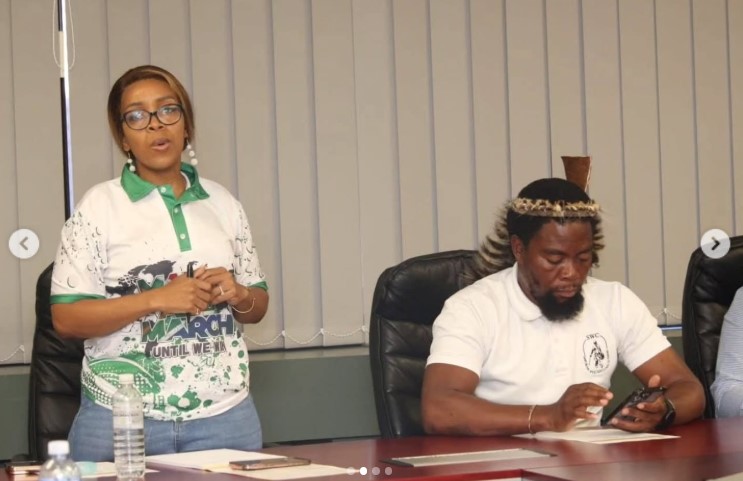
KwaZulu-Natal Premier Thami Ntuli and Provincial Police Commissioner Lieutenant-General Nhlanhla Mkhwanazi have held an urgent closed-door meeting in Durban with leaders of the “March and March” movement, including founder Jacinta Ngobese-Zuma and co-leader Nkosikhona Ndabandaba, also known as “Phakelamthakathi.”
The high-level engagement took place at the Premier’s Office and included senior provincial officials, members of the Executive Council (MECs), and representatives from the Department of Home Affairs. The meeting was convened amid growing public concern over recent anti-immigration demonstrations and rising tensions in parts of KwaZulu-Natal.
During the discussions, provincial authorities reiterated that immigration enforcement is exclusively the responsibility of the state.
Premier Ntuli and Lieutenant-General Mkhwanazi reportedly emphasized that only the South African Police Service and the Department of Home Affairs have the constitutional mandate to enforce immigration laws. Officials warned that any attempt by private individuals or groups to conduct enforcement actions falls outside the legal framework and poses risks to public order.
The meeting was described by officials as a decisive effort to reinforce the rule of law and prevent further escalation linked to street-level mobilization.
Provincial authorities and municipal enforcement teams also addressed concerns raised about alleged hijacked buildings in the Durban central business district, as well as claims regarding irregular business operations involving foreign nationals.
Officials confirmed that such matters would be handled through formal, state-led enforcement operations rather than community-led interventions or independent action groups.
The Metro Police and relevant departments indicated that coordinated crackdowns and compliance operations would be pursued in accordance with established legal procedures.
A significant portion of the meeting focused on the spread of misinformation across social media platforms.
Authorities reportedly confronted movement leaders over viral posts and unverified claims that officials say have contributed to heightened tensions and fears of retaliatory violence.
Government representatives instructed that all stakeholders must avoid sharing or amplifying content that could incite unrest, emphasizing the importance of verified information and responsible communication.
Following the government intervention and recent violent incidents linked to individuals associated with broader unrest—including the reported burning of activist Ngizwe Mchunu’s home—the “March and March” movement has shown signs of internal division.
Co-leader Nkosikhona Ndabandaba publicly distanced the organization from any form of unlawful conduct, stating that the planned June 30 “national shutdown” should be understood as a political accountability action rather than a call for violence or disruption.
He stressed that supporters must remain within the boundaries of the law and rejected any interpretation that the movement endorses riots, looting, or vandalism.
Jacinta Ngobese-Zuma also addressed growing concerns about radical elements operating under the movement’s banner. She stated that she does not support or condone violent actions and warned that the organization could be dissolved if individuals continue to engage in criminal behavior while claiming affiliation with “March and March.”
Her remarks reflect increasing pressure on the movement’s leadership to maintain control over its supporters and distance itself from escalating confrontations on the ground.
Provincial officials have described the meeting as part of a broader effort to stabilize tensions in KwaZulu-Natal and ensure that public demonstrations remain within constitutional limits.
As authorities continue to monitor developments, the focus remains on preventing further unrest, restoring public confidence, and ensuring that all immigration-related concerns are addressed through lawful and institutional channels rather than informal or vigilante action.
Source: Omanghana