Omanghana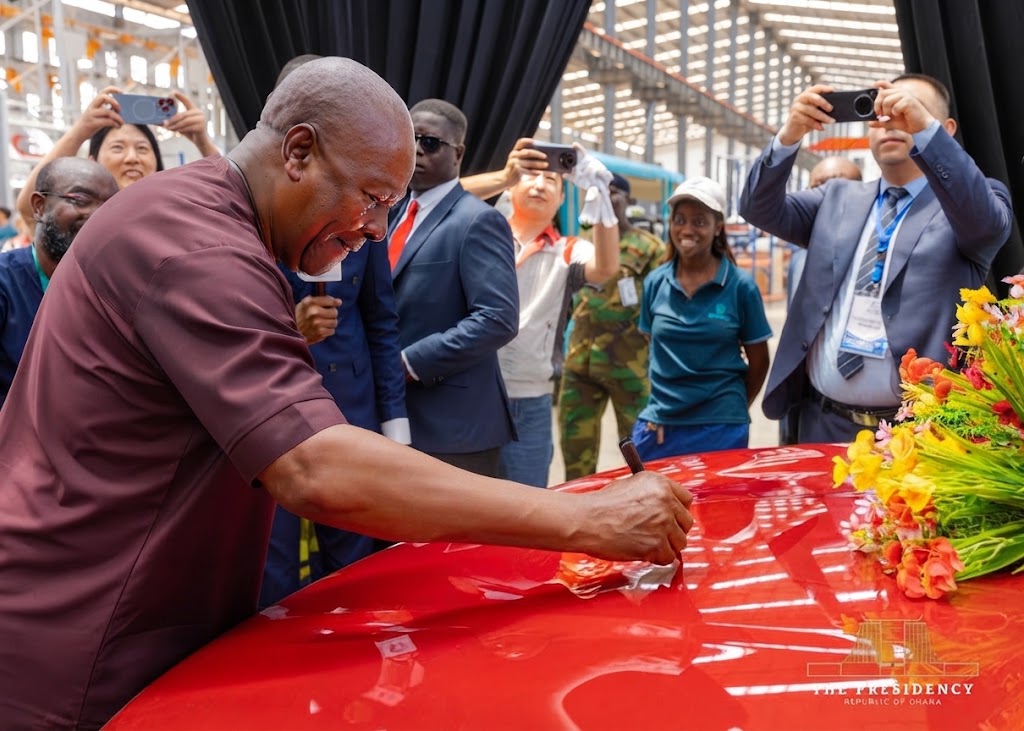
President John Dramani Mahama has commissioned the third phase of the Zonda Tec Ghana automobile assembly plant in Tema, describing the expansion as an important milestone in Ghana’s industrial development.
The new phase increases the company’s annual production capacity to approximately 3,000 heavy and light-duty vehicles.
The plant assembles tipper trucks, cargo trucks, trailers, semi-trailers and tankers, as well as sport utility vehicles, light trucks and smaller passenger cars.
Speaking at the commissioning ceremony on Tuesday, September 15, 2026, Mahama said Ghana could not achieve sustainable prosperity by continuing to import most of the goods it consumes.
He maintained that factories such as the Zonda Tec facility demonstrate growing confidence in the Ghanaian economy and the capabilities of local workers.
“Zonda Tec’s growth is itself a remarkable Ghanaian success story,” the president said, noting that the company had evolved from a vehicle distributor established in 2010 into one of the country’s leading automobile assemblers.
The facility has already created direct employment for more than 800 Ghanaians, with additional jobs expected across transportation, maintenance, spare-parts supply and other supporting industries.
Mahama also commended the company for establishing the Zonda Tech Academy, which provides young Ghanaians with practical technical and vocational training for the automotive sector.
He said such skills-development programs were essential to ensure that Ghanaian workers benefited from technology transfer and could take on more specialized roles within the industry.
The president, however, stressed that vehicle assembly should not be Ghana’s final objective. He called for increased investment in the local production of automotive components to deepen domestic value creation.
He identified batteries, tires, wiring harnesses, seats, glass, plastics and metal parts as products that could be manufactured locally and supplied directly to assembly plants.
According to Mahama, developing a domestic components industry would strengthen supply chains, create opportunities for small and medium-sized businesses and retain more economic value within Ghana.
He also urged Zonda Tec to explore electric vehicle production and take advantage of the country’s strategic minerals and renewable energy potential.
“Our vision is from minerals to batteries, from batteries to vehicles, from vehicles to exports, all proudly made in Ghana,” he stated.
Mahama said the Ministry of Energy and Green Transitions was developing an electric vehicle policy that would include regulations for charging stations. He warned that poorly coordinated charging infrastructure could place excessive pressure on transformers and local electricity networks.
The government also intends to promote solar-powered charging systems as part of efforts to develop a cleaner and more sustainable transport sector.
To expand demand for locally assembled vehicles, the president called for long-term financing schemes that would allow salaried workers to acquire cars through hire-purchase arrangements and pay over time.
He said teachers, nurses, doctors and private-sector employees could purchase locally produced vehicles if banks and manufacturers offered affordable repayment plans linked to regular incomes.
Mahama reiterated the government’s ambition to position Ghana as an automotive manufacturing hub for West Africa by combining local assembly, component manufacturing, skills training, electric mobility and accessible consumer financing.
Source: Omanghana