Omanghana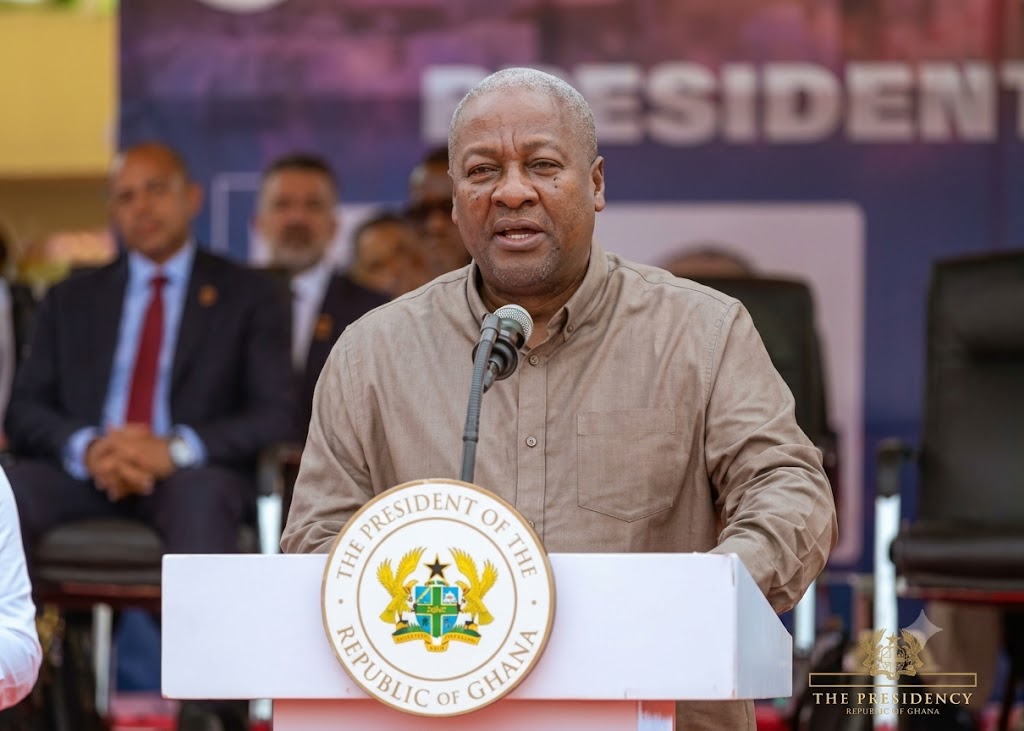
President John Dramani Mahama has commissioned the refurbished Crude Distillation Unit at the Tema Oil Refinery, marking the return of the state-owned facility to full operations after years of limited production and operational difficulties.
The commissioning ceremony, held on Saturday, August 1, 2026, also celebrated TOR’s successful processing of one million barrels of Ghana’s Jubilee Field Medium Sweet crude oil into finished petroleum products.
The milestone supports the government’s strategy of connecting Ghana’s upstream oil production with domestic refining, allowing more value to be created locally before petroleum products reach consumers.
Major Processing Units Restored
The rehabilitation program extended beyond the Crude Distillation Unit, which performs the first major stage of separating crude oil into different petroleum components.
Work completed at the refinery included:
- Installation of a new F-61 crude heater
- Restoration of Boiler Number Eight
- Rehabilitation of the Residual Fluid Catalytic Cracking Unit
- Repairs and upgrades to other supporting infrastructure
Mahama described the projects as more than engineering achievements, saying they demonstrated renewed confidence in Ghana’s industrial capacity.
“Every investment made here strengthens our national resilience. Every improvement in refining capacity reduces our dependence on imported petroleum products,” he said. Ghana News Agency
Revival Completed Without Government Bailout
The President commended Energy and Green Transition Minister John Jinapor, TOR Board Chairman Nayon Bilijo, Managing Director Edmond Kombat and the refinery’s workers for restoring the facility without a direct government bailout.
According to Mahama, the government did not contribute any money towards the operational turnaround.
He said the achievement challenged the perception that struggling state-owned enterprises must be privatised before they can operate efficiently.
The President also confirmed that TOR paid in full for the Jubilee crude it processed. The cargo was not supplied to the refinery on credit.
Since May 2026, TOR has received three separate one-million-barrel crude cargoes Bonga crude, Baleine crude and Ghana’s Jubilee Medium Sweet crude.
TOR Increases Daily Processing Capacity
Before the installation of the new F-61 heater, the refinery was processing approximately 28,000 barrels per stream day.
The new equipment is expected to raise throughput to about 45,000 barrels per stream day, with further improvements potentially taking production towards 60,000 barrels.
At that level, TOR could supply between 45% and 60% of Ghana’s domestic fuel requirements. National consumption is estimated at approximately 100,000 barrels per day.
Mahama has also directed management to develop a longer-term expansion plan capable of increasing the refinery’s capacity to 100,000 barrels per day.
Local Refining Could Reduce Foreign-Exchange Pressure
Ghana spends an estimated $400 million every month importing refined petroleum products. This is equivalent to approximately $4.8 billion annually not $10.2 billion.
Increasing production at TOR could reduce the amount of foreign currency required by fuel importers, ease pressure on the cedi and retain more petroleum-sector revenue within the domestic economy.
Local refining could also create jobs, support associated industries and reduce some of the freight and insurance costs attached to importing finished products from overseas markets.
However, domestic prices would still be influenced by international crude costs, exchange rates, taxes and refinery efficiency.
Return to Nkrumah’s Industrial Vision
Mahama said TOR’s revival represented a continuation of the industrialization agenda of Ghana’s first president, Dr Kwame Nkrumah.
The facility was commissioned in 1963 as the Ghanaian Italian Petroleum Company. Ghana later acquired full ownership in 1977, after which it became the Tema Oil Refinery.
Although the refinery experienced successful production periods, it later accumulated operational, financial and maintenance problems that resulted in repeated shutdowns.
Managing Director Edmond Kombat said the completion of previously outstanding financial accounts covering 2019 to 2025, the processing of indigenous crude and the return to production formed part of a systematic reset of the company.
TOR Revival Complements Sentuo Expansion
The reopening of TOR forms part of a wider effort to expand Ghana’s refining and petroleum-production capacity.
In June 2026, Mahama cut the sod for the second phase of the privately owned Sentuo Oil Refinery in Tema. The expansion is expected to increase its processing capacity from 40,000 to 100,000 barrels per day.
The government has also announced a $3.5 billion upstream investment program. Jubilee partners are expected to invest $2 billion to drill as many as 20 new wells, while OCTP partners will commit another $1.5 billion to field development and exploration.
Together, the TOR revival, Sentuo expansion and planned upstream investment could help Ghana increase oil production, strengthen domestic refining and reduce its long-standing dependence on imported fuel.
Source: Omanghana