Omanghana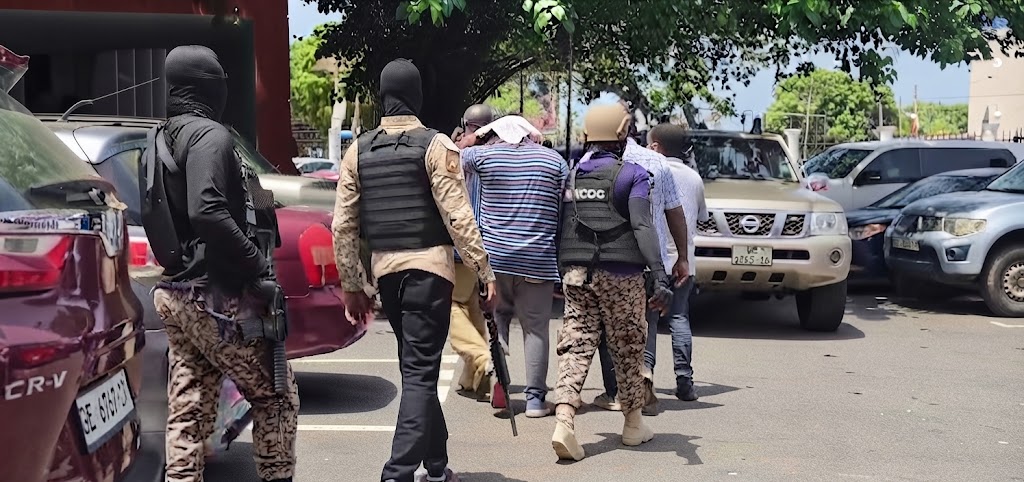
The Narcotics Control Commission has intensified intelligence gathering, passenger profiling and cargo inspections at Kotoka International Airport as criminal networks employ increasingly sophisticated methods to move illegal drugs through Ghana’s main aviation gateway.
Recent operations have resulted in the interception of large quantities of suspected cocaine and cannabis, as well as the arrest and prosecution of Ghanaian and foreign nationals allegedly connected to trafficking attempts.
The cases have involved drugs concealed in passenger luggage, commercial cargo, packaged food and boxes labelled as containing traditional artefacts.
Four Arrested Over 89.74kg Cocaine Shipment
One of the most prominent cases involved the interception of 73 slabs of substances suspected to be cocaine at the Swissport cargo terminal near Kotoka International Airport.
NACOC officers discovered the shipment on April 23, 2025, while inspecting cargo being prepared for transportation to the Netherlands.
The substances, which weighed a combined 89.74 kilograms, were reportedly hidden inside three wooden boxes declared as containing artefacts. A detailed examination revealed the powdered packages, which later tested positive for cocaine.
Four people were arrested in connection with the shipment. They were identified as artefact dealer Gariba Soli and three freight forwarders—Josiah Baidoo, Emmanuel Mintah and Kwabena Ampfo Anti.
The suspects were charged with conspiracy, attempted exportation of a narcotic substance without lawful authority and possession of a narcotic substance without a license.
The charges remain allegations that must be proved by prosecutors before the court.
Suspects Granted GH¢13 Million Bail Each
In May 2025, an Accra court granted each of the four accused persons bail in the amount of GH¢13 million, bringing their combined bail value to GH¢52 million.
Each suspect was required to provide four sureties. They were also ordered to report to NACOC twice every week while the case remained under investigation and prosecution.
The court placed them on a no-fly list and directed that their personal information be submitted to the Passport Office to prevent them from obtaining new travel documents.
Granting bail did not amount to an acquittal or a determination of innocence. It allowed the accused persons to remain outside custody under strict conditions while the case proceeded.
According to the prosecution’s account, Mr Soli told investigators that an individual identified only as Kevin had engaged him to send artefacts to the Netherlands.
He maintained that the boxes delivered to the cargo terminal on April 14 contained only artefacts and that he became aware of the suspected drugs when he was called to attend an inspection on April 23.
Investigators continued working to establish how the substances entered the cargo, the identities of other possible participants and the intended recipients abroad.
Cocaine Found in Packaged Gari
In another intelligence-led operation in February 2026, NACOC arrested a senior manager of a manufacturing company for allegedly attempting to export cocaine concealed in packaged gari.
The suspect, whose identity was not officially disclosed, was intercepted at Kotoka International Airport after officers examined the consignment.
Investigators said they were working to determine whether other individuals or members of a wider trafficking network were connected to the shipment.
The use of gari as a concealment method demonstrated how traffickers may attempt to disguise illegal substances within familiar Ghanaian food products to avoid detection.
British Nationals Arrested With Cannabis
NACOC also arrested two British nationals and two alleged accomplices during separate operations at the airport on May 18, 2025.
Jada Chyna Brown-Frater, then aged 23, was reportedly intercepted while preparing to board British Airways Flight BA 2066 to Gatwick.
A search of her luggage allegedly uncovered 32 slabs of cannabis weighing approximately 17.72 kilograms.
On the same day, officers arrested Christian Williams Owusu, then aged 19, after he arrived in Accra from Dubai aboard Emirates Flight EK 787.
His two suitcases allegedly contained 92 slabs of cannabis with a combined weight of 53.60 kilograms. Further investigations resulted in the arrest of two other individuals suspected of assisting him.
NACOC said all four suspects were detained as investigations continued.
$6.48 Million Cocaine Seized in 2024
An earlier joint operation by NACOC and the United Kingdom’s National Crime Agency produced one of the largest airport seizures reported in recent years.
On June 10, 2024, officers intercepted two British passengers scheduled to travel from Accra to Gatwick.
The suspects, identified as Hall Shamin Ethline and Graham Omar Adel, were travelling with three suitcases each. A search reportedly uncovered 72 slabs of suspected cocaine weighing 166.88 kilograms.
Each passenger allegedly carried approximately 83.44 kilograms. NACOC estimated the street value of the total seizure at about $6.48 million at the time.
The two were arrested and detained to assist with investigations.
KIA Remains a Strategic Security Point
Kotoka International Airport plays a central role in Ghana’s international trade and passenger movement, making it an attractive target for transnational drug-trafficking networks.
Criminal organizations may attempt to exploit passengers, freight-forwarding companies, airline employees, food exporters and legitimate commercial shipments to transport illegal substances.
Effective interdiction therefore requires collaboration among NACOC, the Ghana Airports Company, Customs officials, immigration authorities, airlines, cargo handlers and foreign law-enforcement agencies.
Intelligence sharing is especially important because drug shipments may originate in one country, pass through Ghana and be destined for markets in Europe or elsewhere.
Enforcement Extends Beyond Arrests
Airport seizures are only the first stage of a wider investigation.
Authorities must establish the origin of the drugs, identify financiers and organizers, trace intended recipients and determine whether airport or logistics workers assisted the operation.
Successful prosecutions also depend on preserving exhibits, maintaining the chain of custody and presenting laboratory results and other evidence before the courts.
NACOC has repeatedly assured the public that surveillance, profiling and intelligence-led operations at the airport will continue.
The Commission has also warned travelers against accepting packages or luggage from other people without verifying their contents. Passengers remain legally responsible for items found in their possession, even when they claim to be transporting them on behalf of another person.
Source: Omanghana