Omanghana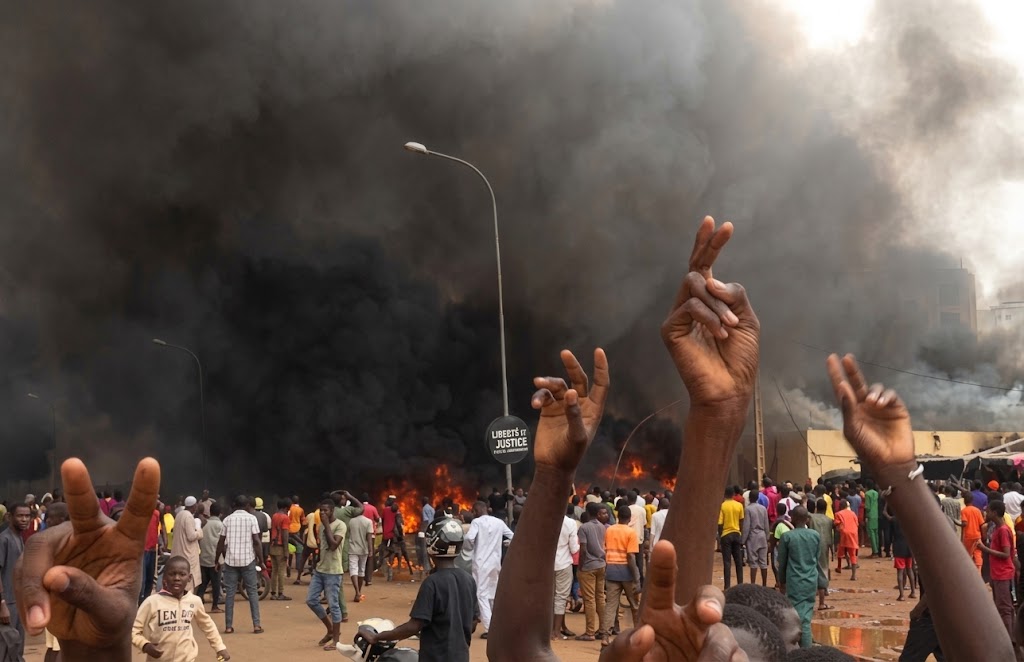
Niger’s military-led government says it has regained control of a strategic airbase following an armed mutiny that triggered hours of heavy fighting across the capital, Niamey.
The uprising, centered on Air Base 101 at Diori Hamani International Airport, represents one of the most serious internal challenges to Gen. Abdourahamane Tchiani’s government since the military seized power in July 2023.
Gunfire and explosions were reported near the airport, the presidential district and other sensitive installations as mutinous soldiers attempted to take control of key military and state facilities.
Mutineers Seize Hostages at Air Base 101
The unrest reportedly began when a group of mainly younger soldiers rebelled against their commanders at Air Base 101, one of Niger’s most strategically important military installations.
Some senior officers were taken hostage as the mutineers attempted to secure the base. Shooting was also reported near the presidential palace and the headquarters of state broadcaster RTN.
Nigerien Defense Minister Gen. Salifou Mody later announced that loyalist forces had gradually restored order after prolonged clashes.
Government forces eventually retook the airbase, while state television broadcast images of soldiers reportedly arrested for participating in the uprising. Several mutineers were also believed to have been killed, although Nigerien authorities had not released a complete casualty figure.
Russian Africa Corps Supports Loyalist Forces
Russia’s Africa Corps played a significant role in helping the government suppress the uprising.
Russian Ambassador to Niger Viktor Voropayev said the command at Air Base 101 formally requested Russian assistance as loyalist forces sought to remove the mutineers.
Russian personnel stationed at the base reportedly provided ground and aerial support to Niger’s elite presidential guard during the operation.
The intervention demonstrates the growing importance of Russian forces to Niger’s military government following the withdrawal of French and American troops from the country.
Niger’s leaders have strengthened defense relations with Moscow since the 2023 coup, presenting Russia as an alternative security partner in the fight against armed groups operating across the Sahel.
Algeria Deploys Military Aircraft to Niamey
Algeria also moved to demonstrate its support for Niger following the attempted uprising.
Reports indicated that four Algerian Su-30 fighter aircraft, an Il-76 military transport plane and an Il-78 aerial refueling aircraft arrived in Niamey. The deployment was described as a strategic show of solidarity and an effort to reinforce Niger’s airspace.
Mali and Burkina Faso, Niger’s partners in the Alliance of Sahel States, condemned the mutiny and reaffirmed their commitment to the bloc’s collective defense arrangements.
The three military-led countries have deepened their political and security cooperation after withdrawing from the Economic Community of West African States.
Battlefield Losses Fuel Military Discontent
Analysts have linked the mutiny to worsening frustration among lower-ranking troops deployed in Niger’s conflict-affected southern and western regions.
Soldiers stationed in those areas have faced repeated attacks from armed groups affiliated with al-Qaeda and the Islamic State. Rising casualties, difficult operational conditions and prolonged deployments are believed to have increased exhaustion and resentment within sections of the armed forces.
Niger’s military leaders justified their July 2023 takeover partly by accusing the previous civilian government of failing to contain the insurgency. However, continuing militant attacks have placed the junta under growing pressure and raised questions about its security strategy.
The involvement of Russian personnel in defending a critical base in the capital could further deepen Niger’s dependence on Moscow. It may also prompt tighter internal controls and possible military purges as the government seeks to prevent another rebellion.
Although loyalist forces have restored control, the mutiny has exposed potentially serious divisions within Niger’s military establishment and underlined the continuing political and security instability facing the wider Sahel.
Source: Omanghana