Omanghana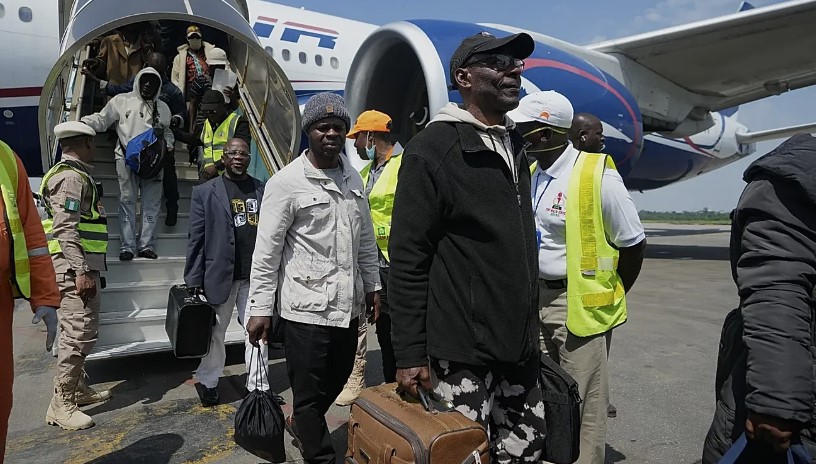
Hundreds of Nigerian nationals evacuated from South Africa have shared distressing accounts of fear, violence, and discrimination after arriving safely in Lagos, describing an environment where many felt their lives and livelihoods were under constant threat.
The first group of 268 evacuees landed at Murtala Muhammed International Airport on June 11, 2026, as part of an emergency repatriation effort funded by the Nigerian government following a surge in anti-immigration protests and growing concerns over the safety of foreign nationals.
Survivors Describe Violence and Fear
Many of the returnees spoke of experiencing physical attacks, harassment, and intimidation during the unrest. Some said they were assaulted in public spaces or while using public transportation, forcing them to live in fear of being targeted simply because of their nationality.
Among the most heartbreaking testimonies was that of a widow who claimed her husband was killed during the violence, leaving her with no choice but to flee South Africa and seek safety in Nigeria.
Several evacuees said the deteriorating security situation made everyday life increasingly dangerous, prompting them to abandon homes, businesses, and personal belongings.
Businesses Destroyed and Livelihoods Lost
Professionals, traders, and entrepreneurs who had spent years building businesses in South Africa reported suffering significant financial losses as shops and commercial premises were allegedly vandalized, looted, or forced to shut down.
Many returned to Nigeria with little more than the belongings they could carry, describing the experience as both economically devastating and emotionally exhausting.
Psychological Trauma and Social Exclusion
Beyond the physical dangers, evacuees recounted living under intense psychological pressure, saying they constantly feared being stopped, questioned, or harassed in public.
Some described feeling dehumanized and isolated, claiming they were treated with suspicion and hostility despite having lived and worked in the country for many years.
Long-term residents also expressed concern about the impact on their children, alleging that some students faced discrimination in schools and were subjected to negative stereotypes because of their Nigerian identity.
Dispute Over Immigration Status
The repatriation has highlighted differing narratives regarding the status of those leaving South Africa.
South African authorities have suggested that many of the evacuees were residing in the country without proper documentation. However, officials from the Nigerian Consulate and several returnees have disputed that characterization, maintaining that numerous individuals held valid documentation and operated legitimate businesses before being displaced by the unrest.
The disagreement has added a diplomatic dimension to an already sensitive humanitarian situation.
Regional Governments Organize Emergency Evacuations
Nigeria is among several African nations that have organized state-supported evacuation efforts in response to the escalating tensions. Countries including Ghana, Zimbabwe, and Malawi have also facilitated the return of citizens amid concerns over safety and anti-immigrant violence ahead of a June 30 deadline for undocumented foreigners to leave South Africa.
The coordinated evacuations reflect growing regional concern about the welfare of migrant communities affected by the unrest.
Reintegration Efforts Underway
Nigerian authorities say more than 1,000 citizens have registered for voluntary evacuation from South Africa.
Upon arrival in Lagos, returnees are being profiled and provided with immediate assistance as part of the government’s reintegration program. Federal officials have also appealed to state governments to support displaced families by creating employment opportunities, providing business assistance, and helping children secure school placements.
As additional evacuation flights are expected in the coming weeks, the experiences shared by those who have already returned underscore the profound human impact of the crisis and the challenges many now face as they rebuild their lives in Nigeria.
Source: Omanghana