Omanghana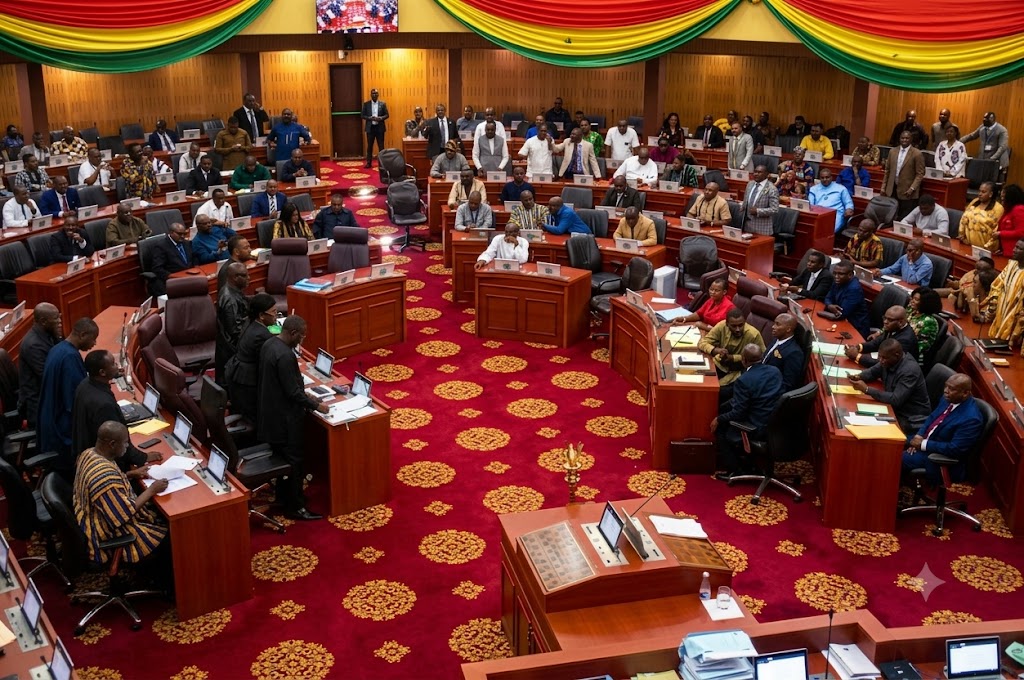
Parliament has passed the Ghana Cocoa Board Bill, 2026, introducing major reforms to the country’s cocoa industry and guaranteeing farmers at least 70 per cent of the gross Free on Board price realised from cocoa exports.
The bill was approved on Thursday, July 30, 2026, after a contentious debate over the government’s decision to process it under a Certificate of Urgency.
Once it receives presidential assent, the legislation will establish a new statutory framework for regulating, financing and overseeing Ghana’s cocoa sector.
Deputy Finance Minister Thomas Nyarko Ampem, who presented the bill’s objectives, said the legislation would strengthen farmer incomes, improve domestic processing and address longstanding governance and financing challenges within the industry.
The bill designates the Ghana Cocoa Board as the statutory institution responsible for regulating, supervising and monitoring activities throughout the cocoa value chain.
COCOBOD will continue to support cocoa cultivation and oversee the purchasing, marketing and export of cocoa while promoting domestic value addition.
Farmers Guaranteed 70% of Export Price
One of the legislation’s most significant provisions is the legal guarantee that cocoa farmers will receive no less than 70 per cent of the gross FOB price.
The provision is intended to strengthen transparency in producer-price calculations and protect farmers from receiving a disproportionately small share of export earnings.
The bill also provides statutory backing for the Producer Price Review Committee and its technical bodies, formalising the process through which Ghana’s farmgate cocoa price is determined.
“This bill is coming out with a new funding model, which will let COCOBOD source funding locally to purchase our cocoa beans from our hardworking farmers,” Nyarko Ampem said.
“Seventy per cent of the FOB price of cocoa will go to the farmers. The bill is to protect our cocoa farms and environment.”
New Domestic Financing Model
The legislation allows COCOBOD to raise funds locally to finance cocoa purchases, marking a shift from the institution’s traditional dependence on annual international syndicated loans.
The government believes greater reliance on domestic financing will make cocoa purchasing more sustainable and reduce COCOBOD’s exposure to external borrowing risks.
The changes follow recent liquidity difficulties that resulted in delayed payments to farmers and buying companies.
Greater Focus on Local Processing
The bill supports the government’s objective of processing at least 50 per cent of Ghana’s cocoa beans domestically rather than exporting most of the crop in its raw form.
The policy is expected to improve value addition, create jobs and provide more beans to domestic cocoa processors, chocolatiers and manufacturers of cocoa-based products.
It also creates a framework for partnerships with local and international institutions to expand domestic processing and strengthen the competitiveness of Ghana’s cocoa industry.
Regulatory flexibility will be introduced to address barriers affecting small-scale chocolate producers and manufacturers of cocoa by-products.
Pension and Education Schemes
The legislation establishes a contributory Cocoa Farmers Pension Scheme to provide farmers with income security after retirement.
It also creates an Educational Trust Scheme to support the education of cocoa farmers’ children.
These initiatives are intended to strengthen social protection for farmers whose livelihoods have historically depended on fluctuating crop prices and seasonal income.
The bill further introduces mechanisms to improve the management of cocoa-sector liabilities and place the industry on a more sustainable financial footing.
Stronger Regulation and Dispute Resolution
Existing administrative rules governing disinfestation, quality inspections, certification, service charges and cocoa takeover procedures will receive statutory backing under the new framework.
The bill also establishes a Dispute Resolution Committee and a Cocoa Board Tribunal to adjudicate disagreements involving licences and other regulated cocoa-sector activities.
Parties dissatisfied with decisions of the tribunal will retain the right to appeal to the High Court.
The legislation consolidates existing cocoa laws into a single framework while repealing obsolete enactments, including N.R.C.D. 265 and A.F.R.C.D. 47.
It also formally places COCOBOD under the supervision of the Ministry of Finance, giving legal effect to the government’s March 2025 decision to transfer oversight from the Ministry of Food and Agriculture.
Minority Opposes Urgent Passage
Despite supporting reforms to improve the cocoa sector, the Minority Caucus objected to the use of a Certificate of Urgency.
Ofoase Ayirebi MP Kojo Oppong Nkrumah argued that the 2026 bill was materially different from the Ghana Cocoa Board Amendment Bill introduced in 2025.
According to him, the new legislation contained wide-ranging provisions, repealed existing enactments and introduced significant changes that required broader consultations with cocoa farmers, civil society organisations and other stakeholders.
He maintained that major decisions affecting such an important sector should not be made through a rushed legislative process.
Oppong Nkrumah also raised concerns that a flexible producer-pricing system could create uncertainty for farmers if adequate safeguards were not included.
Majority Leader Mahama Ayariga rejected the Minority’s objections and argued that the sector’s challenges required immediate legislative action.
He said consultations had already been conducted by COCOBOD and the supervising ministry, with a consultant gathering views from farmers and other industry participants across the country.
“You can no longer delay the solution to the problems of cocoa farmers,” Ayariga said. “We will not procrastinate. We will not delay.”
He described the Certificate of Urgency as a recognised parliamentary procedure that primarily waives the mandatory 14-day gazette period and does not prevent MPs from proposing amendments.
The bill will become law after completing the remaining constitutional process, including presidential assent and publication.
Source: Omanghana