Omanghana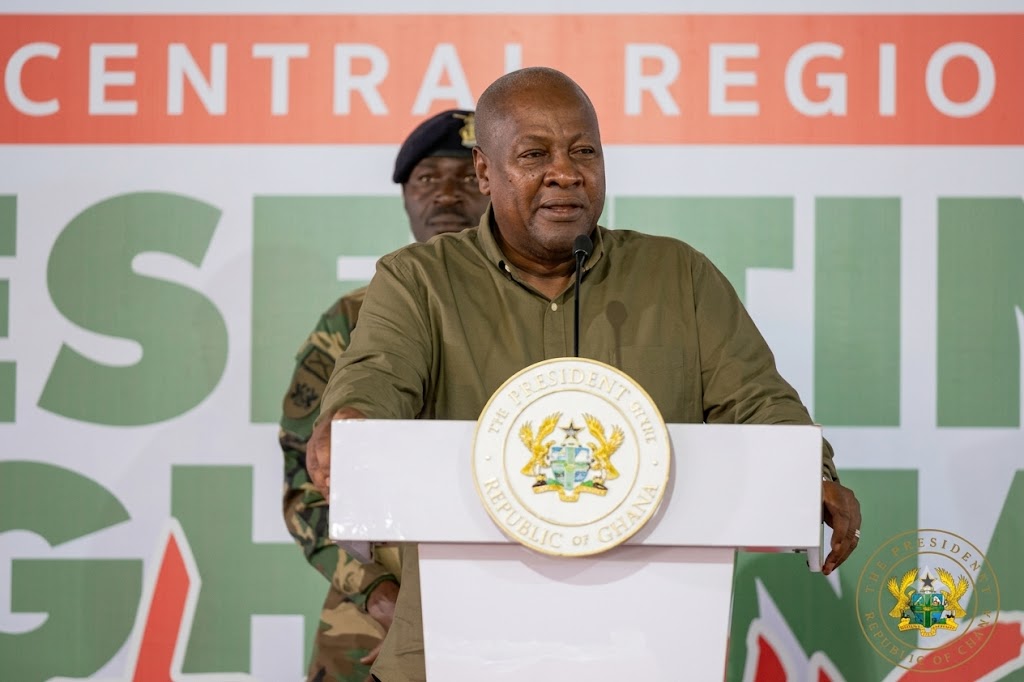
President John Dramani Mahama has inspected several major road projects in the Central Region as part of his ongoing two-day “Resetting Ghana” tour aimed at assessing progress on the government’s flagship “Big Push” infrastructure initiative.
The inspection formed part of the President’s commitment to ensuring that critical road projects are delivered on schedule and to the highest engineering standards, while improving connectivity, reducing transportation costs, and stimulating economic growth across the region.
Accompanied by senior government officials, engineers, and contractors, President Mahama visited strategic road corridors expected to enhance trade, agriculture, tourism, and fishing activities in some of the region’s most economically active communities.
President Tours Key Road Corridors
One of the major projects inspected was the Kafodzidzi–Aburansa Road in the Komenda-Edina-Eguafo-Abirem (KEEA) Municipality, where work is currently progressing under the second phase of its rehabilitation program.
The President also visited the Apam–Mumford–Hweda–Dago–Otuam Road Corridor, a vital coastal route that serves numerous fishing communities and facilitates the movement of agricultural produce, goods, and passengers throughout the Central Region.
Government officials say the rehabilitation of these roads will significantly improve mobility, reduce vehicle operating costs, and provide easier access to markets, schools, healthcare facilities, and other essential services.
Roads Expected to Boost Local Economies
Speaking during the inspection, President Mahama emphasized that the projects are not merely road construction initiatives but strategic investments intended to unlock economic opportunities for communities across the region.
He noted that improved transport infrastructure will enhance the movement of farm produce from rural communities to urban markets while supporting fishing activities along the coast by making it easier to transport fresh catches to processing center’s and commercial hubs.
The President added that better road networks would also encourage private sector investment, promote tourism, and improve access to social services.
Strict Quality Standards Ordered
President Mahama directed engineers and officials of the Ghana Highways Authority to ensure that every project meets approved engineering specifications before contractors are certified for payment.
He stressed that quality assurance must remain a top priority throughout the construction process.
According to the President, road compaction tests, material quality assessments, and all required engineering standards must be fully verified before any certificates of completion are issued.
He cautioned contractors against compromising on quality, declaring that government would not accept substandard infrastructure.
“Our objective is to build durable roads that will serve communities for many years, not projects that deteriorate shortly after completion,” he indicated.
Contractors Assured of Prompt Payment
President Mahama also sought to reassure contractors working under the Big Push program that funding for the ongoing projects has already been secured.
He explained that once engineers certify completed work, payment certificates will be processed within two weeks, ensuring that contractors are not burdened by unnecessary delays.
The President said prompt payment remains essential to maintaining construction momentum and ensuring timely delivery of projects nationwide.
Weather Conditions Temporarily Slowed Progress
Addressing concerns about the pace of construction at some sites, President Mahama explained that recent heavy rainfall had temporarily affected work schedules.
He noted that slowing certain aspects of construction during periods of intense rainfall was necessary to protect the structural integrity of the roads and ensure long-term durability.
According to him, full-scale construction activities will resume once weather conditions improve, allowing contractors to continue work safely and efficiently.
High-Performing Contractors to Benefit from Phase Two
President Mahama announced that contractors who successfully complete their assigned projects on schedule and in accordance with international engineering standards will receive priority consideration for future contracts under the next phase of the Big Push program.
He said the government intends to reward efficiency, professionalism, and quality workmanship while promoting accountability in the execution of public infrastructure projects.
The approach, he explained, is expected to encourage higher standards across the construction industry and ensure better value for public investment.
Senior Officials Join Inspection Tour
The President was accompanied by a high-level delegation that included Deputy Minister for Roads and Highways, Alhassan Sayibu Suhuyini, and Central Regional Minister, Ekow Panyin Okyere Eduamoah, along with officials from the Ghana Highways Authority and other government agencies.
The inspection forms part of a broader regional tour during which President Mahama is reviewing several ongoing development projects under the government’s infrastructure agenda.
In addition to the road projects, the President is expected to inspect other public investments, including market redevelopment initiatives, healthcare infrastructure, and community development projects aimed at improving living standards across the Central Region.
Advancing the ‘Resetting Ghana’ Agenda
The Big Push infrastructure program remains one of the government’s flagship development initiatives, focusing on expanding and modernizing Ghana’s transport network to stimulate economic growth and improve connectivity across the country.
Government officials say investments in strategic roads, bridges, markets, schools, and health facilities are expected to create jobs, strengthen regional economies, and improve access to essential services.
President Mahama reiterated that infrastructure development remains central to his administration’s “Resetting Ghana” agenda, describing quality roads as a critical foundation for sustainable national development and inclusive economic transformation.
Source: Omanghana