Omanghana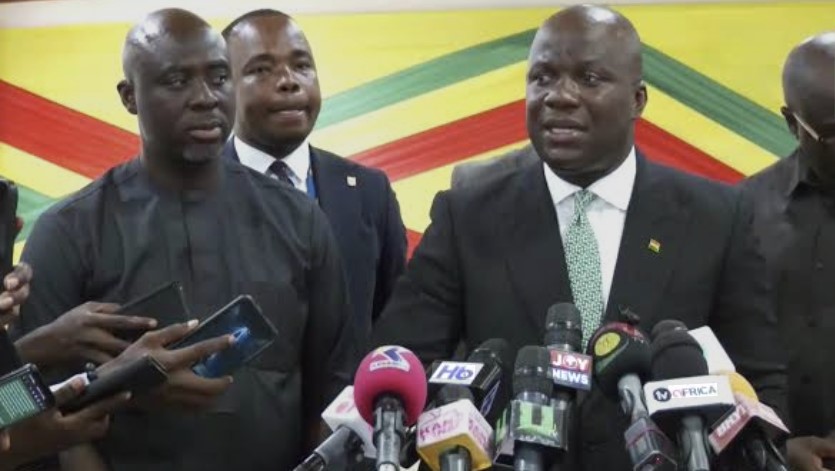
A rare moment of bipartisan engagement unfolded in Parliament on Tuesday, June 9, 2026, when Communications, Digital Technology and Innovation Minister Samuel Nartey George unexpectedly joined a press briefing being addressed by New Patriotic Party (NPP) MP Samuel Abu Jinapor and the Minority Caucus.
The spontaneous intervention came as the Minority criticized what it described as the growing persecution of citizens for exercising their constitutional right to free expression. The exchange, which quickly gained traction on social media, sparked widespread discussion about free speech, responsible communication, and democratic accountability in Ghana.
Unexpected Parliamentary Encounter
The incident occurred as Samuel Abu Jinapor concluded remarks urging the government to halt what the Minority sees as the use of state institutions to intimidate critics and suppress dissenting voices.
Noticing Minister Sam George nearby, Jinapor seized the opportunity to invite him into the media briefing. In a light-hearted but pointed gesture, he told journalists that the Communications Minister—well known for his outspoken political commentary during his years in opposition—had arrived to support the Minority’s position on free speech.
The invitation transformed what could have been a routine press conference into a symbolic cross-party conversation on one of Ghana’s most important democratic freedoms.
Sam George Offers Assurance on Free Expression
Taking the podium, Sam George responded directly to the concerns raised by the Minority and offered assurances that freedom of speech would remain protected under the current administration.
“I can assure my brother that he has nothing to fear. We have a country to protect and we will build our country together. Free speech will be protected under this government and every other government, but we should also be responsible in our utterances. That’s all we are asking for… we certainly don’t support irresponsible speech,” the Minister stated.
His comments emphasized the government’s commitment to safeguarding constitutional freedoms while urging citizens and public figures alike to exercise responsibility in public discourse.
Debate Over Enforcement Methods
While welcoming the Minister’s assurances, Jinapor and members of the Minority quickly shifted the discussion to what they described as the more pressing issue: how the state responds when individuals allegedly engage in defamatory or irresponsible speech.
According to the Minority, legal disputes arising from public commentary should be resolved through civil litigation rather than criminal prosecution.
Jinapor argued that the use of arrests, police detention, and stringent bail conditions against individuals accused of controversial statements amounts to state harassment and undermines democratic freedoms. He maintained that civil courts provide the appropriate avenue for addressing alleged defamation or reputational harm.
The exchange highlighted an ongoing national debate over the balance between protecting free expression and ensuring accountability for harmful or misleading public statements.
Viral Moment Sparks Public Debate
Videos of the interaction quickly circulated online, attracting widespread attention from political observers, journalists, and civil society groups.
Many commentators praised the exchange as a refreshing example of Ghana’s democratic maturity, noting the respectful tone adopted by both politicians despite their differing positions. Supporters described the encounter as evidence that robust political disagreements can coexist with civility and mutual respect.
Others, however, argued that the symbolic gesture did little to address concerns surrounding recent arrests and legal actions involving content creators and government critics. These critics contended that a gap remains between official assurances on free speech and the realities of enforcement on the ground.
A Test of Ghana’s Democratic Credentials
The unexpected interaction between Sam George and Samuel Abu Jinapor has become more than a viral political moment. It has reignited broader conversations about constitutional freedoms, the role of state institutions, and the limits of acceptable public discourse in a democratic society.
As debates over free speech and accountability continue, the parliamentary exchange serves as a reminder that safeguarding democratic rights requires not only legal protections but also ongoing dialogue between government, opposition parties, and the public.
Source: Omanghana