Omanghana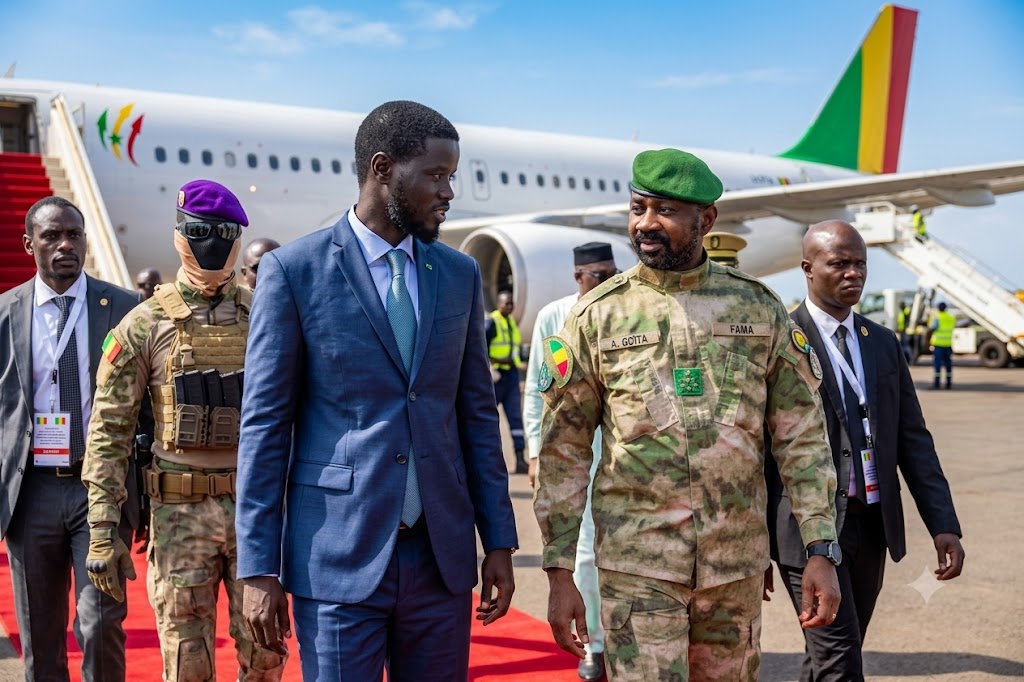
Senegalese President Bassirou Diomaye Faye has strengthened diplomatic ties with Mali’s transitional leader, General Assimi Goïta, as he seeks to rebuild cooperation between ECOWAS and the breakaway Alliance of Sahel States.
Faye travelled to Bamako for a working and friendship visit about 10 days after assuming the rotating chairmanship of the Economic Community of West African States.
It was his first foreign visit since taking over the ECOWAS leadership, but his second trip to Mali since becoming Senegal’s president in 2024. Faye was received by Goïta at the Koulouba Palace for talks covering regional integration, security and economic cooperation.
The visit carried significance beyond bilateral relations. It represented a renewed diplomatic effort to prevent the growing political separation between the traditional West African bloc and the military-led Sahel states from becoming permanent.
Faye Seeks Dialogue Between ECOWAS and AES
Mali, Niger and Burkina Faso formally withdrew from ECOWAS and established the Alliance of Sahel States, later developing it into a confederation focused on defense, diplomacy and economic cooperation.
Their departure reversed decades of regional integration and raised concerns about the future of free movement, trade, security cooperation and political stability in West Africa.
ECOWAS previously appointed Faye and Togolese leader Faure Gnassingbé as facilitators for engagement with the three Sahel countries. The mandate was intended to maintain dialogue and explore new forms of cooperation despite their withdrawal from the bloc.
By strengthening his personal relationship with Goïta, Faye is positioning Senegal as a trusted diplomatic bridge between ECOWAS and the AES. His approach relies on direct engagement and an acknowledgement of the concerns that prompted Mali and its allies to break away.
Dakar-Bamako Trade Corridor Remains Crucial
Senegal also has major economic interests in maintaining stable relations with landlocked Mali.
Mali relies heavily on Senegalese ports and the Dakar-Bamako transport corridor for access to the Atlantic Ocean. The route carries fuel, food, machinery and other essential imports while providing an export channel for Malian products.
Any prolonged diplomatic confrontation, border restriction or customs dispute could disrupt commerce and increase transportation costs for both countries.
Protecting the corridor is therefore a major priority for Dakar. Stronger bilateral relations could help prevent political tensions from interfering with trade, customs procedures and the movement of goods.
Senegal Pledges Security Solidarity
Security cooperation was another central issue during the meeting. Mali continues to confront attacks from armed groups, including organizations linked to al-Qaeda, alongside continuing tensions involving Tuareg separatists.
Faye condemned recent terrorist attacks and pledged Senegal’s solidarity with Mali in its fight against insecurity.
The Senegalese leader also assured Goïta that Senegalese territory would not be used by individuals or organizations seeking to destabilize Mali. The commitment reflects Faye’s emphasis on peaceful coexistence and non-interference between neighboring states.
The two countries are expected to deepen intelligence sharing and security coordination as militant violence threatens to spread from the central Sahel towards West Africa’s coastal states.
Leaders Push Economic and Monetary Cooperation
Faye and Goïta also discussed closer coordination on monetary policy, economic development and water-resource management.
The two leaders proposed a summit dedicated to these areas, reflecting growing demands for African countries to strengthen financial autonomy, improve the management of shared natural resources and reduce reliance on external institutions.
Cooperation on water is particularly important because Senegal and Mali share the Senegal River basin, which supports agriculture, electricity generation and livelihoods across several countries.
A Test of Faye’s ECOWAS Leadership
The Bamako visit represents an early test of Faye’s leadership of ECOWAS. His success will depend partly on whether he can maintain productive relations with the Sahel states without weakening the principles and institutions of the regional bloc.
Although an immediate return of Mali, Burkina Faso and Niger to ECOWAS appears unlikely, sustained dialogue could preserve cooperation in areas such as trade, counterterrorism, infrastructure and humanitarian assistance.
For Senegal, repairing relations is both a diplomatic mission and an economic necessity. The country’s commercial links with Mali, exposure to regional insecurity and strategic position between the Sahel and Atlantic coast make it particularly vulnerable to a prolonged West African divide.
Source: Omanghana