Omanghana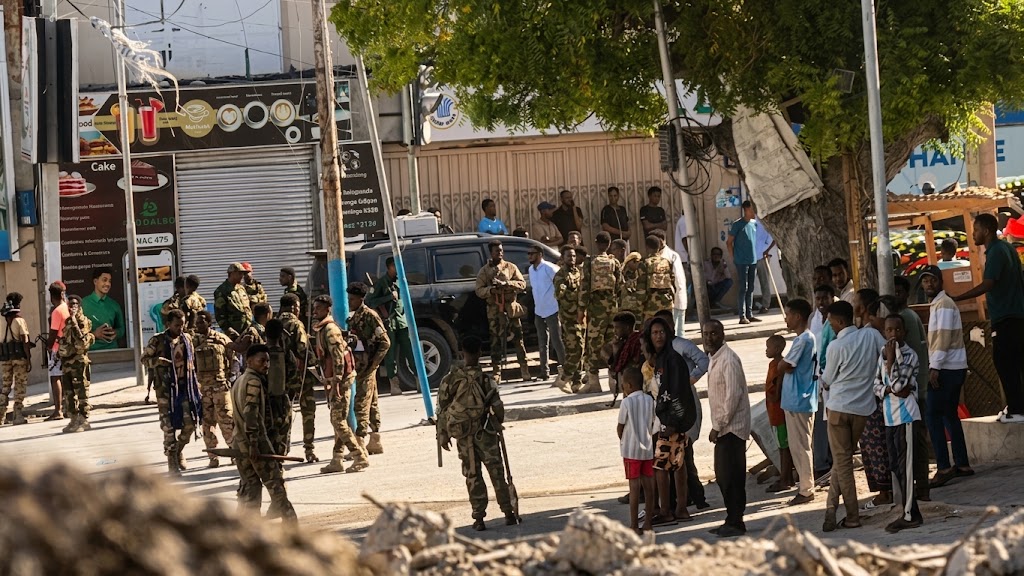
Somali national forces have repelled an early-morning attack by fighters loyal to the ousted president of South West State following intense clashes in Baidoa, the regional capital.
The fighting reportedly began at about 5:00 a.m. on Monday, August 17, 2026, when forces supporting former regional leader Abdiaziz Hassan Mohamed Laftagareen attacked positions occupied by the Somali National Army.
Residents reported several hours of heavy urban combat as the rival forces battled for control of strategic parts of the city. The violence raised fears of further instability in Baidoa, which remains an important political and security center in southern Somalia.
Somalia’s federal government accused Laftagareen’s fighters of cooperating with the Islamist militant group Al-Shabaab to conduct the assault. According to the government, vehicles loaded with explosives were used during the operation.
The allegation of cooperation with Al-Shabaab has not been independently confirmed. Forces loyal to the former regional leader have also not provided a detailed response to the federal government’s claims.
Federal authorities said government troops successfully resisted the assault and regained control of the affected areas. They claimed that nearly 30 militants were killed during the military response, although no independent casualty assessment was immediately available.
A spokesperson representing Laftagareen offered a conflicting account, claiming that his fighters had captured parts of Baidoa. Local witnesses, however, reported that the pro-Laftagareen forces were pushed out of the city after several hours of intense fighting.
The clashes represent a significant escalation in the political dispute between Somalia’s federal government and supporters of the former South West State president.
Laftagareen was removed from office by the central government in March 2026 following a prolonged disagreement over his leadership mandate. Federal authorities accused him of remaining in office illegally after his term had theoretically expired in 2022.
The dispute became more serious after Laftagareen opposed constitutional reforms adopted in early March 2026. The changes extended the presidential term and introduced direct universal suffrage to replace Somalia’s longstanding indirect voting system, which relies heavily on clan representation.
Supporters of the reforms argue that direct elections could strengthen democratic participation by allowing citizens to choose their leaders. Critics, however, maintain that major constitutional changes should be agreed upon through broader consultation with regional administrations and other political stakeholders.
Laftagareen’s opposition to the reforms deepened his confrontation with the federal government and contributed to his eventual removal. His supporters continued to challenge the decision, creating the conditions for the armed confrontation in Baidoa.
The latest violence threatens to complicate Somalia’s wider campaign against Al-Shabaab, which continues to carry out attacks across several parts of the country. Political divisions between federal and regional authorities could divert troops and resources away from counterterrorism operations.
Authorities have not yet released complete information on civilian casualties, displacement or damage caused by the fighting. The security situation in Baidoa remains closely watched as the federal government seeks to prevent renewed attacks and restore stability in the city.
Source: Omanghana