Omanghana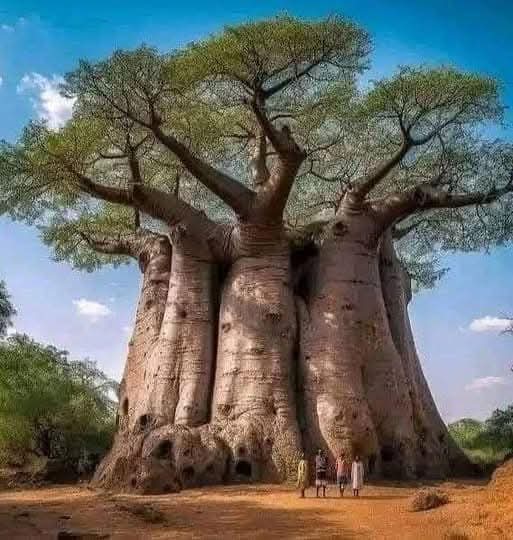
Towering over the African savannah with its massive trunk and unmistakable silhouette, the baobab tree is one of nature’s most remarkable creations. Often referred to as the “Tree of Life,” the baobab has become a symbol of resilience, survival, and abundance in some of the world’s harshest environments.
Belonging to the genus Adansonia, baobabs are believed to represent an ancient lineage that dates back more than 200 million years, making them among the oldest surviving groups of flowering trees on Earth. Their evolutionary history stretches so far into the past that it predates the emergence of humans and traces back to an era when the continents were still connected.
Built to Survive Harsh Climates
One of the baobab’s most distinctive features is its enormous trunk, which can swell dramatically during the rainy season as it stores vast quantities of water. This natural reservoir enables the tree to survive prolonged droughts and thrive in the dry, arid landscapes of the African savannah.
For generations, communities have regarded the baobab as a source of life, providing shade, water, food, and shelter for both humans and wildlife in environments where few other large trees can flourish.
A Wide Geographic Distribution
Eight recognized species of baobab exist worldwide. The African baobab (Adansonia digitata) is the most widespread, growing across the dry regions of 32 African countries.
Six additional species are native to the island of Madagascar, while the eighth species is found in northwestern Australia, highlighting the remarkable geographic spread of this ancient genus.
The Sagole Big Tree: Africa’s Largest Living Baobab
Among the most impressive surviving specimens is the Sagole Big Tree in Masisi, Vhembe, South Africa, near the Zimbabwean border. Recognized as the largest known living baobab, it boasts extraordinary dimensions:
- Base area of approximately 60.6 square meters
- Height of nearly 19.8 meters
- Estimated wood and bark volume of 414 cubic meters
- Above-ground dry mass of roughly 54 tonnes
Its immense size makes it one of the most significant natural landmarks on the African continent.
Trees That Can Live for Millennia
Baobabs are renowned for their exceptional longevity. Scientific studies have estimated the ages of some African specimens to range between 1,100 and 2,500 years, allowing these giants to witness centuries of environmental and human history.
Many mature trees reach heights of up to 30 meters and trunk circumferences approaching 50 meters, making them among the largest trees by girth in the world.
Historically, villages and settlements often developed around baobabs because of the protection and resources they provided. Archaeological remains, including early medieval sites and Portuguese-era artifacts, have frequently been discovered in their vicinity.
Giants Lost to Time
Until 2018, the largest living baobab was believed to be the sacred Tsitakakoike Baobab (Adansonia grandidieri) in Madagascar’s Ambiky Forest.
The remarkable tree featured a base covering approximately 59.6 square meters, stood 14.6 meters tall, and possessed an estimated total volume of 455 cubic meters. However, it suffered a major structural collapse in February 2018, leaving only a portion of the tree standing.
Another legendary specimen, the Platland (or Sunland) Baobab in Modjadjiskloof, South Africa, once ranked among the largest on record with a base area of 67.9 square meters and a total volume of 448 cubic meters. Large sections of the tree collapsed in 2016, paving the way for the Sagole Big Tree to become the largest surviving known baobab.
Surprisingly Light Despite Their Massive Size
Despite their colossal dimensions, baobabs possess some of the lightest wood of any tree species.
Their average wood density is estimated at approximately 0.13 grams per cubic centimeter, making it even lighter than balsa wood, which is widely known for its exceptionally low density and is commonly used in model aircraft construction.
Because of this lightweight structure, even enormous baobabs weighing tens of tonnes have relatively low wood density compared with many other large hardwood species. By contrast, Australia’s giant eucalyptus trees rank among the heaviest hardwood trees in terms of total mass.
A Living Symbol of Africa
More than just botanical curiosities, baobabs have long held cultural, ecological, and historical significance across Africa. They provide food through their nutrient-rich fruit, support biodiversity by sheltering birds and animals, and serve as gathering places for local communities.
As some of the oldest and most resilient trees on the planet, baobabs continue to stand as enduring symbols of life, endurance, and adaptation—living monuments that connect the ancient past with the present across the landscapes they have dominated for centuries.
Source: Archaeo – Histories/Omanghana