Omanghana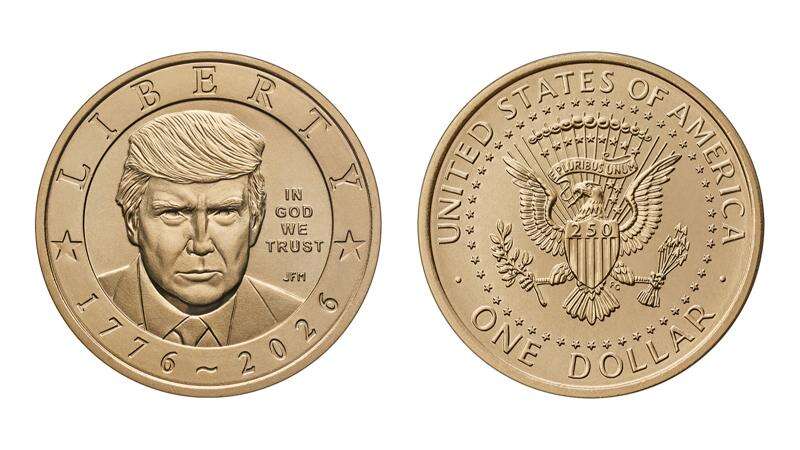
The release of a legal-tender $1 coin bearing the portrait of US President Donald Trump has ended a century-old American convention against featuring sitting presidents on the country’s currency.
The coin entered circulation on September 2, 2026, as part of events marking the 250th anniversary of the signing of the United States Declaration of Independence.
Trump is the first serving US president to appear on American coinage since Calvin Coolidge in 1926. Coolidge was depicted alongside George Washington on a commemorative half-dollar issued to celebrate the country’s 150th anniversary.
Produced at the Philadelphia Mint, the Trump coin is made from manganese brass. Its obverse displays the president’s profile alongside the inscriptions “1776–2026,” “LIBERTY” and “IN GOD WE TRUST.”
The reverse features the Great Seal or a presidential emblem connected to the semi quincentennial celebrations.
The coin’s introduction has generated legal and political debate because an 1866 federal law generally prohibits living people from appearing on US currency.
The administration maintains that the Circulating Collectible Coin Redesign Act of 2020 gave Treasury Secretary Scott Bessent authority to approve special designs for the country’s 250th anniversary.
Congressional critics and some advisory bodies have disputed that interpretation, arguing that the anniversary legislation did not clearly override the long-standing restriction.
The decision has also prompted comparisons with monarchies and former authoritarian governments where living leaders have appeared on national currencies while exercising power.
Morocco’s King Mohammed VI is featured on circulating dirham banknotes and coins as part of the country’s established royal tradition.
King Mswati III of Eswatini also appears on the country’s currency, including the E200 banknote. His portrait reflects his position as the sovereign of Africa’s last absolute monarchy.
Several post-independence African leaders also placed their portraits on national currency while in office. They included Mobutu Sese Seko of Zaire, now the Democratic Republic of Congo; Daniel arap Moi of Kenya; Idi Amin and Milton Obote of Uganda; and Julius Nyerere of Tanzania.
Many contemporary African democracies have since moved towards designs featuring national monuments, wildlife, cultural imagery or deceased independence leaders instead of serving political figures.
Democratic lawmakers in Washington have criticized the Trump coin, arguing that placing a sitting president on circulating money resembles a monarchical tradition and conflicts with established American civic values.
The White House and the Treasury Department have defended the release as an official commemorative symbol honoring the United States’ 250th anniversary rather than an attempt to elevate the president above democratic institutions.
Source: Omanghana