Omanghana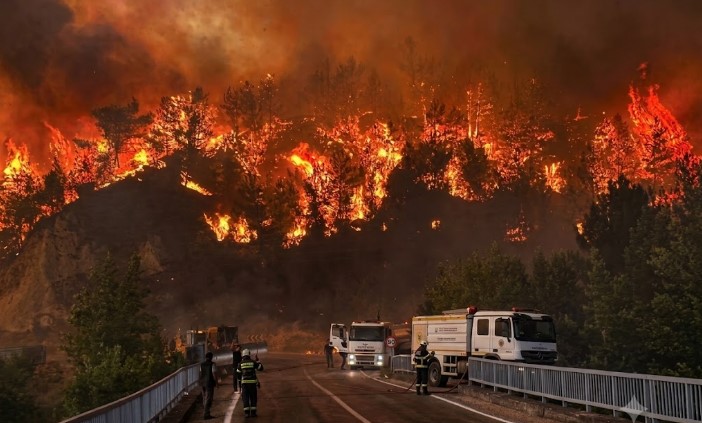
Firefighters have made significant progress against a wave of forest and rural fires across Turkey, although authorities have warned that extreme heat, dry vegetation and strong winds will maintain dangerous conditions into the coming week.
Five major fires remained active across western and southern Turkey on Friday, July 31, after emergency teams responded to more than 200 outbreaks over several days.
Agriculture and Forestry Minister İbrahim Yumaklı initially reported that 202 of 206 fires had been brought under control. The figures were later revised as additional incidents were recorded. By August 1, authorities said 258 of 260 fires had been contained, with the remaining blazes no longer presenting an immediate threat.
Yumaklı nevertheless warned that the underlying wildfire danger had not passed, urging residents to avoid any activity that could produce flames or sparks near forests and dry vegetation.
Strong Winds Complicate Firefighting Operations
Winds exceeding 50 kilometres per hour played a major role in spreading the fires and repeatedly disrupted containment efforts.
Rapid changes in wind direction caused flames to jump into new areas, limiting the effectiveness of water-dropping aircraft and placing ground crews at additional risk.
Authorities issued high-risk warnings for 10 provinces, including Çanakkale, Balıkesir, İzmir, Aydın, Muğla, Antalya and Adana. These areas include some of Turkey’s most heavily forested and tourism-dependent coastal regions.
Extreme temperatures and prolonged dry conditions have left vegetation highly combustible, allowing relatively small sparks to develop into fast-moving fires.
Some of the most difficult operations were conducted in Çine district in Aydın province and Susurluk in Balıkesir.
The Çine fire expanded rapidly under strong winds, requiring an intensive response from both aircraft and ground units. Teams also battled flames around Susurluk as authorities attempted to prevent the fire from reaching settlements and agricultural areas.
By August 1, Yumaklı said both incidents had largely been brought under control. Fires in Gömeç in Balıkesir and Gülnar in Mersin were reported as fully contained.
Seydikemer Fire Disrupts Major Highway
In Muğla province, a large wildfire around Seydikemer forced evacuations and temporarily affected travel along sections of the Fethiye-Antalya highway.
The road is an important transport route through Turkey’s southwestern tourism region. Smoke, flames and emergency operations made parts of it unsafe for motorists.
Aircraft and helicopters repeatedly dropped water on the affected forest while ground crews worked to create containment lines and protect nearby communities.
At Least 65 Buildings Severely Damaged
Environment, Urbanisation and Climate Change Minister Murat Kurum said 65 buildings were either severely damaged or destroyed by fires in Muğla, Antalya and Balıkesir.
Official assessments identified 39 affected structures in Seydikemer, 20 in Kumluca in Antalya and six in Gömeç in Balıkesir.
Residents in several communities reported losing homes, livestock, olive groves and fruit orchards. Damage-assessment teams have been deployed to determine the full scale of the destruction and identify families requiring assistance.
More Than 22,000 Hectares Burned This Year
Data from the European Forest Fire Information System estimated that at least 22,587 hectares had burned across Turkey during 2026 at the time of the latest assessment.
The scale of the damage reflects the combined effects of recurring drought, high temperatures, strong winds and human activity.
Turkey’s Mediterranean and Aegean regions are particularly vulnerable during the summer because forests, grasslands and farmland can become extremely dry after prolonged periods without rain.
Aircraft, Helicopters and Drones Deployed Nationwide
The General Directorate of Forestry mobilised a large national firefighting fleet, including:
- 28 aircraft
- 119 helicopters
- 14 surveillance drones
- 1,953 water tenders
- 2,766 first-response vehicles
- 878 pieces of heavy equipment
Personnel and equipment were stationed across more than 1,600 locations to allow rapid intervention when new fires were detected. Crews operated continuously while drones monitored forested areas and helped direct aircraft towards the most dangerous sections.
Public access to high-risk forests remains restricted in several provinces as authorities attempt to prevent additional outbreaks.
Two Arrested Over Welding Sparks
Police arrested two people in connection with the Gömeç fire in Balıkesir.
Investigators alleged that the suspects were welding in the garden of a house when sparks ignited dry vegetation. The flames reportedly spread rapidly into the surrounding rural area.
The incident has renewed official appeals for residents to avoid welding, waste burning and the use of machinery capable of producing sparks during extreme fire conditions.
Although most of the latest fires have been contained, emergency teams remain on alert. Authorities have warned that continued heat and strong winds could quickly produce another round of dangerous outbreaks.
Source: Omanghana