Omanghana
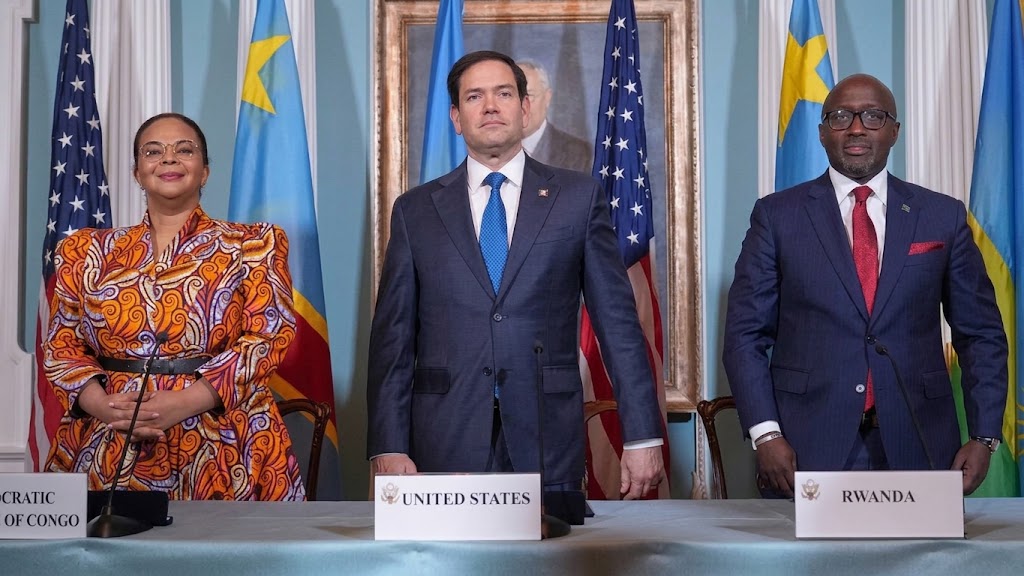
The United States has hosted military planners from the Democratic Republic of the Congo and Rwanda in Germany to advance security commitments under the Washington Accords for Peace and Prosperity.
The conference took place from October 20 to 22 at the George C. Marshall European Center for Security Studies in Garmisch. Representatives from the African Union, Qatar and US government agencies also participated.
Delegations Work on Security Operations Plan
The meeting focused on preparing an Operations Order under the Joint Security Coordination Mechanism, which supports implementation of the peace framework.
The proposed plan addresses two central commitments: action by Congolese forces to neutralize the Democratic Forces for the Liberation of Rwanda, known as the FDLR, and the disengagement of Rwandan forces alongside the lifting of Rwanda’s defensive measures.
The conference followed an agreement reached during the mechanism’s August meeting in Geneva to hold further military planning discussions. No final approval of the revised Operations Order or implementation timetable was publicly announced in the conference reporting.
Peace Framework Includes Economic Cooperation
The Washington Accords, signed by the leaders of the DRC and Rwanda in December 2025, combine security commitments with plans for regional economic integration.
The framework seeks to expand trade and investment while improving transparency in critical mineral supply chains. US authorities have described action against illicit mineral networks as part of efforts to prevent resource revenues from financing armed groups.
Washington Announces Further Sanctions
Despite the diplomatic engagement, the United States announced sanctions on October 28 against Rwanda’s Ministry of Defense and Zigama Credit and Savings Society, a financial institution serving the country’s security services.
US officials accused the entities of supporting military activities linked to the M23 armed group in eastern Congo.
The State Department said Rwandan troops were fighting alongside M23 and providing weapons and training. It also alleged that surface-to-air missiles and jamming equipment deployed by Rwandan forces endangered civilian aviation. These were the US government’s stated grounds for the action.
The sanctions underscore the continuing gap between diplomatic commitments and implementation, as Washington presses for an end to support for M23 and the withdrawal of Rwandan troops from eastern Congo.
Source: Omanghana