Omanghana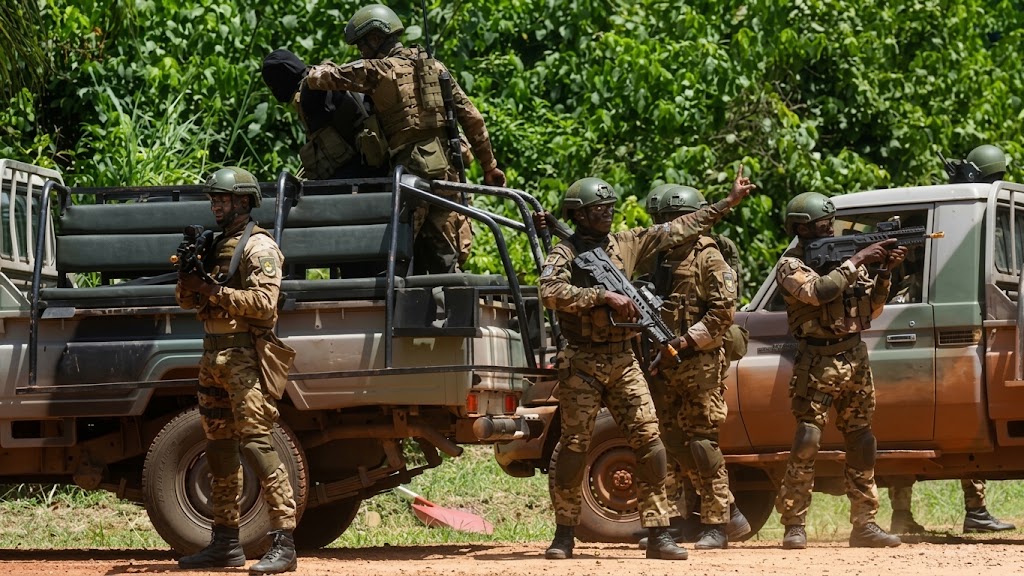
Bipartisan lawmakers in the United States have introduced legislation aimed at rebuilding Washington’s engagement with the central Sahel as Islamist militant groups expand their operations across Mali, Burkina Faso and Niger.
The proposed Mali Security Partnership and Counterterrorism Act focuses on threats posed by Jama’at Nusrat al-Islam wal-Muslimin (JNIM), an al-Qaeda affiliate, and the Islamic State Sahel Province, also known as the Islamic State in the Greater Sahara.
The initiative comes amid growing concern that Russian forces and their regional partners have failed to halt the insurgencies despite maintaining a significant security presence in the area for several years.
Bipartisan Bill Targets Regional Terrorist Networks
The legislation was introduced by US Representatives Jimmy Panetta, a Democrat from California, and Joe Wilson, a Republican from South Carolina.
It directs the US State Department to develop a comprehensive diplomatic and counterterrorism strategy for addressing al-Qaeda-linked organizations operating in Mali. The plan would also assess how insecurity in Mali is connected to militant activity and political instability in neighboring Burkina Faso and Niger.
Although Mali is the bill’s primary focus, its broader objective is to establish a coordinated American response to the deteriorating security environment throughout the central Sahel.
Militant Financing Under Scrutiny
A major component of the legislation concerns the financial networks sustaining armed groups across the region.
The proposed law calls for an investigation into the use of Mali’s artisanal gold-mining industry as a source of militant revenue. It also seeks greater scrutiny of ransom payments, extortion schemes and illicit cross-border trade.
Lawmakers are particularly concerned that terrorist organizations have strengthened their finances by taxing mining communities, controlling smuggling routes and demanding large payments for the release of hostages. One reported ransom payment in late 2025 was estimated at approximately $50 million.
By identifying and disrupting these sources of income, the legislation seeks to weaken the ability of militant organizations to recruit fighters, purchase weapons and expand their territorial influence.
Washington Examines Russia’s Expanding Presence
The bill also requires an assessment of Russia’s growing military footprint in the Sahel and its consequences for regional security, governance and Western diplomatic engagement.
Mali, Burkina Faso and Niger began shifting toward Moscow after military officers seized power in successive coups. Mali experienced takeovers in 2020 and 2021, Burkina Faso underwent two coups in 2022, and Niger’s elected government was removed in 2023.
The new military-led governments subsequently ended or significantly reduced longstanding security partnerships with France and the United States. Western troops were ordered to leave several military installations as the Sahel governments pursued closer defense cooperation with Russia.
Russian involvement initially included Wagner Group mercenaries. Following Wagner’s restructuring, many of its operations were absorbed into the Africa Corps, which operates under the authority of Russia’s Ministry of Defense.
Insurgent Violence Continues to Expand
Despite Russia’s military involvement in Mali since 2021, militant violence has intensified across several parts of the Sahel.
JNIM and the Islamic State Sahel Province have expanded their influence over rural areas in Burkina Faso and northern and central Mali. In some locations, armed groups have attacked military posts, surrounded communities and disrupted important transport and commercial routes.
Russian personnel and allied national forces have also suffered significant casualties. Among the most notable incidents was the 2024 battle near Tinzaouaten in northern Mali, where Russian and Malian troops sustained heavy losses. Further ambushes against security forces were reported in central Mali during 2026.
The worsening instability has also raised fears of a sustained southward expansion toward coastal West Africa. Northern communities in Benin, Togo and Côte d’Ivoire are considered particularly vulnerable as militant organizations search for new recruitment areas, supply corridors and operational bases.
AES Alliance Complicates US Re-engagement
Any attempt by Washington to rebuild its regional security role will face considerable diplomatic challenges.
Mali, Niger and Burkina Faso have withdrawn from the Economic Community of West African States and established the Confederation of Sahel States, commonly known by its French abbreviation, AES.
The three governments are developing a combined military force of about 5,000 personnel while coordinating their diplomatic and security policies more closely. Their growing relationship with Moscow could make them reluctant to accept renewed American involvement.
Diplomatic Distrust Remains a Major Obstacle
Relations between the United States and the Sahel’s military governments have deteriorated following the cancellation of defense agreements and the removal of American and European personnel from regional bases.
Restoring formal security cooperation would therefore require more than a new counterterrorism framework. Washington would also need to rebuild trust with governments that increasingly view Western pressure over democratic governance and political transition timelines as interference in their domestic affairs.
The bipartisan legislation nevertheless signals renewed interest in preventing Russia from becoming the dominant external security partner in the central Sahel. Its effectiveness will ultimately depend on whether the region’s military governments are prepared to reopen diplomatic channels and cooperate with Washington against their common militant threats.
Source: Omanghana