Omanghana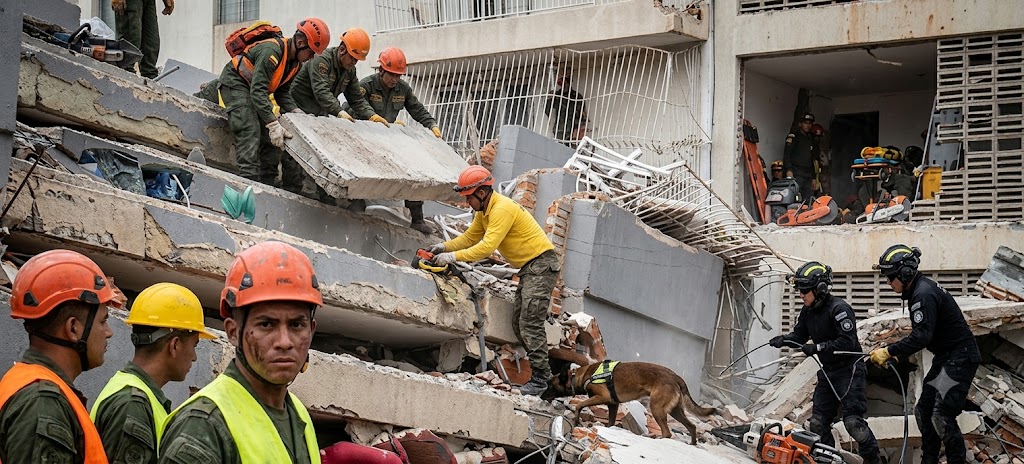
The confirmed death toll from the powerful twin earthquakes that struck Venezuela has risen to 1,719, according to National Assembly President Jorge Rodríguez, as rescue operations continue across the country’s devastated central-northern region.
The back-to-back quakes, measuring 7.2 and 7.5 in magnitude, caused widespread destruction, with the coastal state of La Guaira among the hardest hit areas. Emergency teams are still working through collapsed buildings and rubble in search of survivors as the humanitarian crisis deepens.
Death Toll Expected to Rise Further
Disaster response officials caution that the official figure may significantly underestimate the true scale of the tragedy.
The U.S. Geological Survey (USGS) has warned that final fatalities could potentially reach tens of thousands, given the magnitude of the quake and the level of structural collapse across affected regions.
As of June 29, 2026, authorities report:
- 1,719 confirmed deaths
- 5,034 people treated for injuries
- 15,866 displaced residents housed in temporary shelters
Meanwhile, the number of missing persons remains unclear. Opposition-linked registries suggest that tens of thousands of people may still be unaccounted for, as search efforts continue under increasingly difficult conditions.
Widespread Structural Collapse
Satellite analysis from NASA indicates that approximately 58,870 buildings have been damaged or completely destroyed across affected regions.
Entire neighborhoods in parts of central and northern Venezuela have been reduced to rubble, severely complicating rescue operations and humanitarian access.
Rescue Window Closing
Emergency responders are now working beyond the critical 72-hour survival window, a period typically considered crucial for finding survivors trapped under debris.
While isolated rescues continue—such as the survival of a 21-year-old man pulled from rubble after 106 hours in Caraballeda—rescue teams are increasingly shifting focus toward recovery operations.
Despite this, officials stress that hope remains for additional survivors in void spaces beneath collapsed structures.
Strained Infrastructure Compounds Crisis
Experts say the scale of destruction has been worsened by long-standing structural vulnerabilities, including aging infrastructure, inconsistent enforcement of building codes, and an overstretched healthcare system.
These weaknesses have slowed emergency response efforts and intensified pressure on hospitals already struggling to cope with mass casualty inflows.
Global Humanitarian Response Expands
The United Nations has taken a leading coordination role in the international response, mobilizing large-scale humanitarian assistance efforts.
According to relief agencies, 27 countries have deployed more than 2,000 specialist search-and-rescue personnel to support local emergency teams in locating survivors and delivering aid.
Additional medical supplies, temporary shelters, and logistical support are being rapidly dispatched as part of a widening global response effort.
A Nation in Crisis
As Venezuela grapples with one of its worst natural disasters in modern history, rescue operations remain urgent and ongoing.
Authorities continue to urge the public to avoid unstable structures and to report missing persons as emergency teams race against time to locate survivors and manage the growing humanitarian emergency.
Source: Omanghana