Omanghana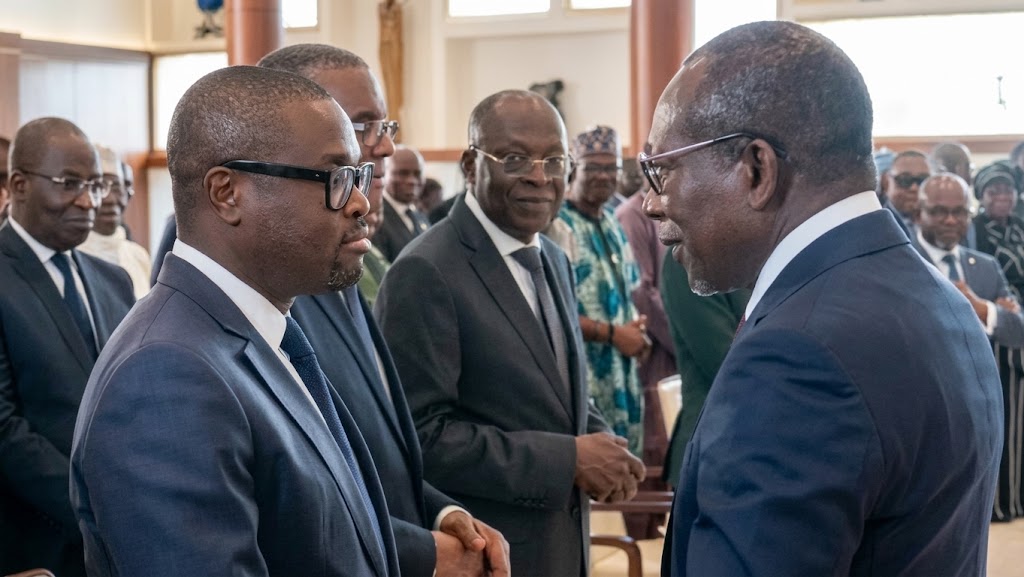
Former Beninese president and current Senate President Patrice Talon has intensified efforts to reunify the Celestial Church of Christ, a religious movement divided by competing leadership claims for more than four decades.
Talon’s intervention reflects concerns extending beyond internal church administration. The process touches on public order, religious governance, national heritage and Benin’s position as the birthplace and spiritual center of one of West Africa’s most influential indigenous Christian movements.
The Celestial Church of Christ, also known in French as Église du Christianisme Céleste, was founded in Porto-Novo in 1947 by Samuel Biléhou Joseph Oshoffa.
Following Oshoffa’s death in 1985, the church became divided over succession and the location of its supreme authority. Rival leadership structures subsequently emerged in Benin, Nigeria and other countries where the denomination had expanded.
Among the principal figures involved in the current dialogue are Reverend Pastor Bennett Akande Adeogun, recognized by one section of the church’s membership from the Porto-Novo Holy See, and Reverend Pastor Emmanuel Mobiyina Friday Oshoffa, whose leadership is centered at Imeko in Nigeria.
Both men initially participated in the reconciliation process and committed themselves to protecting the church’s doctrine while working toward a more inclusive system of governance.
The mediation led to the establishment of a High Transitional Council tasked with examining the church’s governing documents, leadership structures, property administration and international organization.
After completing its assignment, the council submitted its report in April 2026. A 34-member implementation body coordinated by Bertin Bada was subsequently created to carry out the adopted recommendations.
One of the central principles emerging from the process is “one country, one diocese.” The proposal is intended to replace competing jurisdictions within individual countries with a single, legally recognized and accountable diocesan structure.
Supporters believe this approach could reduce leadership disputes, conflicting ordinations, rival property claims and disagreements over the control of parishes and pilgrimage sites.
For the Beninese authorities, divisions within a large religious institution also present public-order concerns. Internal disagreements have previously generated court cases, contested ownership claims and confrontations among rival groups.
A unified governance system could provide state institutions with a clearly identifiable legal body through which administrative, security and property matters may be addressed.
The church also represents an important cultural and social constituency. It has extensive membership across Benin, Nigeria, Côte d’Ivoire and Togo, along with established congregations in Europe and the Americas.
Its size and community influence mean that prolonged leadership disputes can affect social relations beyond individual parishes. A successful reconciliation would therefore carry considerable cultural significance and enhance Talon’s standing as the process facilitator.
Religious tourism is another important consideration. The annual Christmas pilgrimage to Sèmè-Kpodji attracts worshippers from numerous countries and generates economic activity for transport operators, traders, hotels and surrounding communities.
Benin’s government has openly described the pilgrimage as part of its strategy to develop the country into a major African destination for religious tourism.
The competing pilgrimage center at Imeko in Nigeria has remained a major point of disagreement. Recent reconciliation proposals designate Sèmè-Kpodji as the principal pilgrimage site while allowing worshippers unable to travel to Benin to commemorate the Nativity at Imeko.
Talon’s mediation has also become connected to a wider legal debate about regulating religious organizations in Benin.
During a meeting with Celestial Church leaders and worshippers in France on August 29, 2026, Talon announced that legislation specifically governing religious associations was being prepared and could be introduced in 2027.
The proposed law is expected to clarify the recognition, organization and legal responsibilities of religious institutions. Its supporters argue that a clearer framework would help authorities determine institutional accountability and intervene when internal conflicts threaten public order.
Benin already adopted the Associations and Foundations Act of 2025, under which the Celestial Church revised its constitution and internal regulations. The proposed legislation would provide a framework directed specifically at religious organizations.
Not all church leaders support the process. Senior Evangelist Matthew Olatosho Oshoffa, a son of the church’s founder, and several international representatives have accused Talon of exceeding the appropriate limits of state mediation.
They argue that the unification committee was not sufficiently representative and excluded some senior elders. Critics have also warned that the proposed regulatory framework could place the church under excessive state control or allow political authorities to influence spiritual leadership.
The international nature of the denomination creates an additional challenge. Beninese legislation can regulate religious associations operating within Benin, but it cannot automatically determine the leadership or internal organization of congregations in Nigeria, Europe or the Americas.
Any lasting worldwide settlement would therefore require voluntary acceptance by national dioceses, senior clergy, the Babi Oshoffa family and the church’s international membership.
The success of Talon’s initiative will ultimately depend on whether the mediation can establish common governance without appearing to impose political authority over religious doctrine.
For supporters, the process offers the strongest opportunity in decades to restore unity to a church born in Benin but now spread across the world. For opponents, it raises fundamental questions about representation, religious freedom and the limits of state involvement in church affairs.
Source: Omanghana