Omanghana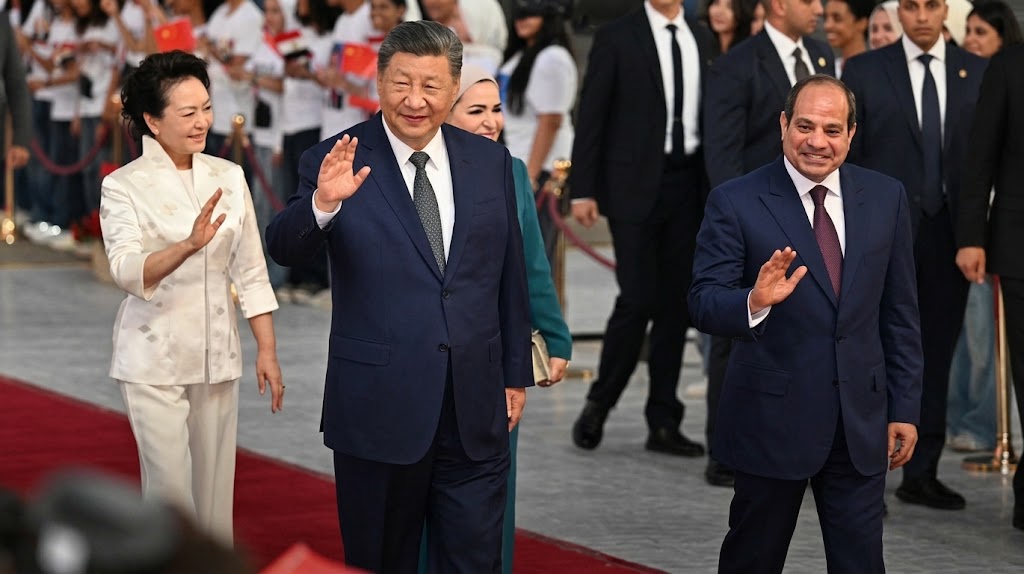
Chinese President Xi Jinping has arrived in Cairo for a high-profile state visit aimed at expanding cooperation with Egypt in artificial intelligence, industrial manufacturing, clean energy and regional security.
The visit is Xi’s first trip to Egypt since 2016 and coincides with the 70th anniversary of diplomatic relations between the two countries. Egyptian President Abdel Fattah al-Sisi welcomed the Chinese leader with military honors before the two presidents began discussions on bilateral and regional issues.
The summit reflects an effort by Beijing and Cairo to move their relationship beyond conventional trade toward joint production, advanced technology, infrastructure development and greater financial cooperation.
It also comes at a volatile moment in the Middle East, where regional conflicts and disruption to major shipping routes have intensified debate about security arrangements and the future roles of China and the United States.
China and Egypt Mark 70 Years of Relations
Egypt established diplomatic relations with the People’s Republic of China in 1956, becoming the first Arab and African country to do so.
Relations were elevated to a comprehensive strategic partnership in 2014. Since then, Chinese companies have become increasingly involved in Egyptian infrastructure, telecommunications, manufacturing and energy projects.
Xi’s visit is intended to review the implementation of that partnership and identify new areas of cooperation. Discussions also cover regional conflicts, Red Sea security, international trade and broader coordination through organizations such as BRICS.
Sisi has visited China several times since becoming president in 2014, while Xi’s previous state visit to Egypt took place a decade ago.
The Egyptian State Information Service said the anniversary provided an opportunity to open a new phase in relations between the two countries.
Huawei’s AI Data Centre Proposal Draws Attention
Artificial intelligence and sovereign computing infrastructure have emerged as important areas of discussion surrounding the visit.
Egypt is considering a proposal from Chinese technology company Huawei to build AI data centers for government and public-sector operations. The offer reportedly includes more than 2,000 Huawei Ascend processors and supporting computing infrastructure.
Under the proposal, Huawei would provide 1,408 Ascend 950-series processors for a cloud platform capable of training artificial intelligence models.
A further 600 processors either Ascend 950-series chips or the earlier Ascend 910B model would be deployed across two inference clusters used to operate trained AI systems.
Huawei has proposed completing the infrastructure within approximately 12 months. Egypt has not announced a final decision or selected a winning bidder.
If approved, the project could become one of Huawei’s earliest major overseas government deployments involving its most advanced AI processors. It would also strengthen Egypt’s ambition to become a regional center for data storage, cloud computing and artificial intelligence services.
Reports on the proposal indicate that the United States is exploring whether American companies could present a competing offer.
Egypt Positioned Between Chinese and American Technology
The Huawei proposal places Cairo in the middle of the wider technology rivalry between China and the United States.
Washington has imposed controls intended to restrict China’s access to advanced semiconductors and manufacturing equipment. Beijing has responded by accelerating the development of domestic processors, including Huawei’s Ascend range.
An Egyptian government deployment would give Huawei an important international customer while providing Cairo with computing capacity that may be difficult or expensive to obtain elsewhere.
However, accepting the proposal could expose Egypt to diplomatic pressure from Washington and raise questions about cybersecurity, data governance and dependence on a single foreign technology provider.
Egypt receives approximately $1.3 billion in annual US foreign military financing and maintains extensive defense and diplomatic ties with Washington. At the same time, Cairo has expanded its cooperation with China and Russia as part of a foreign policy centered on maintaining relationships with competing global powers.
Technology Partnership Extends Beyond Data Centers
The bilateral agenda includes broader cooperation in semiconductors, telecommunications, critical minerals and technical education.
Both governments are seeking to develop training facilities and joint programs that could provide Egyptian engineers and students with experience in artificial intelligence, cloud computing and advanced manufacturing.
Egypt hopes this cooperation will strengthen its position as a technology and data hub serving North Africa and the wider Arab region.
China, meanwhile, views Egypt as an important gateway to African, Middle Eastern and European markets. The country’s large population, industrial base and control of the Suez Canal give it strategic value within Beijing’s Belt and Road Initiative.
Focus Shifts Toward Local Manufacturing
Economic discussions during Xi’s visit are expected to focus heavily on industrial localization.
China is already one of Egypt’s largest trading partners, but the relationship remains weighted toward Chinese exports. Egyptian officials want a greater share of Chinese investment to support domestic factories, create jobs and produce goods for export.
The two countries are seeking to expand annual trade while increasing Egyptian participation in manufacturing supply chains.
Priority sectors include renewable-energy equipment, batteries, electric vehicles, electronics, industrial machinery and construction materials.
For Egypt, the objective is to reduce reliance on imported finished products and use Chinese capital and technology to develop domestic production capacity.
Renewable Energy and Green Manufacturing
Energy cooperation is expected to move beyond electricity-generation projects toward manufacturing the equipment required for the transition to cleaner power.
Proposed areas of cooperation include the domestic production of solar panels, wind-turbine components, battery systems and equipment for green-hydrogen projects.
Egypt has significant solar and wind resources and is attempting to establish itself as a producer and exporter of green hydrogen, ammonia and other low-carbon fuels.
Its proximity to Europe and location along one of the world’s most important shipping routes could allow it to supply energy products to international markets.
Chinese manufacturers, facing intense competition and trade restrictions in some Western economies, may also view Egypt as an attractive base for serving African, Middle Eastern and European customers.
Battery and Electric-Vehicle Projects Under Discussion
China and Egypt are exploring additional investment in battery manufacturing, energy-storage systems and electric-vehicle assembly.
Initial projects valued at about $200 million have been discussed as part of efforts to establish local battery-production lines. Larger investments could follow if manufacturing conditions and export demand prove favorable.
Egyptian industrial zones could provide Chinese companies with access to relatively competitive production costs, regional trade agreements and nearby markets.
Local assembly would also support Egypt’s efforts to develop an electric-vehicle industry rather than depending entirely on imported cars and batteries.
The long-term ambition is to create supply chains capable of producing vehicles and energy-storage equipment for customers across Africa and the Middle East.
Suez Canal Economic Zone Remains Central
The Suez Canal Economic Zone is one of the most important components of China’s investment strategy in Egypt.
More than 200 Chinese companies are involved in projects connected to the zone, covering logistics, construction materials, textiles, chemicals, renewable energy and manufacturing.
The China-Egypt TEDA Suez Economic and Trade Cooperation Zone has attracted billions of dollars in investment since its establishment. A 2025 agreement provided for an additional $100 million investment to expand the zone’s infrastructure by 2.86 square kilometers.
Egypt and China are now discussing further industrial and logistics concessions around the Suez Canal.
For Chinese companies, the zone offers access to a major maritime corridor and an opportunity to locate production closer to European, African and Middle Eastern consumers. For Egypt, the development could generate employment, increase exports and strengthen the country’s position in global supply chains.
Xi Proposes New Regional Security Framework
Regional security featured prominently in talks between Xi and Sisi.
The Chinese leader called on Middle Eastern countries to take greater control of their security and political future, urging them to resist external interference and unilateral sanctions.
Xi also promoted the creation of an updated regional security framework led by countries within the Middle East rather than imposed by outside powers.
He argued that regional states should become “masters of their own destiny,” language consistent with Beijing’s broader support for what it describes as a multipolar international system.
China and Egypt agreed to deepen cooperation in security, counterterrorism, semiconductors, critical minerals and the use of their currencies in bilateral commerce.
Red Sea Shipping and Regional Conflicts Discussed
Talks also addressed the security of international shipping routes and conflicts affecting the Middle East and North Africa.
Egypt has suffered economically from instability around the Red Sea, which has reduced traffic through the Suez Canal and weakened an important source of foreign-currency revenue.
China has a major interest in restoring secure shipping because the canal is a critical route for goods moving between Asia and Europe.
The two leaders also exchanged views on conflicts involving Israel and the Palestinians, Sudan and Libya, as well as broader tensions involving Iran and the United States.
China is seeking to present itself as a diplomatic and economic partner that supports regional sovereignty while opposing foreign military intervention and sanctions.
Currency Cooperation Under BRICS
Financial cooperation is another major part of the expanding partnership.
China and Egypt are considering wider use of the yuan and Egyptian pound in bilateral transactions. Extending currency-swap arrangements could allow businesses to complete some trade without first converting payments into US dollars.
Such arrangements would not eliminate the dollar’s importance, but they could reduce transaction costs and provide Egypt with additional options during periods of foreign-currency shortages.
The discussions are taking place within the broader context of Egypt’s BRICS membership and the group’s efforts to expand trade and financial cooperation among emerging economies.
Egypt Maintains Strategic Balance
Cairo’s closer relationship with Beijing does not signal a complete departure from its Western partnerships.
Egypt continues to receive substantial American military assistance and operates defense equipment supplied by the United States and European countries. It also maintains extensive diplomatic, intelligence and economic cooperation with Washington.
At the same time, Sisi’s government has pursued what officials describe as strategic balance by building stronger ties with China and Russia.
Recent China-Egypt military exercises, known as Eagles of Civilization, demonstrated the expanding security relationship between the two countries. The drills involved Chinese military aircraft operating alongside Egypt’s French-made Rafale fighters.
Egypt’s diversified approach allows it to obtain investment, technology and military cooperation from several international partners while avoiding complete dependence on any single power.
Visit Signals a Broader Economic Shift
Xi’s return to Cairo after a decade highlights the growing strategic importance of Egypt in China’s relationships with Africa and the Middle East.
For Beijing, Egypt offers access to the Suez Canal, a major consumer market and an industrial platform connecting three regions. For Cairo, China represents a potential source of investment, manufacturing technology, infrastructure financing and advanced computing systems.
The success of the partnership will depend on whether the agreements produce lasting industrial capacity and employment in Egypt rather than reinforcing an uneven trade relationship dominated by imports.
As discussions move from diplomacy to implementation, the Huawei data-centre proposal, renewable-energy factories, battery projects and expansion of the Suez Canal Economic Zone will provide key tests of whether the 70-year relationship is entering a genuinely new economic phase.
Source: Omanghana