Omanghana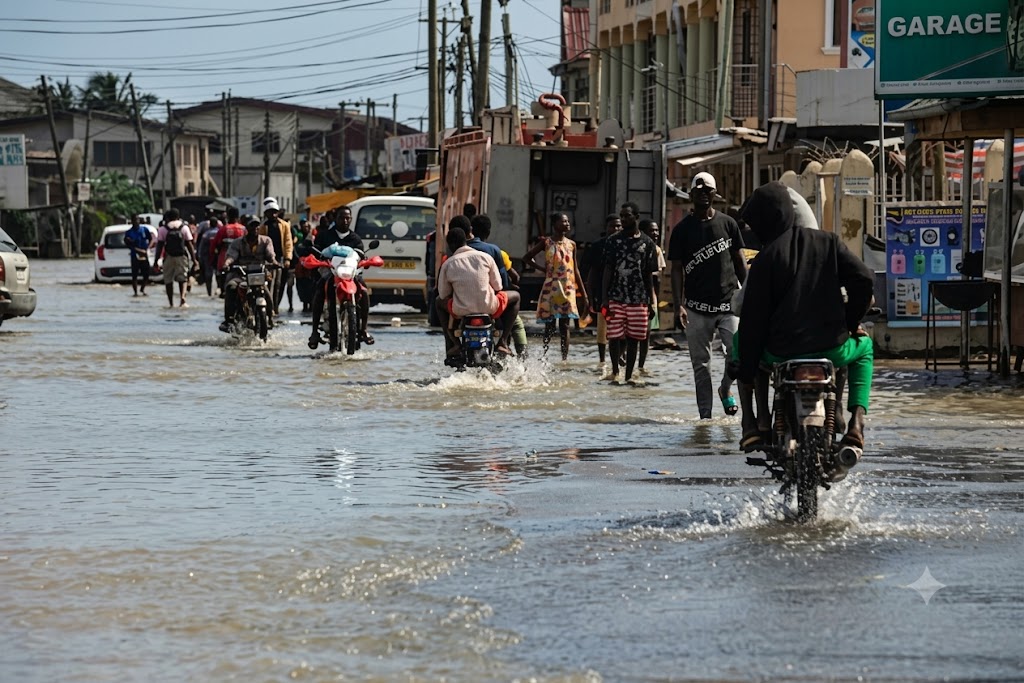
A young migrant woman has died after being electrocuted in Accra’s Alajo district during catastrophic flooding that has paralyzed large parts of Ghana’s capital and claimed multiple lives.
The incident occurred amid one of the most severe flash flood events in recent years, triggered by more than 140 millimetres of rainfall within 24 hours, which overwhelmed drainage systems and submerged several low-lying communities.
Emergency officials confirmed that rising floodwaters came into contact with exposed live electrical wiring inside a residential compound, resulting in the fatal electrocution.
Floodwaters Turn Residential Areas Into Danger Zones
According to emergency response teams, the victim was attempting to move through a heavily flooded section of Alajo when waist-high water breached a compound and made contact with an active power conduit.
Authorities say the combination of submerged infrastructure and unstable electricity supply created extremely hazardous conditions across multiple neighborhoods.
The tragedy is one of several electrocution-related deaths recorded during the flooding crisis, prompting immediate safety interventions from power authorities.
Grid Shutdowns to Prevent Further Deaths
Following the fatal incident, as well as two other electrocution deaths linked to the floods, the Electricity Company of Ghana (ECG) and GRIDCo temporarily shut down several key substations across Accra.
Officials said the precautionary measure was necessary to reduce the risk of additional deaths as floodwaters continued to spread through densely populated areas.
However, emergency response efforts were significantly hindered by submerged roads, debris, and impassable routes, forcing some residents and volunteers to assist in rescue and recovery operations.
Migration Background Under Investigation
Local authorities have confirmed that the victim had recently arrived in Ghana after traveling from Latin America via Spain.
Her journey is believed to be connected to broader migration flows linked to Spain’s large-scale regularization program, which has seen more than 1.3 million undocumented migrants apply for legal status ahead of its closure on June 30, 2026.
Officials noted that some migrants unable to complete documentation processes or facing administrative delays in Europe have recently moved through international transit routes, including West Africa.
However, authorities have not confirmed how the victim entered Ghana or her legal status in the country at the time of the incident.
Infrastructure Strain and Urban Planning Concerns
Former President John Mahama, who visited affected communities, described the flooding as evidence of long-standing urban planning challenges in Accra.
He said the disaster highlights the consequences of building on flood-prone areas and natural waterways, which has significantly reduced the city’s drainage capacity.
Experts have similarly pointed to rapid urban expansion, blocked drainage channels, and poor waste management as key factors that intensified the severity of the floods.
A City Under Pressure
Accra remains in a state of emergency response as authorities continue rescue operations, restore disrupted services, and assess the full scale of damage.
With multiple fatalities recorded and large parts of the city still submerged, officials have urged residents to avoid flooded areas, stay away from exposed electrical installations, and comply with safety advisories as recovery efforts continue.
Source: Omanghana